
Article
Upgrading Your Alexandria Apartment: Safe Borrowing Limits That Hold
Thinking of upgrading from an Alexandria apartment to a family home? This guide shows how to set a safe borrowing limit, check your risks and decide what you can genuinely afford to do this week.
Key Takeaway
Upgrading from an Alexandria apartment to a family home safely means borrowing below the bank maximum by stress-testing repayments at current rates plus 3% and keeping total home and investment loan repayments under about 30–35% of after‑tax income. For a $1.6m house and $400k equity, that often caps safe borrowing near $1.1m–$1.2m with a 20% deposit. Buyers should model cashflow, LVR, and buffers before committing, and act this week by checking current loan terms and obtaining a robust pre-approval.
This topic is covered in full on Tailored Loans Sydney
Thinking of upgrading from an Alexandria apartment to a family home? This guide shows how to set a safe borrowing limit, check your risks and decide what you can genuinely afford to do this week.
Read the full guide on tailoredloans.sydneyUpgrading from an Alexandria apartment to a family home is safe when you borrow less than the bank will lend, stress‑test repayments at current rates +3%, and keep total home/investment repayments under about 30–35% of your after‑tax income.
That’s the decision line that matters more than the property photos.
1. What’s a safe borrowing limit for an Alexandria upgrade?
For inner‑Sydney borrowers, a practical rule is:
- Model repayments at current interest rates +3%.
- Keep total home and investment repayments ≤30–35% of after‑tax income.
- Keep your new home loan ≤80% LVR if possible to avoid LMI and give yourself flexibility.
This aligns with how APRA expects banks to assess loans (3% buffer) and with stress benchmarks we use across Alexandria and the Eastern Suburbs.
Quick example (illustrative, not advice):
- Combined after‑tax income: $230k (around $320k gross).
- Safe repayment band (30–35%): $5,750–$6,700/month.
- At a stressed rate of 8% P&I over 30 years, that supports roughly $900k–$1.05m of total home debt.
If the bank offers you $1.3m, the safe move is to ignore that number and work off the lower figure.
For more on using this framework across different suburbs, see /insights/rose-bay-apartment-to-house-borrowing-limits-risks.
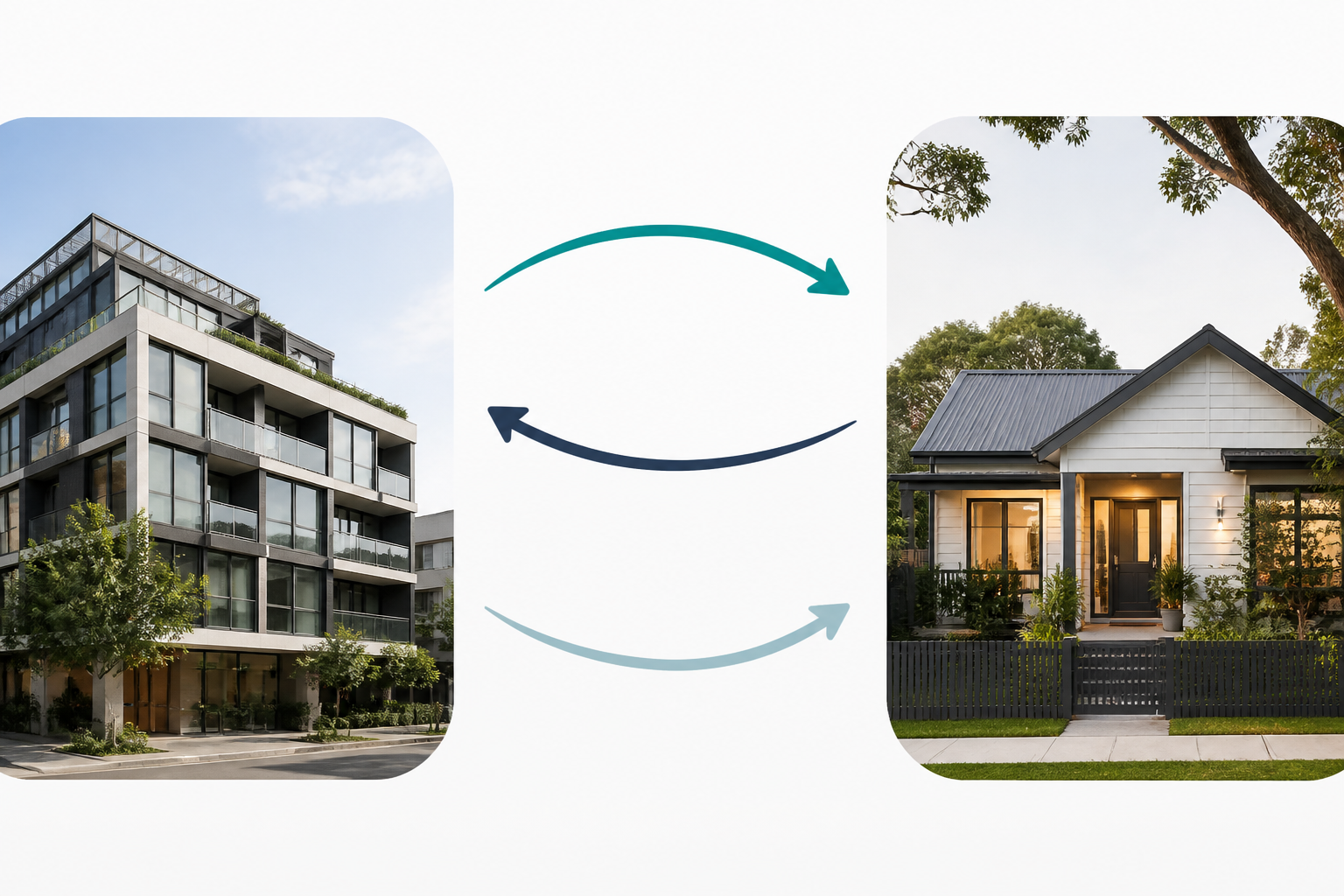
2. From Alexandria apartment to house: working the equity and LVR
Most Alexandria upgraders start with an apartment worth $800k–$1.2m and a partial mortgage left.
Step 1: Estimate your usable equity
Usable equity is usually capped at 80% of value minus your current loan.
Say your apartment is worth $950k and you owe $520k:
- 80% of value: $760k
- Usable equity: $760k − $520k = $240k
If you sell, that $240k (before selling costs) can form most of your house deposit.
Step 2: Price band for a family home
Suppose you’re eyeing a $1.6m inner south house:
- 20% deposit target (to avoid LMI): $320k
- Purchase costs (stamp duty, legals, inspections): say $80k–$90k
You’d ideally want $400k+ available, or you accept either:
- Higher LVR (85–90%) + LMI, or
- A cheaper house now and upgrade again later.
Step 3: Check the new loan against your safe limit
If you had $400k cash/equity on a $1.6m house:
- New loan: $1.2m (75% LVR)
- At 6% over 30 years: ~$7,200/month
- At stressed 9%: ~$9,650/month
On $230k after‑tax income, that stressed repayment is ~50% of income – well above a safe 30–35% band.
That’s the key risk: the inner south upgrade often breaks the 35% rule unless income is strong or you keep the purchase price down.
The strategy continues below
You've seen the problem and the groundwork — now unlock the exact steps our CPA-certified brokers use, including 3 more sections. Enter your email for instant, free full access.
Free access. No spam — unsubscribe anytime. Your details stay confidential.
Frequently asked questions
Talk to a CPA-certified broker
Free consultation, plain-English advice tailored to your situation.