
Article
How Rose Bay Retirees Should Compare Reverse Mortgages, LOCs and Downsizing
A clear, decision-grade guide for Rose Bay retirees comparing reverse mortgages, lines of credit and downsizing, with worked numbers and next steps for this week.
Key Takeaway
This article explains how Rose Bay retirees can choose between a reverse mortgage, a home‑equity line of credit, and downsizing to unlock housing wealth, using worked examples on a $4m home and typical LVR and serviceability settings. It outlines cashflow, risk, and Centrelink impacts of each option, noting that keeping total housing costs below roughly 30–35% of net income is a practical ceiling. It concludes with clear decision rules and a one‑week action checklist.

This topic is covered in full on Tailored Loans Sydney
A clear, decision-grade guide for Rose Bay retirees comparing reverse mortgages, lines of credit and downsizing, with worked numbers and next steps for this week.
Read the full guide on tailoredloans.sydneyMost Rose Bay retirees who come to us have the same basic problem: a multimillion‑dollar home and relatively modest cashflow. The three main ways to unlock that value are a reverse mortgage, a home‑equity line of credit, or downsizing. This guide walks through how each actually works, what it costs, and how to pick the least‑regret option for the next 10–20 years.
If you want the short version: 1) use a reverse mortgage when income is tight and staying put long‑term is critical, 2) use a line of credit if you have reliable income to cover interest, and 3) downsize when you’re ready to trade some space for more cash, less maintenance and lower risk. The right choice depends on your health, family plans and how important it is to remain in Rose Bay.

1. Start with your Rose Bay retirement balance sheet
Before comparing products, you need a clear picture of what you’re solving for.
1.1 Your likely starting point in Rose Bay
From Woollahra Council’s 2021 data, we know:
- Local incomes and housing costs are far higher than the Sydney average.
- Many older residents own high‑value homes outright or with small loans.
- The median mortgage repayment is about $900 a week, well above Greater Sydney.
For many Rose Bay retirees, that means:
- Home value: often $3m–$6m+.
- Super/investments: solid but not always enough to fund 25–30 years of retirement.
- Cashflow: age pension (if eligible), some investment income, maybe part‑time work.
If most of your wealth is tied up in the home, you’re facing the same core question explored in Using Your Rose Bay Home Equity Safely to Fund Retirement: how do I turn bricks and mortar into income without risking my security?
1.2 Define your non‑negotiables first
Before looking at numbers, be crystal clear on:
- How long do you want to stay in this home?
- How important is leaving an inheritance versus enjoying more now?
- How much risk and paperwork can you tolerate?
- Are you willing to move within Rose Bay (or nearby) if the trade‑off is more cash and less worry?
Answering these honestly will often rule out at least one option quickly.
2. Reverse mortgage vs line of credit vs downsizing – how they really differ
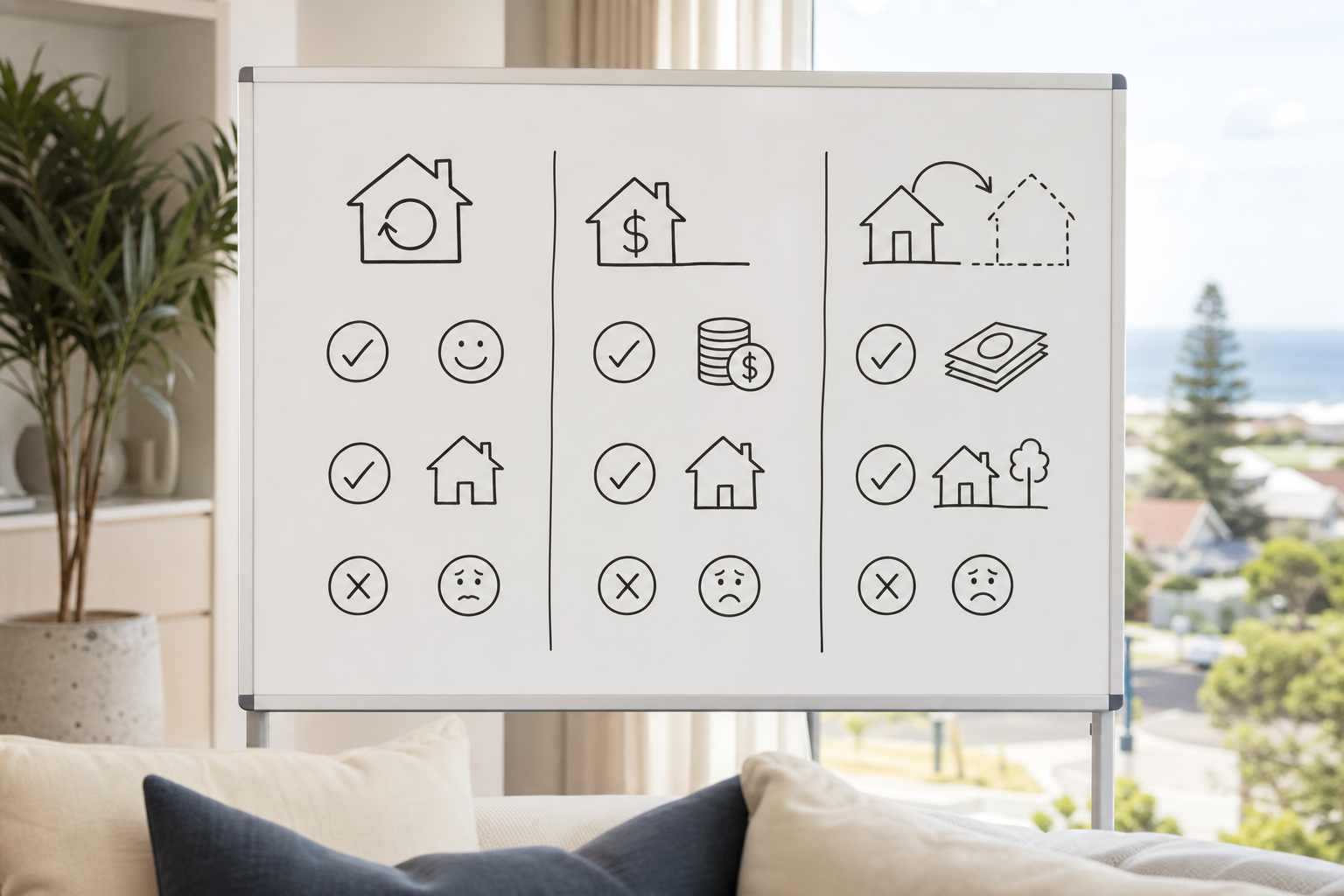
2.1 Quick comparison table
| Option | Cashflow impact now | Key risks | Centrelink impact (broadly) | Works best for… |
|---|---|---|---|---|
| Reverse mortgage | No required repayments; interest compounds | Debt grows over time; reduces estate; rate usually higher | Loan itself ignored; unspent cash counts as asset | Staying in home long‑term with limited income |
| Line of credit (LOC) | Flexible drawdown; interest only on what you use; repayments required | Need to meet serviceability; rate risk; can creep up | Similar to regular mortgage; unused limit ignored | Those with reliable income wanting flexibility |
| Downsizing | No loan if you buy cheaper; cash lump sum | Emotional cost of moving; market timing | Sale proceeds (after exemptions) count as assets | Those happy to move for more cash and lower costs |
Each of these can be the “right” answer for the same $4m Rose Bay house in different situations.
3. Reverse mortgages: structure, costs and traps
3.1 How a reverse mortgage actually works
A reverse mortgage lets you draw against your home with no required repayments while you live there. The interest is added to the loan, so your balance grows over time.
Common features (illustrative only – not live offers):
- Maximum loan‑to‑value ratio (LVR) often starts around 15–20% at age 60, rising with age.
- Interest rate typically higher than a standard home loan.
- You can take money as a lump sum, regular income, a cash reserve, or a combination.
- You usually must keep the property insured and in good repair, and pay rates.
3.2 Worked example – $4m Rose Bay home
Assume:
- Home value: $4,000,000.
- Age: 72.
- Safe illustrative maximum reverse mortgage LVR: say 25%.
Potential maximum loan: 25% × $4,000,000 = $1,000,000.
You might decide to start with:
- Lump sum for renovations and debt clearance: $200,000.
- Regular income top‑up: $2,000 per month for 10 years.
That’s $240,000 over 10 years, plus the $200,000 lump sum, so $440,000 of drawn funds (before interest). Interest accrues on what you’ve used, not the full maximum.
3.3 Pros for Rose Bay retirees
- Stay put in a community you know.
- No mandatory repayments – helpful if income is tight.
- If you choose a loan with a no negative equity guarantee, you or your estate should never owe more than the home’s sale value (subject to the provider’s rules).
- Can be structured as an income stream for predictable cashflow.
3.4 Key risks and things to stress‑test
- Compounding interest: the loan can grow quickly, especially over 10–20 years.
- Estate impact: your children may inherit significantly less.
- Interest rate risk: reverse mortgage rates may rise like other variable rates.
- Centrelink: the loan amount doesn’t count as an asset, but any unspent cash or investments financed by the loan do (check with Services Australia or a financial planner).
For Eastern Suburbs retirees, one core principle from our Dover Heights guide holds here too: aim to keep total housing‑related costs under 30–35% of net income at stressed rates to avoid later‑life mortgage stress.
3.5 When a reverse mortgage makes sense
Consider prioritising a reverse mortgage when:
- You are strongly attached to your Rose Bay home and likely to stay 10+ years.
- Your income is modest and servicing a standard loan or LOC comfortably is unrealistic.
- You are comfortable with a smaller estate in exchange for living better now.
If you’re still deciding whether to move, read the real‑world case study in How Rose Bay Downsizers Unlocked Equity And Reduced Risk Nearby to see what a near‑by move can look like in practice.
The strategy continues below
You've seen the problem and the groundwork — now unlock the exact steps our CPA-certified brokers use, including 7 more sections. Enter your email for instant, free full access.
Free access. No spam — unsubscribe anytime. Your details stay confidential.
Frequently asked questions
Talk to a CPA-certified broker
Free consultation, plain-English advice tailored to your situation.