
Article
How to Juggle Multiple Property Moves Around an Off‑the‑Plan Settlement
A practical, decision-grade guide to lining up sales, leases and new finance around an off‑the‑plan apartment settlement, without blowing up your cashflow or timelines.
Key Takeaway
Coordinating multiple property moves around an off-the-plan settlement means sequencing finance, sales, and leases so you can settle even if one piece slips. Buyers should first map a conservative settlement window, build cash and time buffers, and avoid cross-collateralised loan structures where possible. A worked example shows how a 3–6 month buffer can prevent distress sales. The key actionable step is to build a written, date-based move plan with clear “Plan B” options for each property.

Coordinating multiple property moves around an off‑the‑plan settlement means building a written sequence for your sale, purchase, leases and loans so you can still settle if one piece slips. You lock in the finance structure and buffers first, then line up your selling, renting and moving dates to fit inside that safety zone.
In practice, that means three things: (1) know your realistic settlement window, not just the date on the contract, (2) decide which properties you’ll hold, sell or rent before you apply for finance, and (3) have a documented Plan B for each step.
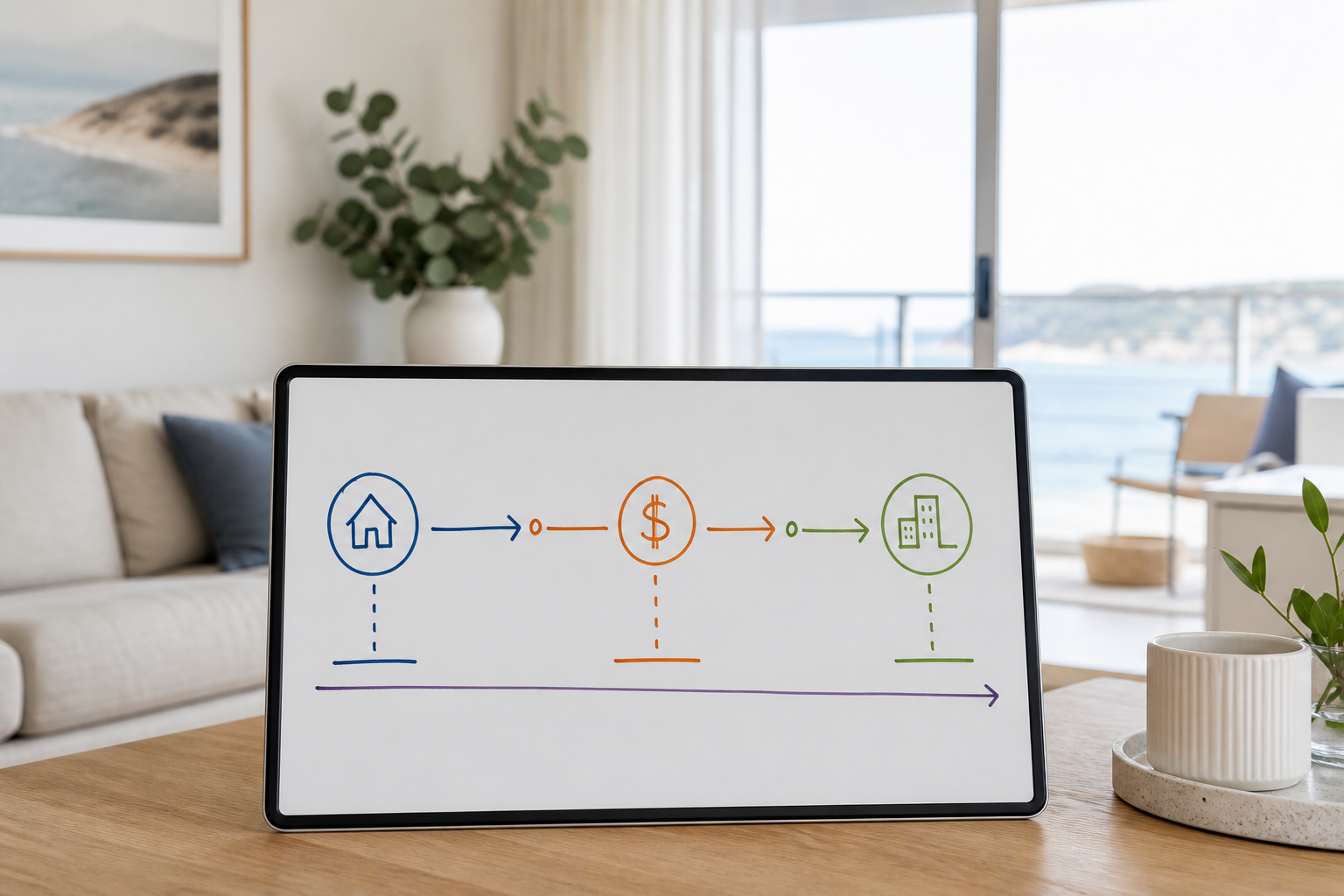
Step 1: Map your off‑the‑plan settlement window and risk
Understand “practical completion”, not just the glossy date
Most off‑the‑plan contracts give the developer a range, not a fixed day. Weather, approvals and materials can push settlement out by months.
Ask your solicitor to confirm:
- The sunset date and any rights the developer has to extend.
- How much notice you’ll get before settlement (often 14 days).
- Whether you can request a short extension in hardship.
Mentally plan around a worst‑case window (e.g. “anytime between February and July 2027”), not the sales agent’s best‑case.
Align this with lending rules and buffers
Your lender will reassess you close to settlement, using current income, debts and rates. APRA expects banks to apply around a 3% serviceability buffer, so a loan that looked fine at contract may no longer fit.
If you’re self‑employed or on variable income, build your plan off the more detailed guidance in /insights/self-employed-variable-income-off-the-plan-finance-guide and assume more scrutiny at settlement.
Step 2: Decide your sell‑rent‑hold strategy up front
Common juggling patterns
Most clients fall into one of four patterns:
- Sell existing home, move to rental, then into new OTP.
- Sell existing home and settle OTP on the same week (high risk).
- Keep existing as an investment, rent it out, move to OTP.
- Own multiple properties (home + investment/SMSF) and reshuffle.
Your finance options, tax position and stress levels change depending on which you pick.
Timing trade‑offs: early sale vs just‑in‑time
| Strategy | Pros | Cons | Best for |
|---|---|---|---|
| Sell 3–6 months before OTP | Cash certainty, easier loan approval, buffer | Temporary rent, double moves, storage hassle | Risk‑averse upsizers/downsizers |
| Sell right on settlement | One move, minimal rent overlap | If sale falls over, you may not settle OTP | People with big buffers + Plan B |
| Keep and rent existing | Build portfolio, rental income | Need higher borrowing capacity, more rate risk | Strong incomes, investors, SMSF |
For many busy professionals, the low‑drama option is sell early, rent for a short period, then move once.
Step 3: Design the finance structure before you move a box
Get the loan scaffolding right
Your goal is to be able to sell or keep each property without having to refinance the entire portfolio. That usually means one primary loan per property with minimal cross‑collateralisation (see knowledge facts 4 and 5).
For example:
- Existing home: one main home loan, plus a separate split if you’ve already released equity.
- New OTP: its own loan, secured only to the new apartment where possible.
This gives you the flexibility to sell or hold the current place independent of the new purchase, echoing the portfolio rules in /insights/designing-first-second-investment-loans-starting-mascot.
Worked example: upsizer juggling two properties
Assume:
- Current home loan: $650,000, repayments ~$3,900/month at 6.5% P&I.
- Expected sale price: $1,100,000.
- New OTP purchase price: $1,300,000.
- Target LVR on new loan: 80% (to avoid LMI).
New loan needed: 80% × $1,300,000 = $1,040,000.
If sale achieves $1.1m and costs are ~3% ($33,000):
- Net sale proceeds: $1,100,000 − $33,000 − $650,000 = $417,000.
- You can tip $260,000 into the new purchase as deposit/balance and keep ~$150,000 as buffer.
Your broker’s job is to model this under lower sale prices (say $1.0m) and higher rates (say 9.5% test rate with buffer) so you know the minimum viable outcome before you list.
The strategy continues below
You've seen the problem and the groundwork — now unlock the exact steps our CPA-certified brokers use, including 3 more sections. Enter your email for instant, free full access.
Free access. No spam — unsubscribe anytime. Your details stay confidential.
Frequently asked questions
Talk to a CPA-certified broker
Free consultation, plain-English advice tailored to your situation.