
Article
Using Dover Heights Home Equity to Buy a Weekender Safely
How Dover Heights owners can safely use home equity to buy a weekender or investment property, without over‑gearing or risking the family home.
Key Takeaway
Dover Heights owners can unlock home equity to buy a weekender or investment property by drawing a separate split on their home for deposit and costs and using a standalone loan on the new property for the balance, while keeping total LVR within safe bands. With Sydney’s Eastern Suburbs prices, most aim to stay at or below 80% LVR and hold 3–6 months of buffers in offset. A clear structure, cashflow stress test, and exit plan turn idle equity into a controlled strategy.

This topic is covered in full on Tailored Loans Sydney
How Dover Heights owners can safely use home equity to buy a weekender or investment property, without over‑gearing or risking the family home.
Read the full guide on tailoredloans.sydneyYou can usually unlock equity in a Dover Heights home to fund the deposit and costs on a weekender or investment property, then take a separate loan secured against the new place for the balance. The key is keeping your overall loan‑to‑value ratio (LVR) in safe bands, avoiding messy cross‑collateralisation, and stress‑testing cashflow at higher interest rates before you commit.
Step 1: How much Dover Heights equity can you actually use?
Start with conservative numbers.
- Estimate current value of your Dover Heights home (recent comparable sales, not dinner‑party guesses).
- Multiply by a safe LVR (usually 70–80%, not 90%).
- Subtract your existing home loan.
Worked example
Home value: $4.0m
Safe target LVR: 75% → $3.0m
Current loan: $1.8m
Indicative usable equity: $1.2m
That doesn’t mean you should use $1.2m.
For a weekender or investment, many Eastern Suburbs clients cap total gearing at 70–80% on the home and keep at least 3–6 months of all property costs in offset.
If you want a deeper numbers walk‑through of what “affording Dover Heights” looks like, see /insights/can-you-afford-dover-heights-home-numbers-walkthrough.
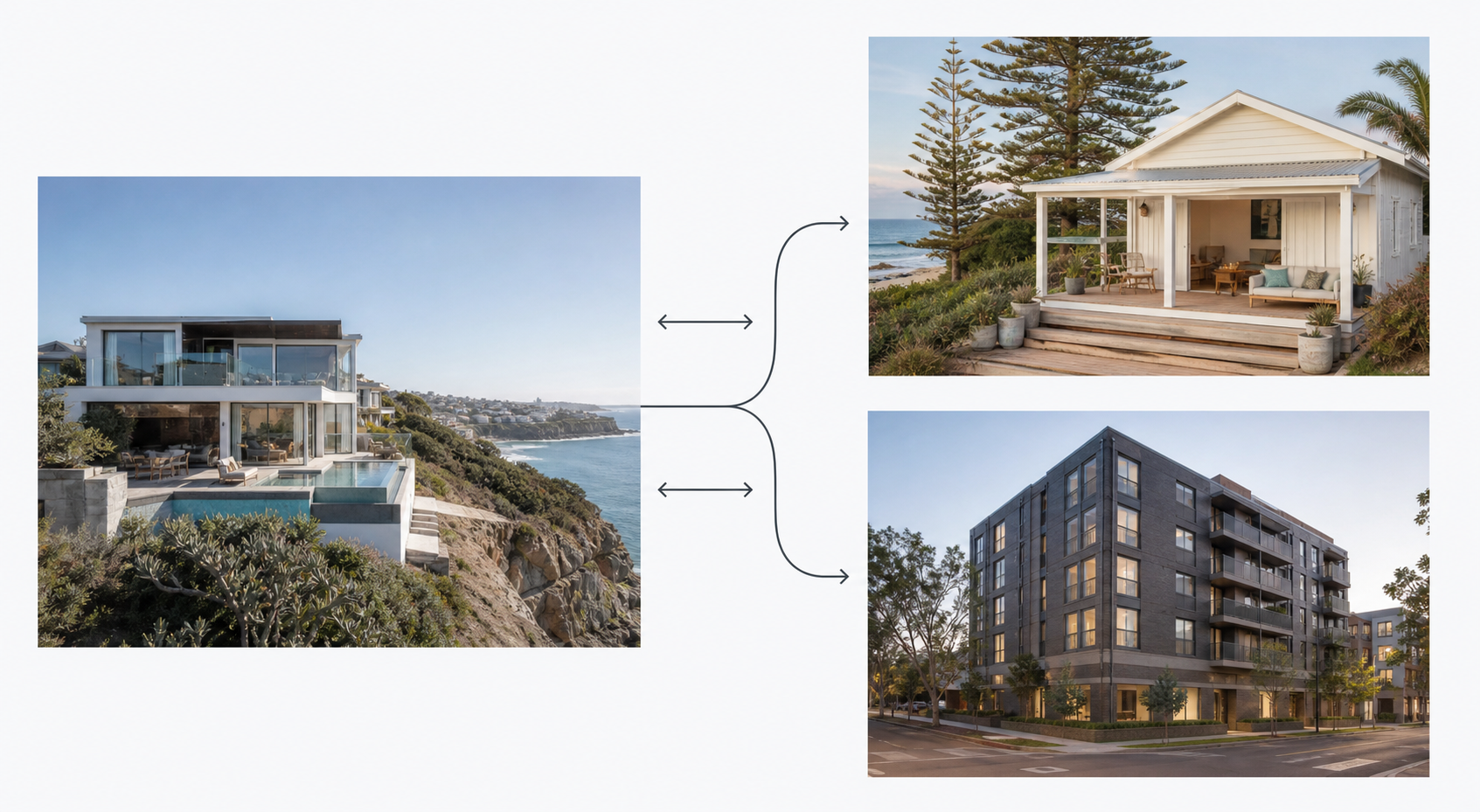
Step 2: Weekender vs investment – structure them differently
A weekender and a pure investment behave very differently in your cashflow and tax.
Weekender (holiday house you mostly use yourself)
- Rent: minimal or seasonal.
- Interest: generally not tax‑deductible for private use.
- Strategy: treat like an expensive lifestyle decision.
You’ll want:
- A separate equity split on your Dover Heights home for deposit and costs.
- A stand‑alone loan on the weekender property for the balance.
Even though the interest likely isn’t deductible, clean splits make refinancing or selling one property far easier later.
Investment property
- Rent: ongoing income, but stress‑test with zero negative gearing benefit under the 2026–27 reforms.
- Interest: usually deductible to the extent the borrowing is for producing rental income (ATO).
A practical structure, consistent with our broader equity guides, is:
- New interest‑only split on the Dover Heights home for deposit and purchase costs.
- Stand‑alone investment loan secured only by the new property for the remaining 80% (or lower) of its value.
This mirrors the approach in /insights/step-by-step-using-home-equity-first-investment-property and keeps tax tracing clean.
The strategy continues below
You've seen the problem and the groundwork — now unlock the exact steps our CPA-certified brokers use, including 4 more sections. Enter your email for instant, free full access.
Free access. No spam — unsubscribe anytime. Your details stay confidential.
Frequently asked questions
Talk to a CPA-certified broker
Free consultation, plain-English advice tailored to your situation.