
Article
Downsizing Your Rose Bay Family Home into a Luxury Apartment Safely
Thinking about selling the Rose Bay family home and moving into a luxury apartment? This guide walks you through finance, tax, timing and superannuation basics so you can make a clear decision and put a practical action plan in place this week.
Key Takeaway
This article explains how to downsize from a Rose Bay family home into a luxury apartment while managing finance, tax and superannuation safely. It covers estimating sale proceeds, structuring purchase funding, and using the ATO downsizer contribution of up to $300,000 per person to boost super. It also outlines main residence CGT rules, sequencing of sale and purchase, and cash buffer targets so readers can build a concrete, low‑risk action plan this week.
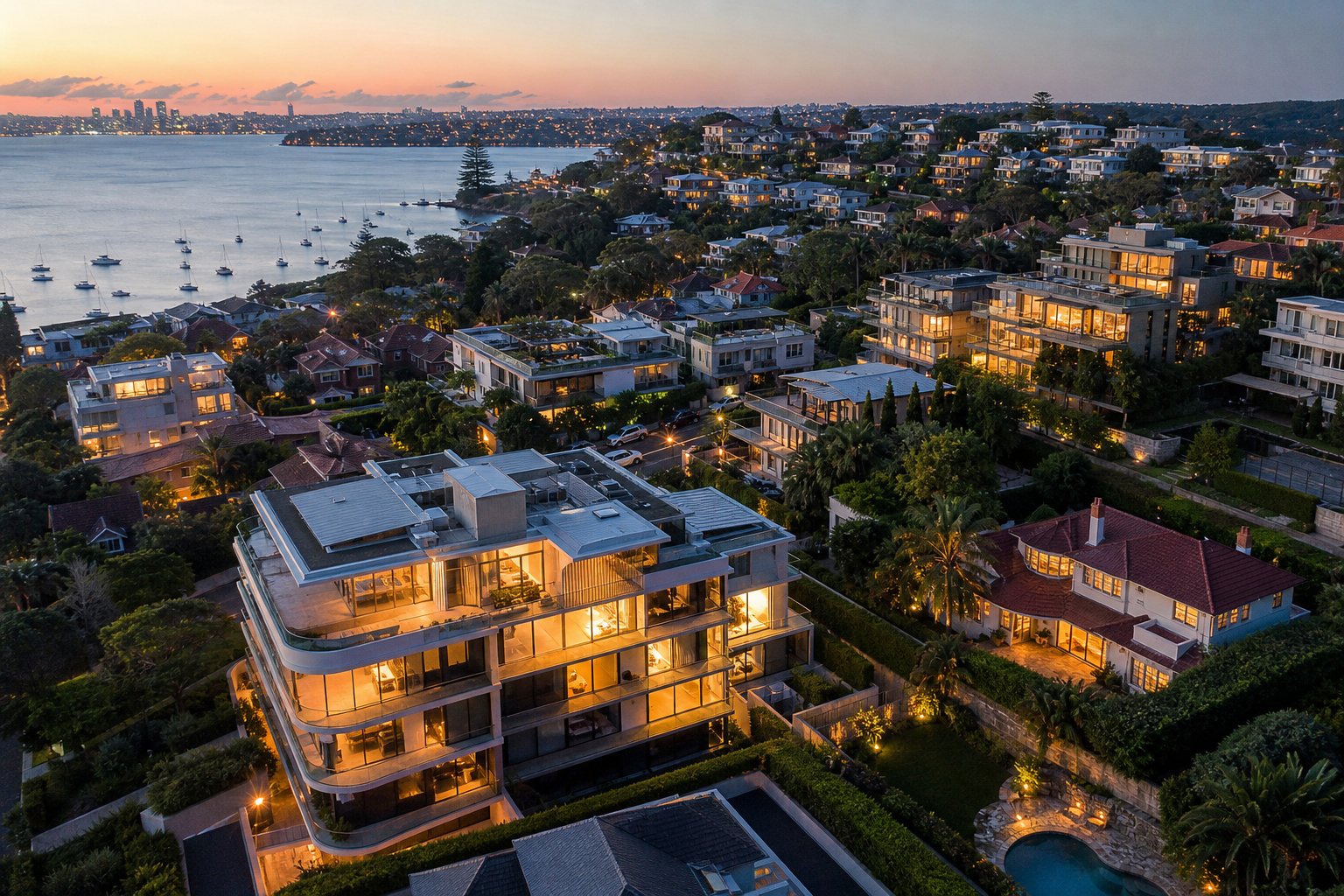
This topic is covered in full on Tailored Loans Sydney
Thinking about selling the Rose Bay family home and moving into a luxury apartment? This guide walks you through finance, tax, timing and superannuation basics so you can make a clear decision and put a practical action plan in place this week.
Read the full guide on tailoredloans.sydneyDownsizing from a Rose Bay family home into a luxury apartment is first and foremost a finance and tax project. You’re converting a very large, often debt‑free asset into a mix of new home, investments, super and cash buffer — and you only get to sell once. This guide sets out the key numbers, tax rules and sequencing steps so you can decide, this week, whether to move, when to move, and how to fund it safely.
In plain terms:
- Your Rose Bay family home is usually CGT‑free when sold as your main residence.
- The freed‑up equity can fund a luxury apartment, top up super via downsizer contributions, and build an income‑producing portfolio.
- The risk is tying up too much of that equity in the new apartment and leaving yourself short of income and buffers.
Use this article as a decision‑grade playbook — whether you’re 2 months or 5 years away from moving.

1. The real decision: lifestyle upgrade or balance‑sheet restructure?
Most Rose Bay downsizers start with the lifestyle picture: less maintenance, level access, a view, walk to Plumer Road or the ferry. But the real decision is about how you want your balance sheet to look for the next 20–30 years.
1.1 What you’re really doing when you downsize
When you sell a family home and buy a luxury apartment, you’re:
- Swapping land‑heavy value (house on a larger block) for building‑heavy value (apartment in a strata complex).
- Re‑allocating equity between:
- the new home,
- superannuation,
- investment assets (shares, managed funds, possibly an investment property), and
- cash buffers.
- Shifting from illiquid, non‑income producing equity to a mix that should ideally:
- fund your lifestyle, and
- still give you options to help children or manage aged care later.
A good downsizing plan makes those trade‑offs explicit. A poor one simply replaces one expensive home with another and leaves you “asset‑rich, cash‑flow thin”.
1.2 Why Rose Bay downsizing decisions feel so high‑stakes
Rose Bay and nearby Eastern Suburbs values mean you’re often dealing with $4m–$8m of home equity. A handful of choices — settlement timing, how much you borrow, what you do with surplus cash — can shift your retirement outcome by six figures.
Related reading for the broader strategy around downsizing into prestige apartments: Smart money moves when downsizing into a luxury apartment.
2. First pass: map your numbers in under an hour
Before you talk to agents, sketch three numbers:
- Likely sale price of your family home.
- Target purchase budget for the new apartment.
- Your lifetime cashflow need: what you actually need per year.
2.1 Estimating sale proceeds (after costs)
Work with a local agent you trust for a realistic price range. Then build a conservative estimate.
Example:
- Expected sale price: $6.0m
- Agent commission @ 1.8% incl. GST: $108,000
- Marketing, styling, legals: $35,000
- Existing mortgage: $400,000
Indicative net proceeds:
$6,000,000 − 108,000 − 35,000 − 400,000 = $5,457,000
Include any break costs if your current loan is fixed, and allow a contingency of $25k–$50k for odds and ends.
2.2 Defining a sensible apartment budget
Most Rose Bay downsizers find a sweet spot buying 20–40% below what they sell for. That usually frees enough equity to improve lifestyle and flexibility.
Rough guide if you sell at $6m:
| Strategy | Target apartment budget | Likely surplus equity (before super/investments) |
|---|---|---|
| Horizontal move (lifestyle only) | $5.5m | ~$0.0–0.2m after costs — little extra flexibility |
| Moderate release | $4.5–5.0m | ~$0.5–1.0m to deploy elsewhere |
| Strong release | $3.5–4.0m | ~$1.5–2.0m to super/investments/cash |
The right choice depends on your income, super balance, health and how much you want to help children. We’ll come back to this in the readiness check.
2.3 Clarity on “what you need to live on”
List annual after‑tax spending for the lifestyle you’re planning:
- Baseline essentials: food, utilities, insurances, medical, car, modest holidays.
- Discretionary: dining out, bigger trips, gifts, hobbies, support for children/grandchildren.
Many Rose Bay households land between $120k and $220k per year after tax, but your number is personal.
From there, work backwards:
- How much income can you draw from super and investments sustainably?
- How much must stay in growth assets vs being spent over the next 10–20 years?
For complex, high‑value moves in the Eastern Suburbs, it’s worth reading: Using Eastern Suburbs home equity safely when income looks low.
3. Finance structures: borrow, or stay debt‑free?
The next question is how much, if anything, you should borrow for the new apartment. That decision influences your bank options, tax flexibility and stress levels.
3.1 Common finance patterns for Rose Bay downsizers
-
Debt‑free downsizer
- Sell the house, buy the apartment entirely in cash.
- Pros: simplicity, no bank approvals, lower stress.
- Cons: may over‑concentrate wealth in the new home, less invested for income.
-
Small, strategic loan (e.g. 20–40% LVR)
- Retain a modest mortgage on the new apartment.
- Pros: keeps more capital in super/investments; flexible if structured well.
- Cons: must be confident about long‑term repayments and buffers.
-
Bridging or overlap finance
- Buy first, then sell.
- Pros: you can shop for the “right” apartment without pressure.
- Cons: higher risk if your home takes longer to sell or sells for less than expected.
The detailed bridging and timing trade‑offs are covered in: Smart money moves when downsizing into a luxury apartment.
3.2 How banks assess you as a later‑life borrower
Major lenders will look at:
- Age and term: they may prefer terms that do not run far past typical retirement ages, unless income streams are clear.
- Income: salary, business income, superannuation pensions, rental income and investment income.
- Expenses: benchmarked against HEM plus any known health or education costs.
- Existing debts: investment loans, car finance, credit cards.
APRA guidelines require banks to apply a 3% serviceability buffer over actual interest rates. So if your actual rate is 6%, the bank must test your ability to repay at 9%.
For self‑employed or complex borrowers, a practical internal limit (rather than the bank maximum) is to keep total home and investment repayments below roughly 35% of net income when stress‑tested at least 3% above current rates (see the Dover Heights case study in /insights/self-employed-professional-buys-dover-heights-complex-income).
3.3 Worked example: modest loan, strong buffer
Assume:
- New luxury apartment: $4.5m
- You contribute: $3.5m from sale proceeds
- New loan: $1.0m (LVR ~22%)
- Indicative rate (P&I): 6.0% p.a.
- Term: 20 years
Approximate monthly repayment at 6.0%: $7,160.
Stress‑tested at 9.0% (APRA buffer): $9,000+ per month.
That is manageable only if:
- Your combined pension/investment income clearly covers this plus living costs, and
- You retain a cash/offset buffer of 6–12 months of living costs plus all loan repayments (consistent with our broader Eastern Suburbs buffer guidance in /insights/build-cash-buffer-bronte-home).
If this feels tight, either shrink the loan, lengthen the term within reason, or downshift the purchase budget.
3.4 Debt‑free vs small‑loan: comparison table
| Aspect | Debt‑free apartment | Small strategic loan (20–40% LVR) |
|---|---|---|
| Simplicity | Very high | Moderate |
| Monthly stress | Lower (no repayments) | Higher (repayments + rate risk) |
| Investable surplus | Smaller | Larger (more in super/investments) |
| Flexibility to help kids | Depends on surplus | Often higher (more liquid assets) |
| Bank options | May need less credit, easier overall | Need to pass serviceability with 3% buffer |
| Psychological comfort | Suits very risk‑averse | Suits those comfortable with measured risk |
There is no universal right answer; it’s about matching structure to temperament and income certainty.
The strategy continues below
You've seen the problem and the groundwork — now unlock the exact steps our CPA-certified brokers use, including 10 more sections. Enter your email for instant, free full access.
Free access. No spam — unsubscribe anytime. Your details stay confidential.
Frequently asked questions
Talk to a CPA-certified broker
Free consultation, plain-English advice tailored to your situation.