
Article
How Property Leverage Really Works: The Upside, Downside And Safe Limits
Leverage lets Australians control big property assets with small deposits, but it amplifies both gains and losses. Here’s how it really works, when it helps, and when it quietly puts your family at risk.
Key Takeaway
Leverage in property means using borrowed funds so a small deposit controls a much larger asset, which magnifies both gains and losses on your equity. For example, a 10% price fall on a 90% LVR property can wipe out almost all your cash contribution. This article explains Australian-specific leverage mechanics, compares 80% vs 90–95% borrowing, and sets out practical stress tests and buffer rules so investors can decide a safe gearing level this week.

This topic is covered in full on Tailored Loans Sydney
Leverage lets Australians control big property assets with small deposits, but it amplifies both gains and losses. Here’s how it really works, when it helps, and when it quietly puts your family at risk.
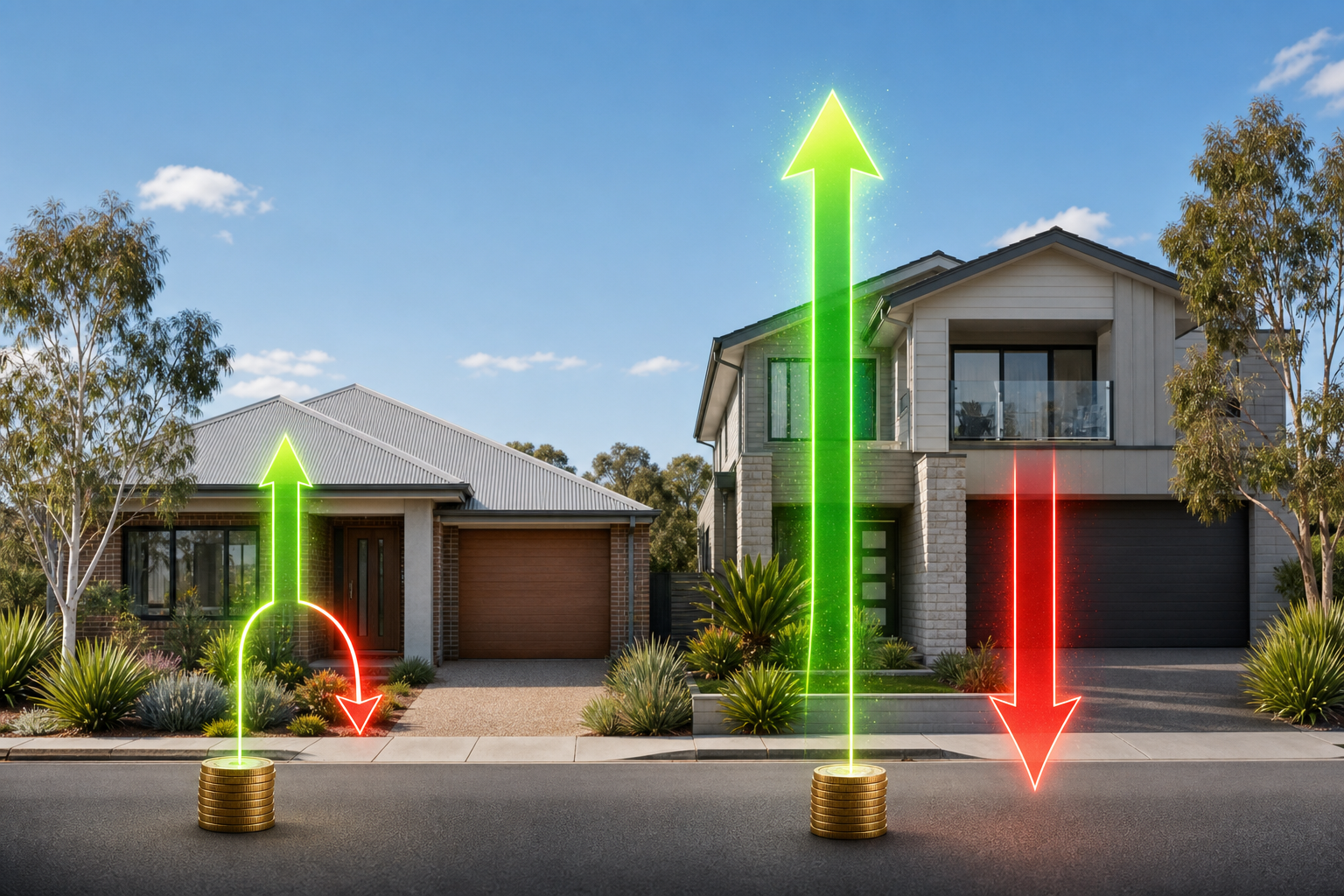
Read the full guide on tailoredloans.sydneyLeverage in property means using borrowed money so a small deposit controls a much larger asset — and that amplifies both gains and losses on your equity. The higher your loan‑to‑value ratio (LVR), the more volatile your personal return becomes, and the faster trouble arrives if rates rise or rents fall.
Here’s how the maths actually works, and how to use leverage without betting the house.
1. The core idea: small deposit, big exposure
Definition: Property leverage is simply total property value ÷ your own cash/equity.
If you buy a $800,000 property with a $80,000 deposit and $720,000 loan:
- Property value: $800,000
- Your equity at purchase: $80,000
- LVR: 90%
- Leverage multiple: $800,000 ÷ $80,000 = 10x
So every 1% price move in the property is a 10% move (before costs) on your equity.
How gains and losses get magnified
Assume no buying/selling costs, interest or rent, just the price move:
-
Property rises 10% to $880,000
- Equity = $880,000 − $720,000 = $160,000
- Your $80k doubled: +100% return.
-
Property falls 10% to $720,000
- Equity = $720,000 − $720,000 = $0
- Your $80k is wiped: −100%.
Same property. Same loan. A modest market move completely changes your outcome.
2. 80% vs 90–95% LVR: very different risk profiles
Borrowing more isn’t a small tweak. Moving from 80% to 90–95% LVR changes your risk category.
Quick comparison
| Scenario | Property price | LVR | Your deposit | Price fall that wipes 50% of equity |
|---|---|---|---|---|
| A | $800,000 | 80% | $160,000 | ~10% |
| B | $800,000 | 90% | $80,000 | ~5% |
| C | $800,000 | 95% | $40,000 | ~2.5% |
The buffer between you and zero shrinks fast as LVR rises.
Cashflow pressure at higher LVRs
Higher LVR usually means:
- Higher interest rate (risk loading, especially with some non‑banks).
- Lenders Mortgage Insurance (LMI) or a lender risk fee.
- Bigger monthly repayments for the same property value.
Indicative example only (not actual rates):
- 80% LVR P&I loan, $640,000 over 30 years at 6.0%
- Repayments ≈ $3,840/month
- 95% LVR P&I loan, $760,000 over 30 years at 6.5%
- Repayments ≈ $4,800/month
- Plus LMI that might be capitalised into the loan.
You’re paying ~$1,000/month more to hold essentially the same asset — with less buffer if something goes wrong.
The strategy continues below
You've seen the problem and the groundwork — now unlock the exact steps our CPA-certified brokers use, including 4 more sections. Enter your email for instant, free full access.
Free access. No spam — unsubscribe anytime. Your details stay confidential.
Frequently asked questions
Talk to a CPA-certified broker
Free consultation, plain-English advice tailored to your situation.