
Article
Strata Loans Explained: Structures, Rules And What Lenders Really Want
A practical guide to how strata finance works in Australia – structures, approval rules and what banks and specialist lenders look for before funding your owners corporation or body corporate.
Key Takeaway
Strata finance in Australia is a loan taken out by an owners corporation or body corporate to fund common-property works, repaid via levies rather than individual mortgages. Lenders assess building condition, scheme financials, arrears (often needing <10%), and levy impact, typically offering 5–15 year terms and LVRs around 70–80% as indicative settings. Understanding structures, state rules and lender appetite helps committees choose between a strata loan and one-off special levies and plan a funding proposal owners can approve this year.
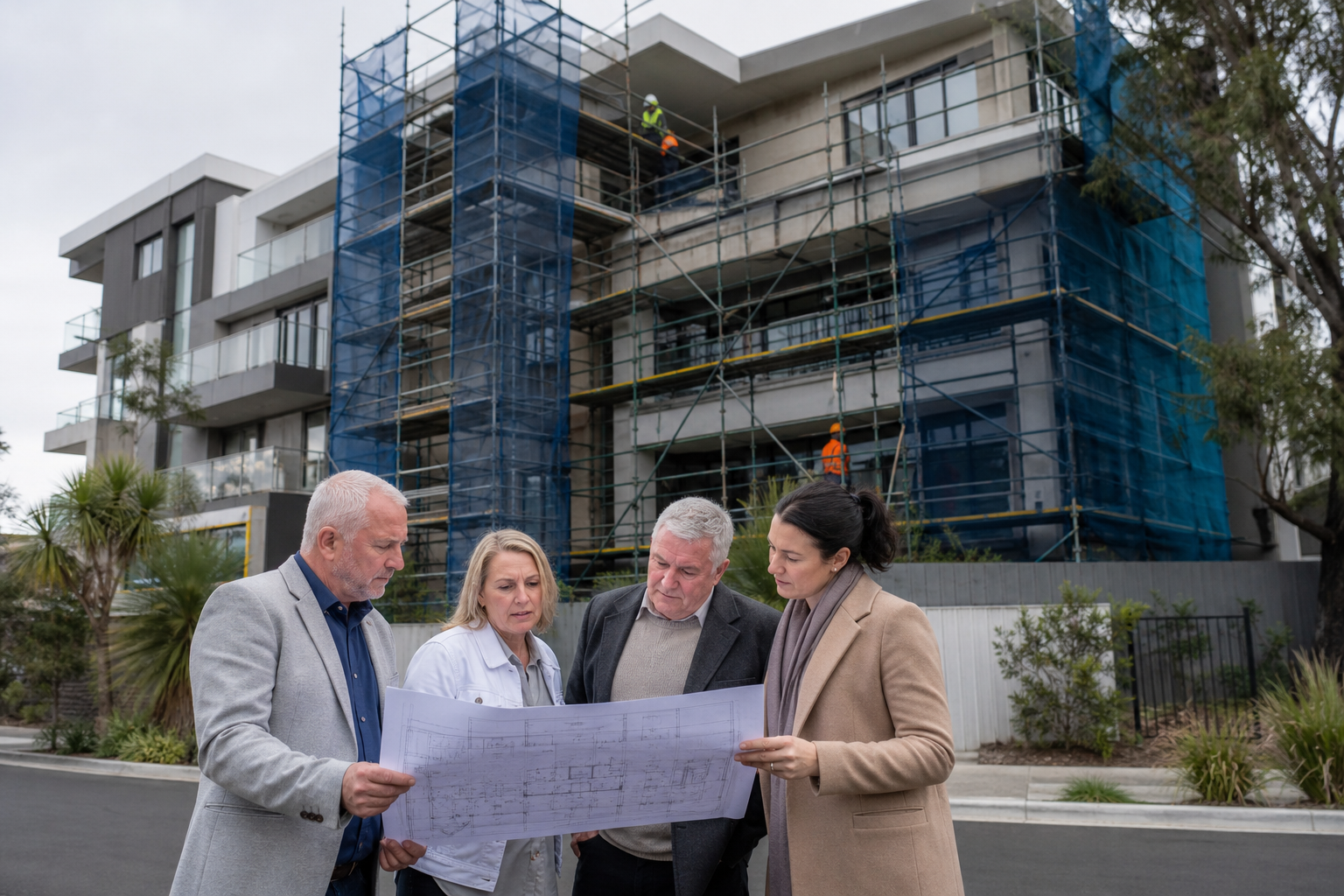
Strata finance is a loan taken out by an owners corporation or body corporate to fund capital works, major repairs or upgrades, with repayments covered by strata levies rather than each owner arranging their own loan. In Australia, lenders focus on the building, scheme financials and levy impact – not just individual owners’ incomes. Done well, a strata loan can get urgent work moving without forcing owners to sell.
This guide explains how strata loans are structured, the rules that sit around them, and what banks and specialist lenders look for so your committee can make a decision this month, not next year.

1. What is strata finance, in plain English?
Strata finance is a loan to the legal entity that manages your building – usually called the owners corporation (NSW/Vic/ACT), body corporate (Qld) or strata company (WA). The money is used for common property, and owners repay it indirectly through levies.
Key points:
- Borrower – the scheme, not individual owners.
- Security – usually an unsecured or limited-security loan over levy income and the right to recover from owners, sometimes supported by a charge over the sinking/capital works fund.
- Use – capital works, defects, structural repairs, services upgrades, green projects (solar, EV, lifts), not day‑to‑day running costs.
- Repayments – built into levies over 5–15 years.
For many buildings, a strata loan is the alternative to a painful special levy or multiple rounds of owner fundraising.
2. Why schemes use strata loans instead of special levies
2.1 Common reasons to borrow at the scheme level
Typical uses include:
- Concrete cancer or structural repairs
- Waterproofing, roofing and façade rectification
- Fire safety upgrades mandated by council or state law
- Lift replacement or major plant upgrades
- EV charging infrastructure, solar, battery or central hot water
- Resolving building defects when developer funding is exhausted or disputed
These are often lumpy, six‑figure projects that hit at the worst time for many owners.
2.2 Strata loan vs special levy: practical trade‑offs
A special levy asks each owner to pay their share upfront, often within 30–90 days. A strata loan spreads that cost over years, coordinated through the scheme.
Worked example
- 20‑lot building, $800,000 façade repair
- Special levy per lot (equal unit entitlement for simplicity): $40,000 each
- Many owners can’t access $40,000 cash quickly, or borrowing individually would stress their personal home loans.
Instead, the scheme takes a $800,000 loan over 10 years at, say, an indicative 8.00% p.a. (illustrative only, not a live rate):
- Approximate annual repayment (principal + interest): ~$116,000
- Per lot per year:
$5,800 ($112 per week)
For many households, an extra ~$110 per week in levies is achievable; a sudden $40,000 lump sum is not.
2.3 Impact on investors and future buyers
Investors can often treat levy payments attributable to income‑producing property as deductible outgoings (check with your tax adviser – purpose still governs deductibility, consistent with ATO rules noted in /insights/company-community-strata-alexandria-finance-differences).
Future buyers inherit:
- A better‑maintained building, but
- Higher levies while the loan is outstanding.
Well‑documented loans for obvious long‑life works (façade, fire, lifts) are usually easier for valuers and buyers to accept than vague, ongoing repair campaigns.
3. Common strata loan structures in Australia
3.1 Core structural features
While each lender has its flavour, most strata loans share these elements:
- Borrower: the owners corporation/body corporate
- Term: typically 5–15 years
- Amount: from ~$100,000 to several million (larger for big, well‑run schemes)
- Repayment type: principal & interest; some early years may allow interest‑only during construction
- Security: charge over levy income and sometimes the sinking fund; rarely a full mortgage over title
Strata loans sit somewhere between unsecured business loans and project finance, which is why they’re often written by commercial or specialist lenders rather than retail home loan teams.
3.2 Individual funding vs scheme‑level funding
An alternative is each owner borrowing their share against their own property. That can work in simple, small schemes, but it creates frictions:
- Some owners can’t or won’t get finance.
- Timing mis‑matches delay works.
- Investors and owner‑occupiers may have different tax and cashflow preferences.
Scheme‑level borrowing:
- Delivers certainty and a single construction schedule
- Avoids putting extra mortgages on individual titles
- Treats owners consistently based on unit entitlements, not lender whims
This mirrors some of the structure logic we see when comparing SMSF property loans with company or trust loans (/insights/smsf-property-loans-vs-commercial-loans-company-trust-rules-differ): the right borrower entity for the project matters as much as the rate.
3.3 Comparison: strata loan vs owners’ personal loans
| Feature | Strata loan (scheme) | Individual owner loans |
|---|---|---|
| Borrower | Owners corporation/body corporate | Each owner separately |
| Security | Levy income, fund charge, limited building charge | Mortgage over each owner’s lot |
| Approval focus | Building, scheme financials, arrears, levies | Each owner’s income, credit, existing debts |
| Works timing | One program for all works | Dependent on slowest owner securing finance |
| Cashflow impact | Higher levies for all owners | Higher home loan repayments for borrowing owners |
| Admin burden | Centralised with strata manager and committee | Highly fragmented |
| Equity and tax planning | Same levies by unit entitlement | Each owner structures their own finance/tax |
For most medium‑to‑large schemes with essential works, a single strata loan provides more coordination and less drama.
The strategy continues below
You've seen the problem and the groundwork — now unlock the exact steps our CPA-certified brokers use, including 7 more sections. Enter your email for instant, free full access.
Free access. No spam — unsubscribe anytime. Your details stay confidential.
Frequently asked questions
Talk to a CPA-certified broker
Free consultation, plain-English advice tailored to your situation.