
Article
Your Safety Net: Buffers, Insurance and Backup Plans When You Restructure Loans
A practical Australian guide to buffers, insurance and contingency plans when you refinance, consolidate or reshuffle home, investment or business debt — with steps you can action this week.
Key Takeaway
When restructuring loans, borrowers should first define a clear buffer target of at least 3–6 months of stressed living costs and repayments in cash or offset, rising to 6–12 months for highly geared or self-employed households. In 2026, around 28% of Australian mortgage holders are ‘At Risk’ of stress, according to Roy Morgan, largely due to rate rises and higher living costs. Reviewing insurance, setting hard buffer rules, and planning a step-by-step contingency response can materially reduce the risk of forced sales or hardship.

This topic is covered in full on Tailored Loans Sydney
A practical Australian guide to buffers, insurance and contingency plans when you refinance, consolidate or reshuffle home, investment or business debt — with steps you can action this week.
Read the full guide on tailoredloans.sydneyRestructuring your loans — refinancing, consolidating, uncrossing, or pulling equity — is a prime chance to fix your safety nets. That means three things: a proper cash/offset buffer, the right mix of insurance, and a clear contingency plan if life or rates go sideways.
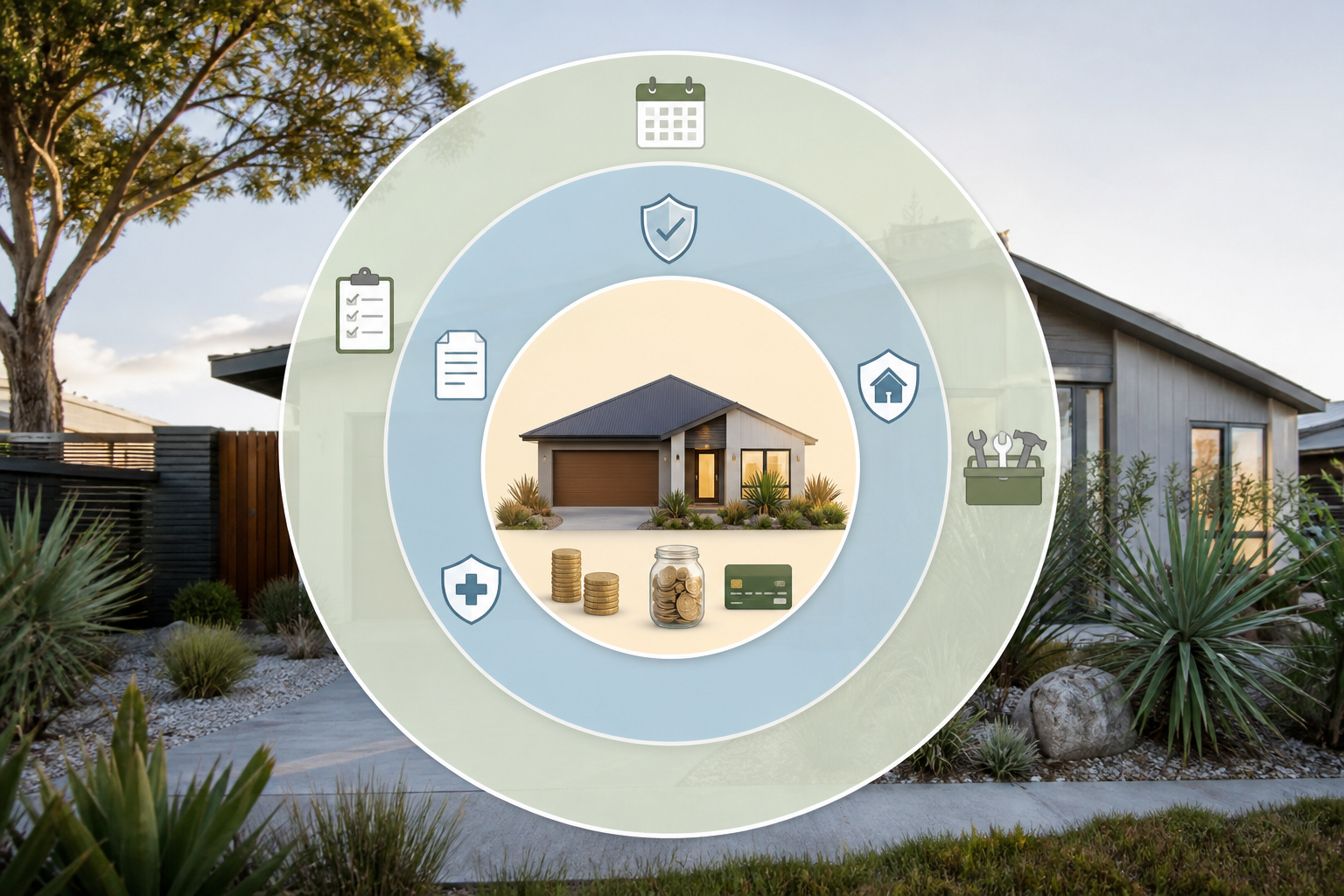
In plain English: a buffer is your cash safety net, insurance is your income and disaster back‑up, and a contingency plan is your step‑by‑step playbook when something goes wrong. Get all three aligned with your new loan structure and you radically cut the chances of default, hardship or being forced to sell.
1. Why buffers and contingency plans matter more in 2026
Australian households are carrying bigger loans into a higher‑rate, higher‑cost world. Roy Morgan reports about 28% of mortgage holders are now ‘At Risk’ of mortgage stress, and the ABS shows living costs rising 3.7–4.7% annually, with mortgage interest and insurance major contributors.
When you restructure your loans, you usually:
- increase or extend debt (equity release, renovations, business top‑ups)
- stretch your cashflow (debt consolidation, interest‑only periods)
- change ownership or security (buying/selling, uncrossing loans).
That’s exactly when you should tighten safety, not loosen it. A sound framework is:
- Cap total loan repayments at roughly 25–35% of net income.
- Hold 3–6 months minimum, ideally 6–12 months, of stressed living costs and loan repayments in cash or offset.
- Back‑stop major risks (death, disability, income loss) with targeted insurance and a written fallback plan.
This guide focuses on how to do that in a week of focused work.
2. How big should your buffer be after you restructure?
2.1 The baseline: 3–6 months of stressed costs
A practical starting point for most households is:
- Minimum: 3 months of total holding costs (all loan repayments, essential living costs, insurances, strata, council, basic utilities).
- Comfortable: 6 months.
- Highly geared / self‑employed / investor portfolios: 6–12 months.
Importantly, calculate this using stressed repayments: test your loans at 2–3% above current interest rates (similar to the APRA 3% buffer lenders apply for new loans).
If your actual rate is 6% p.a., plan your buffer using 8–9% p.a. repayments.
This approach lines up with our other guidance for Bronte, Rose Bay and similar households: six to twelve months of stressed essential costs plus all loan repayments materially reduces the risk of forced sales.
2.2 Worked example: how much is 6 months of buffer?
Say you’re a Sydney household with:
- Home loan: $1,000,000, 6% p.a., 25 years remaining
- Investment loan: $600,000, 6.2% p.a., interest‑only
- Net household income: $13,000 per month
- Essential living costs (food, utilities, transport, insurance): $5,000 per month
Indicative repayments:
- Home loan P&I at 6%: about $6,440/month
- Same loan stress‑tested at 9%: about $8,380/month
- Investment IO at 6.2%: about $3,100/month
Stressed monthly outgoings:
- Home loan (at 9%): $8,380
- Investment IO (at 9.2% stress): ~$4,600
- Essential living costs: $5,000
- Total stressed monthly cost ≈ $17,980
Six months’ buffer = 6 × $17,980 ≈ $108,000 in cash or offset.
Is that a big number? Yes. But consider the alternative: one bad year and a forced sale of your home or investment at a 10–20% discount.
If that number feels impossible today, treat it as your North Star target and build towards it in stages.
2.3 Stage‑building your buffer during a refinance
When you refinance or restructure, you often unlock options to build the buffer:
- Lower rate / better structure → redirect some of the monthly savings into your offset.
- Equity release → carve out a clear portion (e.g. $30,000–$50,000) as a ring‑fenced buffer, not for renovations or lifestyle.
- Debt consolidation → if personal loan/credit‑card repayments drop by $1,000/month, commit a chunk of that (say $600/month) into your buffer before lifestyle creeps.
For a worked buffer‑building strategy in practice, see how we structure offsets and splits around irregular income in [/insights/offset-splits-irregular-income-bronte-mortgage].
3. Where should your buffer live: offset, redraw or savings?
Your buffer is only useful if it’s accessible, low‑risk and reducing interest where possible.
3.1 Comparing common buffer locations
| Buffer location | Pros | Cons | Best used for |
|---|---|---|---|
| Offset account | Reduces non‑deductible interest; flexible access; separate from loan balance | Requires linked loan with offset feature; may have slightly higher rate/fees | Home loan buffers; large, long‑term cushions |
| Redraw on home loan | Reduces interest; simple | Access can be restricted; redraw may be frozen in hardship or policy shifts | Short‑term extra repayments, not core buffer |
| High‑interest savings account | Simple; separate from loan; government guarantee up to $250k per ADI | Taxable interest; doesn’t reduce loan interest | Smaller buffers, tax‑planned cash |
| Business transaction account | Necessary for trading cashflow | Easy to accidentally spend; usually low interest | Basic working capital, not personal buffer |
For most owner‑occupiers, the primary buffer home should be an offset account linked to your non‑deductible home loan. That aligns with our approach in [/insights/build-cash-buffer-bronte-home] and [/insights/using-offset-account-to-park-solar-budget-before-installation].
3.2 Separate buffers: personal, business, settlement
If you’re self‑employed or investing, it often makes sense to keep three buffers (even if they all sit across offsets/savings):
- Personal buffer – living costs and home repayments.
- Business buffer – 1–3 months of fixed business expenses (wages, lease, software, tax instalments).
- Settlement/project buffer – for upcoming risks like off‑the‑plan settlements, renovations or large tax bills.
This mirrors our guidance for off‑the‑plan buyers, where personal, business and settlement buffers are planned separately before you commit.
3.3 Hard rules: what you don’t touch
When you restructure, agree on hard household rules around your buffer:
- “We never let our offset fall below 3 months of stressed costs.”
- “Bonus and RSU income is not for lifestyle — it’s for buffers, debt reduction or investing.”
- “We don’t use the buffer for holidays, cars or non‑essential upgrades.”
These internal rules matter more than lender policy. They’re your personal APRA.

The strategy continues below
You've seen the problem and the groundwork — now unlock the exact steps our CPA-certified brokers use, including 6 more sections. Enter your email for instant, free full access.
Free access. No spam — unsubscribe anytime. Your details stay confidential.
Frequently asked questions
Talk to a CPA-certified broker
Free consultation, plain-English advice tailored to your situation.