
Article
How lenders really see medical, legal and professional suites
Thinking of buying a medical, legal or professional suite? This guide explains how Australian lenders assess risk, value, leases and exit strategies so you can structure your deal for approval, not surprises.
Key Takeaway
Australian lenders favour medical, legal and professional suites in established health or business precincts with strong demand, quality strata, and diversified professional tenancies, but typically cap loan-to-value ratios at 60–75%. They are wary of single-tenant dependence, dated medical fit-outs, and hard-to-repurpose layouts, especially for SMSF deals. Buyers should focus on buildings with broad appeal, realistic market leases, and clear exit strategies, and align loan structure, ownership entity and tax planning before signing contracts.

Most doctors, lawyers and professionals I meet assume banks will love their own suite as much as they do. In reality, lenders are picky: they favour medical, legal and professional suites in proven locations with broad appeal – and quietly avoid anything that’s too specialised, too owner‑dependent or too hard to sell.
In simple terms: a finance‑friendly professional suite is one a bank can easily re-tenant or sell if you disappear. The more your suite depends on you, your brand or a hyper‑niche use, the tougher the lending conversation becomes.
Here’s what I tell my clients: treat this as a financial asset first and a dream room layout second. Then build the lending and tax structure around that asset, not the other way around.
Fast answers: what lenders like – and what they avoid
What lenders generally like:
- Suites in established medical or professional hubs with strong demand and low vacancy.
- Flexible layouts that could suit multiple professionals (GPs, allied health, accountants, lawyers).
- Sensible loan-to-value ratios (LVRs) – often 60–70%, with some appetite to 75% for rock‑solid borrowers.
- Transparent leases at or near market rent, on standard commercial terms.
- Clean, well‑run strata with adequate sinking funds and no major defects.
What lenders tend to avoid or discount:
- Strata titles carved into tiny boxes (e.g. sub‑25 m²) with limited natural light.
- Very bespoke medical fit‑outs that are expensive to repurpose.
- Buildings with high vacancy or over‑supply of similar suites in the same block.
- A single practitioner being both owner and only tenant with no clear succession plan.
- SMSF purchases with thin liquidity or no realistic exit strategy.
If you remember nothing else: buy something a cautious bank credit officer would feel comfortable owning in a downturn.
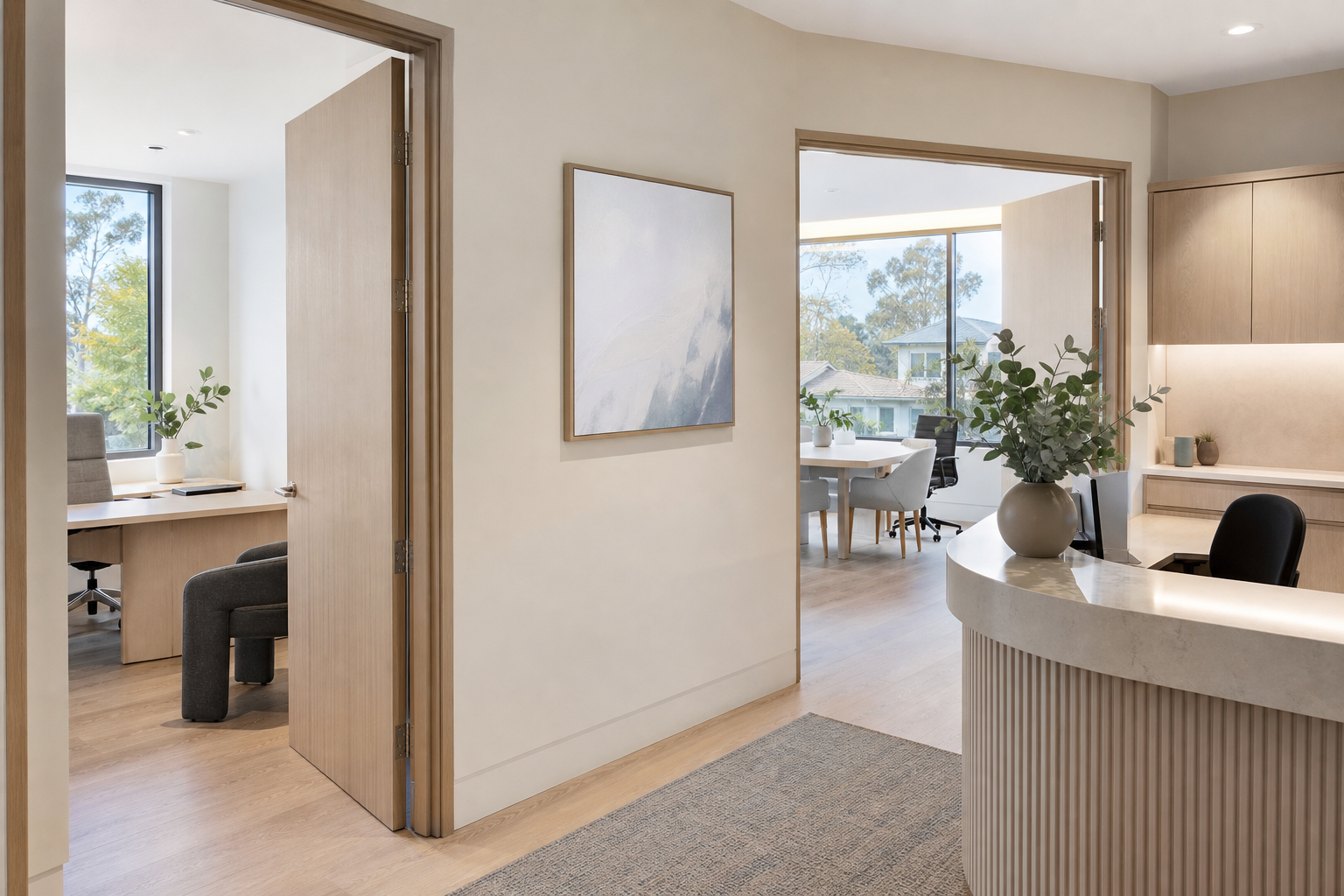
Lenders prefer flexible fit-outs that appeal to a wide range of professional tenants.
How banks categorise medical, legal and professional suites
Commercial – but not all created equal
Banks usually treat these suites as standard commercial property, not residential. That means:
- Lower LVRs: where a home might get 80–90% LVR, expect 60–70% here, sometimes 75% for strong borrowers.
- Shorter terms: 15–20 years is common vs 30 years for a home.
- P&I bias: interest‑only is possible but often for shorter periods and at a pricing premium.
- Tighter servicing: commercial deals go through more conservative cashflow tests, with buffers on rates (often 2–3% like APRA’s residential buffer) and stronger scrutiny of your business income.
From a risk point of view, lenders rank suites something like this (lowest to highest risk):
- CBD or major suburban professional hubs with diversified tenants.
- Integrated health precincts anchored by hospitals or major clinics.
- High‑quality suburban professional parks near courts, hospitals or major employment nodes.
- Stand‑alone specialist conversions (e.g. house converted to rooms) in average locations.
- Niche, single‑use suites that are hard to lease outside the current specialty.
Why location quality matters more than the plaque on the door
The City of Sydney and North Sydney economic profiles both show what lenders already know: central, high‑productivity service precincts have deeper tenant demand and higher incomes than the average suburb. That translates into lower vacancy risk, which is what banks actually lend against.
This is also why local knowledge matters. In some mixed‑use buildings (think Green Square or other urban renewal areas), lenders will love certain floors and quietly dislike others. If you haven’t yet, read how building type shapes lending rules in [/insights/green-square-property-types-lending-rules].
What lenders love in medical, legal and professional suites
1. Buildings with options – not just for you, but the next owner
The mistake I see most is professionals buying the perfect suite for their current practice – then discovering it’s a nightmare to refinance or sell.
Lenders like:
- Good-sized rooms (often 50–150 m²) with regular shapes, windows and accessible amenities.
- Flexible fit‑outs where walls can move and plumbing isn’t locked into one hyper‑specific layout.
- Mixed professional tenancy profiles – lawyers next to accountants next to physios is a positive.
- Reasonable car parking relative to patient or client numbers.
Worked example:
- Suite A: 85 m², generic office layout, in a busy suburban professional hub near a court and train station.
- Suite B: 42 m², heavily plumbed for dental with fixed cabinetry, internal room, no windows.
On paper, the rent on Suite B might be higher today. But many lenders will give Suite A better credit treatment and more generous LVR, because more tenants could use it if your practice leaves.
2. Clean, boring leases – especially where you’re the tenant
Where you have an arm’s‑length tenant, lenders typically want:
- 3–5 year initial term, plus options.
- Net or semi‑gross leases with clear outgoings arrangements.
- Market‑aligned rent, not artificially pumped up to make servicing look better.
- A rent review mechanism that’s understandable (CPI, fixed, or market).
If you’re both owner and tenant, banks look hard at:
- Whether rent is commercially reasonable for the area.
- Whether your practice can actually afford that rent after wages, consumables and other costs.
- What happens to rent if your drawings fall – a real risk in a downturn.
Remember: interest deductibility follows purpose, not security ([/insights/debt-recycling-tax-effective-loan-structuring-australia]). If your SMSF owns the suite and your practice pays rent, that rent is usually deductible to the practice and assessable in the fund. Get tax and lending aligned before signing a 10‑year lease with yourself.
3. Strong personal profiles – especially for owner‑occupiers
Most lenders still look at:
- Personal income stability (at least 2 years in practice, preferably longer).
- Business financials – trends in billings, margin and partner movements.
- Existing home loans and personal debts – these impact serviceability even when the new loan is “for the business”.
For practice owners, small tweaks in how you pay yourself can materially change borrowing power. I go into this in detail in [/insights/structuring-practice-income-maximise-borrowing-power]. If a suite purchase is on your radar in the next 12–24 months, your accountant and broker should be talking about drawings, salaries and dividends now, not after your offer is accepted.
What makes lenders nervous – and how to avoid it
1. Over‑reliance on a single practitioner or niche
Red flags:
- One GP, one room, one lease – no plan for a second doctor, registrar or sub‑tenant.
- A highly specialised clinic (say, a cosmetic niche) in a suburb with limited alternative demand.
- Legal rooms built for one senior partner with no scope for sub‑letting.
Lenders ask: “If this person retires, burns out or moves, how quickly can we re-tenant this?” If the honest answer is “not easily”, expect:
- Lower LVR.
- Higher rates.
- More conservative valuations.
Mitigants you can build in:
- Designs that allow multiple rooms plus shared reception.
- Layouts that would also suit other disciplines (GPs, psychologists, allied health, financial services).
- A medium‑term plan to add clinicians or partners so revenue isn’t one‑person‑dependent.
2. Over‑capitalised or dated medical fit‑outs
Banks love seeing a thriving, modern practice – but they know fit‑outs date quickly.
Weak signs:
- $400k fit‑out bolted into a building whose base shell is worth $500k.
- Highly customised surgical or radiology rooms with limited alternative use.
- Fit‑outs older than 10–15 years in buildings with obvious upcoming refurb costs.
Lenders (and valuers) generally won’t give full credit to that spend. You might value your suite at $1.2m (shell plus fit‑out); the bank might see $900k in an orderly sale.
Rule of thumb I use with clients: make sure the bare shell stacks up as an investment even if the fit‑out went to zero on paper.
3. Problem strata and weak building fundamentals
Common risks:
- Ongoing disputes between medical and non‑medical owners about hours, access or signage.
- Inadequate sinking funds despite known lift, facade or fire upgrade issues.
- Many “for lease” signs at once – a sign of over‑supply.
This is where a broker with suburb‑level context helps. In some precincts, lenders have long memories about particular buildings. I unpack how that local insight plays out in [/insights/what-local-knowledge-looks-like-mortgage-broking].
SMSFs, entities and mixed‑use precincts: where structure can kill a good asset
SMSF purchases – liquidity and exit first, tax second
I like SMSFs for some suite purchases, but only when three conditions hold:
- Strong, broad tenant demand – not a one‑doctor town.
- Moderate gearing – often 50–65% LVR, sometimes less.
- Clear exit path – realistic sale or cash‑out before the members hit pension phase.
Remember: the 2026–27 Budget sharply changes capital gains tax settings for individuals, but commercial property and super funds are affected differently to mum‑and‑dad residential investors. For SMSFs, the bigger risks are illiquidity and contribution caps, not just CGT. A suite that’s hard to sell in 10 years is a problem, no matter how clever the tax planning looks now.
If you’re thinking “I’ll just put it in a company or trust”, be careful. Buying through entities usually makes borrowing harder and more expensive, not easier – I break down the reality in [/insights/lending-reality-buying-home-through-entity-2]. The same principle applies to commercial: structure should follow a strong asset and a clear strategy, not be driven purely by tax.
Mixed‑use buildings and zoning changes
Medical and professional suites in mixed‑use precincts can be excellent – or a headache.
Benefits:
- Close to transport and new residential density.
- Easier patient and client access.
- Often newer buildings with lifts and compliance baked in.
Risks lenders look at:
- High investor concentration in residential levels (a risk for valuations – see the Green Square article above).
- Body corporate rules that restrict medical or high‑traffic uses.
- Future rezoning that could flood the area with competing space.
One of the advantages of working with a local broker is knowing how valuers and lenders already treat that specific building or street. The case studies in [/insights/boutique-broking-case-studies-eastern-suburbs] show how that local nuance changes loan structure, not just rate.
Structuring the right loan and ownership vehicle starts with understanding lender risk views.
Example: how the numbers change between “bank‑friendly” and “bank‑nervy” suites
Let’s say you want to buy a $1,000,000 suite.
Scenario 1 – bank‑friendly professional hub
- Location: established medical building opposite a major hospital.
- Tenancy: two GPs plus a psychologist, 5‑year net lease, options in place.
- Borrower: profitable practice, stable income, modest home loan.
Indicative lender response (illustrative only):
- LVR: up to ~70% → loan of $700,000.
- Term: 20 years, P&I.
- Assessment: rent plus practice income used in servicing.
Approximate repayment at 7.0% over 20 years (P&I):
- Monthly: ~$5,426.
Scenario 2 – niche, single‑practitioner suite
- Location: fringe suburb, minimal complementary services nearby.
- Tenancy: owner‑occupier only, no succession plan.
- Fit‑out: highly specialised cosmetic clinic.
Indicative lender response (again, illustrative):
- LVR: capped at 60% → loan of $600,000.
- Term: 15 years, P&I.
- Rate: possibly a premium for risk.
Approximate repayment at 7.5% over 15 years (P&I):
- Monthly: ~$5,553.
Same purchase price, lower LVR and shorter term, yet almost identical monthly repayments – and you must tip in an extra $100,000 cash.
This is why understanding what lenders like and avoid really matters before you sign a contract.
A one‑week action plan if you’re considering a suite
In the next 48 hours
- Clarify your true goal. Is this primarily about practice control, long‑term investment, or both?
- List 3–5 target precincts, not just one building. Think hospitals, courts, transport hubs.
- Pull your financials together – last two years’ tax returns, BAS, practice P&L, current debt schedule.
Days 3–5 – talk, don’t tour
- Book a 15–30 minute call with a broker who understands both home and commercial lending – not just one side. Articles like [/insights/benefits-using-mortgage-broker-australia] and [/insights/online-phone-vs-local-mortgage-brokers-australia] outline how to choose.
- Get an indicative borrowing range for:
- Owner‑occupied vs investment purchase.
- Different LVRs (60%, 65%, 70%) and what they do to repayments.
- Ask your accountant to sanity‑check entity vs SMSF vs personal ownership before you set your heart on a structure.
Days 6–7 – inspect with a lender’s eyes
- When you inspect suites, ask:
- How easy would this be to lease to a different type of professional?
- What does the strata look like – sinking fund, upcoming works, disputes?
- How many “for lease” or “for sale” signs are in the immediate building and precinct?
- Shortlist only the suites that a conservative lender would like, not just the ones with nice reception couches.
Do this, and by next week you’ll have a realistic budget, a preferred structure and a shortlist of suites that work for both your practice and your bank.
FAQs
Are medical and legal suites easier to finance than other commercial properties?
Not automatically. Lenders like the stability of professional tenants, but they’re just as wary of over‑specialised, owner‑dependent suites as any other commercial asset. Location quality, tenancy mix, leasing strength and building fundamentals carry more weight than the fact the door says “Dr” or “Solicitor”.
Can I use my home equity to buy a professional suite?
Yes, many professionals leverage home equity, often via a separate split secured against their residence. This can improve pricing and LVR but increases risk to your family home, so it needs careful structuring of purpose, security and future exit. Independent tax and lending advice is essential before cross‑collateralising major assets.
Is it better to buy my rooms in an SMSF or personally?
It depends on your age, contributions capacity, practice plans and retirement horizon. SMSFs can offer tax advantages on rental income and capital gains, but they come with borrowing constraints, liquidity risks and strict rules. Personal or trust ownership often gives more flexibility on gearing and refinancing; you need coordinated tax, legal and lending advice before deciding.
What kind of deposit do I need for a $1m professional suite?
For a standard commercial loan, many banks will want you to contribute 30–40% plus costs, so around $300k–$400k plus stamp duty and legal fees. Some professionals can stretch higher LVRs using additional security, but that needs to be weighed against risk to your home and future borrowing flexibility.
How important is the lease when I’m buying as an owner‑occupier?
Very important. Even if you own the suite and your practice is the tenant, most lenders will still want a formal lease at commercial terms. It supports valuation, serviceability and SMSF compliance if relevant. A poorly drafted or unrealistic lease can spook credit teams and reduce how much you can borrow.
Key takeaways
- Lenders prefer medical, legal and professional suites with flexible layouts, strong precinct demand and clean strata over highly specialised one‑practitioner rooms.
- Expect lower LVRs and shorter terms than home loans; borrowing capacity is heavily influenced by how your practice income is structured and how realistic your lease is.
- SMSFs and entities can work but should follow a solid asset and exit strategy, not drive the whole decision.
- The question to keep asking is: would a cautious bank be comfortable owning this suite in a downturn? If the answer is no, look elsewhere.
If you’re weighing up buying rooms in the next 6–18 months, this is exactly the kind of decision that benefits from one joined‑up conversation about tax, loans and structure. Book a free 15‑minute strategy call at /contact to map out your borrowing capacity, ownership options and target precincts – one meeting, three lenses: CPA, tax agent and broker.
General advice only.
Frequently asked questions
Talk to a CPA-certified broker
Free consultation, plain-English advice tailored to your situation.
