
Article
Safely Pushing Your Budget at Dover Heights & Vaucluse Auctions
Written and reviewed by James Chee, CPA · Last reviewed
You can safely stretch your budget at a Dover Heights or Vaucluse auction only if you lock in a hard ceiling, pre‑organise extra funds and stress‑test repayments at higher rates. Go in with a written bidding map so emotion doesn’t quietly rewrite your limits on the day.
Key Takeaway
Buyers can safely stretch their budget at Dover Heights and Vaucluse auctions by running two limits: the bank’s maximum and a lower personal ceiling based on repayments at 2–3% higher interest rates. In prestige markets where auction reserves often beat guides, planning a narrow 3–7% “stretch band” and pre‑locking extra funds, buffers, and timing is critical. The key actionable step is to write a bidding map this week that your broker and solicitor have stress‑tested.
Watch the short answer
Maxed Out on Your Residential Borrowing Capacity?
If you’re testing your limit at Dover Heights or Vaucluse auctions, this video steps through what to weigh up when borrowing is maxed out.
Read the transcript
Are you maxed out on your residential borrowing capacity? It's time to pivot to commercial. Many investors hit a wall where retail banks cut off their residential borrowing, but commercial lending operates on an entirely different rulebook. Lenders look heavily at the lease strength and the yield of the commercial asset itself, often allowing you to borrow outside of your personal PAYG constraints. It's the ultimate pathway to scaling your portfolio when the residential door closes. Ready to scale? DM me the word 'COMMERCIAL' to pivot your investment strategy.
General information only, not personal advice. Your situation is assessed before any recommendation.

This topic is covered in full on Tailored Loans Sydney
You can safely stretch your budget at a Dover Heights or Vaucluse auction only if you lock in a hard ceiling, pre‑organise extra funds and stress‑test repayments at higher rates. Go in with a written bidding map so emotion doesn’t quietly rewrite your limits on the day.
Read the full guide on tailoredloans.sydneyYou can safely stretch your budget at a Dover Heights or Vaucluse auction only if you lock in a non‑negotiable ceiling, pre‑plan a narrow stretch band, and know exactly where the extra money would come from without wrecking your cashflow or tax position.
That means running two limits, stress‑testing repayments 2–3% higher than today’s rates, and making it structurally hard to bid beyond your true maximum.
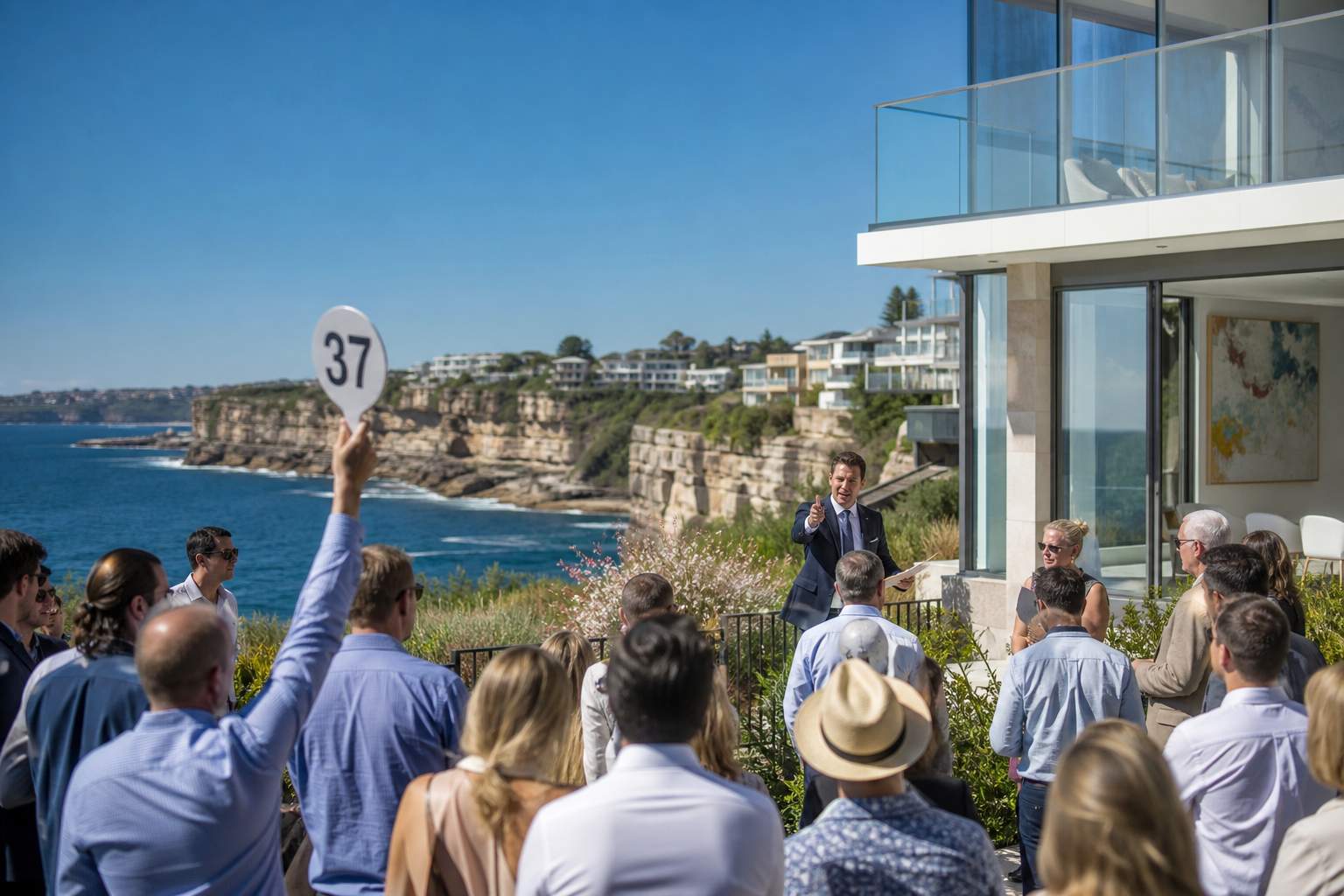
Step 1: Run two limits, not one
In these suburbs, the bank’s limit and your safe limit are rarely the same.
- Bank limit (serviceability) – what a lender will offer under APRA’s 3% buffer.
- Personal safe limit – the lower number where repayments still fit your real life.
A good rule, building on the approach in /insights/real-borrowing-power-eastern-suburbs-first-next-home, is to keep home repayments under ~30–35% of net household income once you model a 2–3% rate rise.
Example (illustrative only):
- Combined net income: $22,000/month.
- Bank might lend enough for repayments of $11,000/month.
- Your safe band at stressed rates (say 7–8% P&I): $6,600–$7,700/month.
Work backwards from that safe repayment to a price ceiling, not from what the bank says you can borrow.
Step 2: Draw your three auction numbers
Go to the auction with three numbers written down:
- Comfort price – where you’d be delighted to buy and cashflow feels easy.
- Stretch band – usually 3–7% above comfort, where you’d still sleep at night.
- Hard ceiling – an absolute no‑go number you cannot physically breach.
For Dover Heights and Vaucluse prestige homes, a typical pattern might be:
- Comfort price: $4.5m
- Stretch band: $4.5m–$4.8m (about 7%)
- Hard ceiling: $4.8m
Your hard ceiling must line up with your personal safe limit, not the bank maximum.
If you’re upsizing within Dover Heights, pair this with the numbers work in /insights/upsizing-dover-heights-family-safe-borrowing-limit so any stretch still leaves room for kids’ costs, school fees, business swings and lifestyle.
What changes as you stretch?
Every extra $100k at 6.5% P&I over 30 years is roughly $630/month in repayments.
If you stretch $400k above comfort, that’s about $2,500/month more.
Ask yourself plainly: Can I still live the life I want with that extra monthly load at 2–3% higher rates?
The strategy continues below
You've seen the problem and the groundwork — now unlock the exact steps our CPA and Registered Tax Agent-led brokers use, including 4 more sections. Enter your email for instant, free full access.
Free access. No spam — unsubscribe anytime. Your details stay confidential.
Frequently asked questions
Related articles
Suburb guides
Heritage overlays in Bellevue Hill, Vaucluse and Rose Bay: risk or edge?
Suburb guides
How to Build a Safe Standby Equity Facility on a Dover Heights Home
Suburb guides
Telltale Signs Your Dover Heights Debt Is Becoming Dangerous
Suburb guides
Airbnb on Dover Heights Prestige Properties: How Banks Really Treat It
Talk to a broker who is a CPA and Registered Tax Agent
Free consultation, plain-English advice tailored to your situation.