
Article
Using Your SMSF To Add Solar To Business Premises, Safely
How SMSFs can fund solar on business premises, when it’s deductible, and how to keep both super and tax rules onside so you can act this week with confidence.
Key Takeaway
An SMSF can fund solar panels on business premises when the system is part of the SMSF‑owned property or financed via an LRBA, with deductions usually claimed either by the trading business as fit‑out or by the SMSF as capital works at 2.5% per year under Div 43. Because banks assess SMSF, personal and business debts as one ecosystem, any SMSF solar borrowing can reduce outside borrowing capacity. Business owners should model a 5–10 year cashflow, document arm’s length lease changes, and coordinate tax and finance advice before installing.

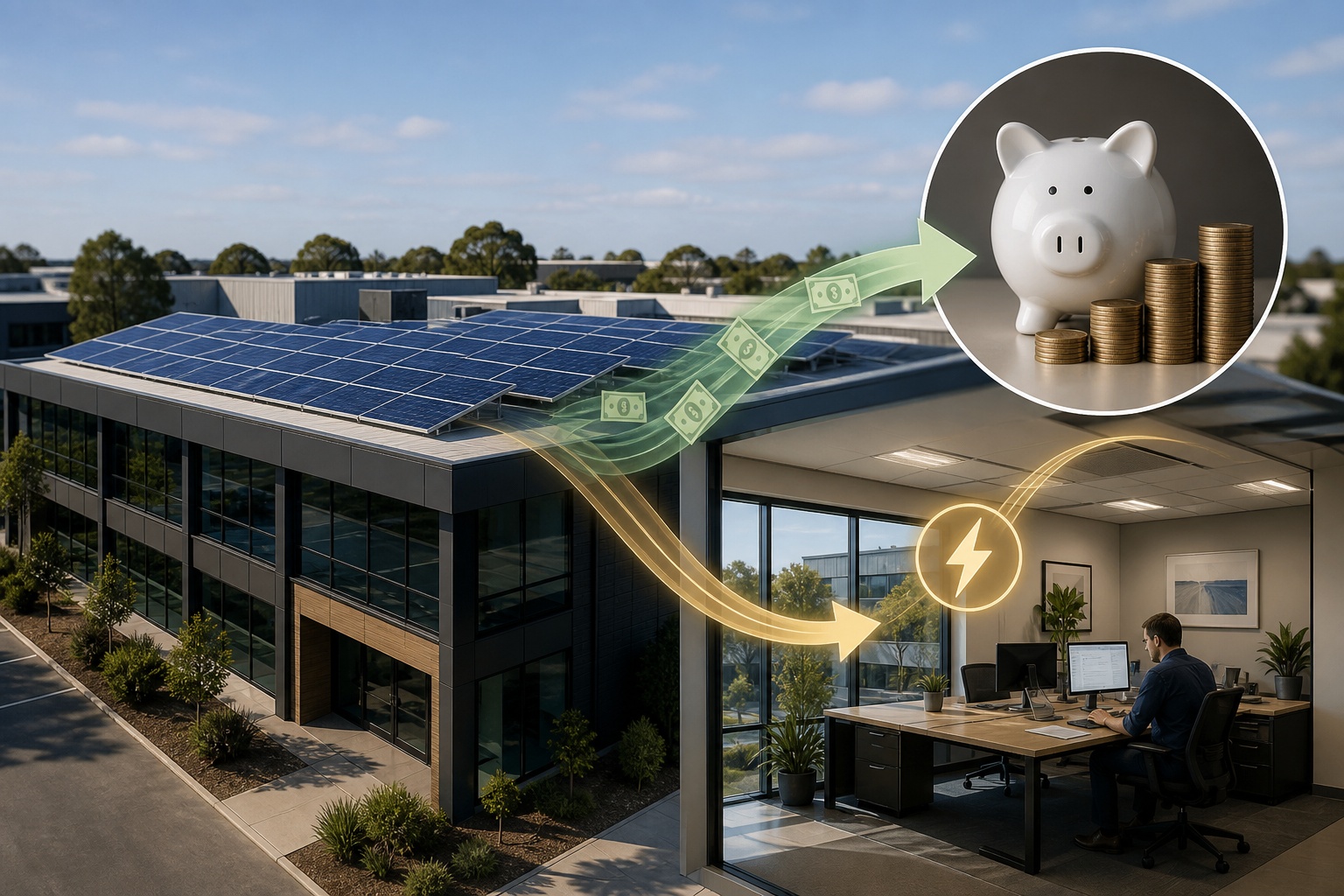
If your SMSF owns your business premises, adding solar can turn an energy headache into a deductible, asset‑backed upgrade. The trick is getting the structure, tax treatment and finance right so you don’t accidentally breach super rules or weaken your wider borrowing power.
In plain terms: your SMSF can usually fund solar on the building it owns and lease that improved property to your business on arm’s length terms. Deductions then sit either in the business (as fit‑out or lease costs) or in the fund (as capital works depreciation), depending on who pays and who owns the system. The key is documenting ownership, lease changes and finance properly before any contracts are signed.
1. The big picture: SMSFs, business premises and solar
1.1 What you’re trying to achieve
For most owner‑operated businesses, solar on SMSF‑owned premises is about three things:
- Cutting long‑term operating costs (power bills), ideally faster than the system wears out.
- Keeping the SMSF’s property investment commercially sound and ATO‑compliant.
- Using tax rules and finance sensibly without over‑gearing your household–business system.
Done well, solar becomes just another improvement to a commercial property: it should pass normal investment tests and still look reasonable if electricity prices or contribution levels change.
1.2 Key parties and where tax rules bite
There are usually three moving parts:
- The SMSF – Landlord, owns the property (and sometimes the solar). Governed by SIS Act rules, the sole purpose test and in‑house asset limits.
- Your business entity – Tenant, pays rent and power bills. Claims tax deductions for rent, fit‑out and electricity on ordinary income tax principles.
- The lender – May fund the SMSF (LRBA), the business, or you personally. Practically, most lenders now assess all of these together as one ecosystem, so a new SMSF or business loan can reduce your home and business borrowing capacity.
If your SMSF is your business landlord, the lease must be at market rent, documented and enforced like any third‑party lease. That doesn’t change just because you add solar. If you haven’t reviewed your lease recently, read /insights/related-party-smsf-business-premises-compliance-pitfalls before you start.
2. When do solar panels become a “deductible asset”?
2.1 Core concept: who owns the solar, who pays, who claims
Whether solar is deductible – and to whom – turns on three questions:
- Who owns the asset? SMSF, business entity, or a third party (e.g. power‑purchase provider)?
- Who paid for it and how? Cash, loan, or power‑purchase agreement.
- How is the benefit flowing? Reduced power bills, higher rent, or both.
In Australia, solar on commercial premises can be deductible via:
- Immediate or accelerated depreciation for small and medium businesses (subject to current rules and thresholds).
- Division 40 plant and equipment depreciation (for systems treated as plant owned by the business).
- Division 43 capital works deductions (usually 2.5% p.a. over 40 years) if treated as part of the building, often claimed by the SMSF as landlord.
- Ordinary rent deductions if solar benefits are reflected in higher commercial rent paid by the business.
2.2 Common ownership models and tax treatment
Below is a simplified comparison of the main structures you’ll see in practice.
| Structure | Who owns solar? | Who pays upfront/loan? | Typical deductions | Key risks |
|---|---|---|---|---|
| A. SMSF buys solar, no LRBA change | SMSF | SMSF | Div 43 (2.5% p.a.), rent at market levels | SIS compliance, lease update, cash drag in SMSF |
| B. SMSF adds to LRBA or new LRBA | SMSF | SMSF (borrowed) | Div 43 + interest (inside SMSF), rent at market | Higher gearing, reduced outside borrowing capacity |
| C. Business buys and owns solar | Business | Business (cash/loan) | Div 40/instant asset write‑off + interest | Over‑gearing business, interaction with rent level |
| D. Third‑party PPA/solar lease | Provider | Business via PPA payments | PPA/lease payments deductible as operating cost | Lock‑in pricing, counterparty risk, lease terms vs SMSF rules |
Exactly which bucket you fall into depends on the installation contract, finance contracts and lease wording. Those documents should be aligned before any signatures.
2.3 Deductibility versus cashflow
A deduction is not the same as positive cashflow.
Example (illustrative only):
- 30 kW commercial system; turnkey price: $30,000 (ex‑GST).
- Electricity savings to the business: $7,000 p.a. (after tariffs and usage).
- Business tax rate: 25% (base rate entity).
If the business owns the system and claims full deduction in year one:
- Tax saving: $30,000 × 25% = $7,500 in year one.
- Net of tax, the system has “cost” $22,500.
- If savings are $7,000 p.a., simple payback ≈ 3.2 years.
If the SMSF owns the system and only claims Div 43 at 2.5%:
- Year‑one deduction: $30,000 × 2.5% = $750.
- At a 15% SMSF tax rate: $112.50 tax saved – negligible.
So why would you ever put solar in the SMSF? Because you might value:
- Asset protection and clean ownership inside super.
- Stronger property value and tenant appeal.
- Keeping business debt lower, or preserving business cash buffers.
You’re trading a weaker deduction in the fund for a potentially stronger balance sheet outside it. That trade‑off needs to be modelled across personal, business and SMSF debts as one system, reflecting knowledge facts 1, 3, 15 and 19.
3. SMSF‑owned solar: property and super rules you must respect
3.1 Is solar part of the SMSF property or a separate asset?
From an SMSF lens, solar on a business premises will usually be treated as:
- An improvement to the real property (integral, permanently attached); or
- A separate asset (plant/equipment that could be removed or separately leased).
Why it matters:
- If your SMSF property is under a limited recourse borrowing arrangement (LRBA), some lenders and auditors want to know whether adding solar is a “replacement asset” (potentially problematic) or simply an improvement allowed under the current LRBA.
- If treated as a separate asset, you must check acquisition rules and whether that creates any in‑house asset issues if a related‑party arrangement is involved.
In practice, most commercial‑scale rooftop solar securely fixed to the premises will be treated as part of the property. But your SMSF auditor and lender need to be comfortable with that position before you sign installation and finance contracts.
3.2 Related‑party lease updates: getting rent right
When your SMSF is the landlord and your business is the tenant, the ATO expects everything to be at arm’s length:
- Market rent for the improved premises (post‑solar).
- Written lease, updated if outgoings allocation or services change.
- On‑time rent payments and clean records.
After adding solar, you might:
- Keep gross rent the same, but have the tenant pay the power bill (benefit sits entirely in the business).
- Increase rent slightly to reflect better net outgoings and property quality.
- Move from gross to net lease or vice versa.
Any of those can be fine, but the logic must be commercial and supported by market evidence. If you haven’t reviewed your lease for years, use the checklist in /insights/related-party-smsf-business-premises-compliance-pitfalls as a starting point.
3.3 Sole purpose test and member benefits
The SMSF’s purpose is to provide retirement benefits, not cheap power. Solar fails the sole purpose test if:
- The main reason for the installation is to give your business discounted power unrelated to market terms; or
- The lease and pricing are obviously non‑commercial (e.g. under‑market rent plus free power that no arm’s length landlord would accept).
To stay safe:
- Document why solar is a sensible investment improvement for the property (tenant demand, improved yield, lower outgoings, ESG etc.).
- Keep rent and outgoings within a defensible market range.
The strategy continues below
You've seen the problem and the groundwork — now unlock the exact steps our CPA-certified brokers use, including 6 more sections. Enter your email for instant, free full access.
Free access. No spam — unsubscribe anytime. Your details stay confidential.
Frequently asked questions
Talk to a CPA-certified broker
Free consultation, plain-English advice tailored to your situation.