
Article
Real Solar Mortgage Case Studies: How Australians Fund Upgrades Safely
Four real‑world style case studies showing how different Australian households safely used (or avoided using) their mortgage to fund solar and batteries, with numbers you can copy this week.
Key Takeaway
This article explains how Australian households can safely finance solar using their mortgage through four realistic case studies, focusing on cashflow, loan structure, and risk. For a typical 6.6 kW system costing $5,000–$9,000 after rebates, it shows why keeping total loan repayments under about 30–35% of after-tax income at rates 3% higher than today materially reduces stress risk. Readers get clear numeric examples, decision rules, and an action plan for structuring solar finance conservatively this week.

This topic is covered in full on Tailored Loans Sydney
Four real‑world style case studies showing how different Australian households safely used (or avoided using) their mortgage to fund solar and batteries, with numbers you can copy this week.
Read the full guide on tailoredloans.sydneyUsing your mortgage to fund solar can be safe when the loan structure, time horizon and cashflow all stack up. The key is to model repayments at interest rates 3% higher than today, keep total home and investment loan repayments under roughly 30–35% of after‑tax income, and avoid stretching a 10‑year asset over a 30‑year loan.
Below are four realistic Australian‑style case studies you can benchmark against this week.
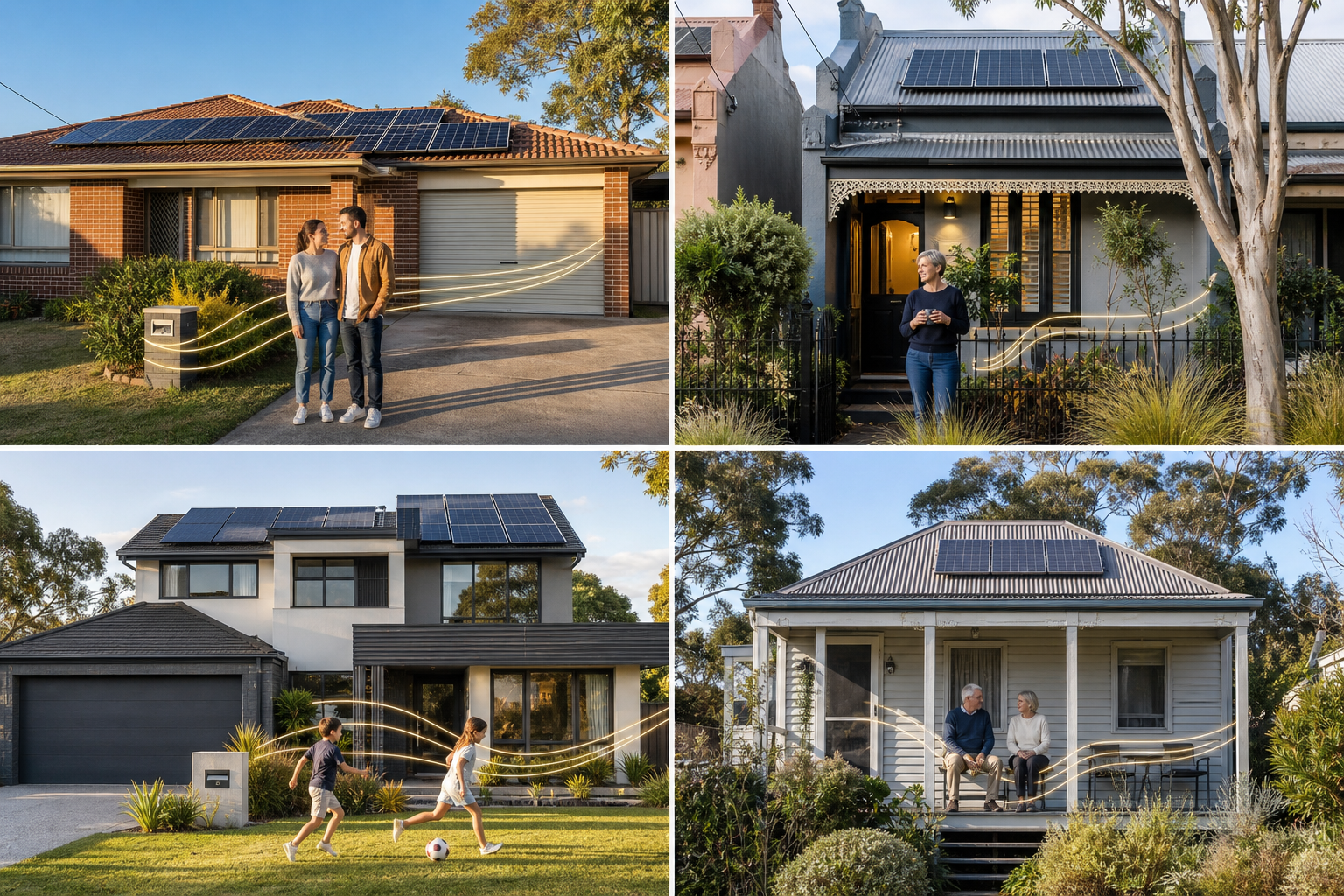
Before you dive in, it’s worth knowing what a system actually costs. A quality 6.6 kW solar system typically runs $5,000–$9,000 after STCs, and adding a 10–13 kWh battery lifts the total to around $14,000–$22,000. You can sanity‑check your quotes against the numbers in /insights/solar-battery-system-real-cost-australia-2026.
Case study 1: Young family, refinance plus solar top‑up
Profile
- Couple with one child, PAYG
- Household after‑tax income: $9,000 per month
- Existing P&I home loan: $640,000 over 25 years, 6.3%
- Current repayment: ~ $4,200/month
They want a 6.6 kW system plus 10 kWh battery for $18,000 after rebates. Installer suggests adding it to the home loan over 25 years.
Safe structure
They refinance to a sharper rate and add a separate 10‑year P&I split for solar and battery:
- Repriced main loan: $640,000 at 5.9%, 25 years → ~ $4,120/month
- New solar split: $18,000 at 5.9%, 10 years → ~ $200/month
- Total new repayments: ~$4,320/month
Stress‑tested at 3% higher (8.9%):
- Combined repayment estimate: ~ $5,500/month
- As a share of income: ~61% of $9,000 → too high
They decide to pay an extra $400/month now while rates are lower to crush the solar split in ~4 years. On that path, even at 8.9% in future the repayment share drops back towards the safer 30–35% band.
Why it works
- Solar kept in a short 10‑year split, not buried in a 25–30 year loan.
- They overpay while rates are lower to protect future cashflow.
- They check that even at +3% rates they can still live, not just scrape by.
The strategy continues below
You've seen the problem and the groundwork — now unlock the exact steps our CPA-certified brokers use, including 5 more sections. Enter your email for instant, free full access.
Free access. No spam — unsubscribe anytime. Your details stay confidential.
Frequently asked questions
Talk to a CPA-certified broker
Free consultation, plain-English advice tailored to your situation.