
Article
What Solar System Really Costs You – And How Much To Borrow
A plain‑English 2026 guide to solar system and battery costs in Australia, how to read quotes properly, and how to budget before you borrow or refinance.
Key Takeaway
This article explains what solar and battery systems typically cost in Australia in 2026 and how to budget before borrowing to pay for them. It outlines indicative price ranges (around $4,000–$8,000 for a 6.6 kW system and $8,000–$16,000 for a 10–13 kWh battery), key drivers of cost, and how to model repayments versus bill savings. It concludes with practical steps to compare quotes, stress‑test cashflow, and align any borrowing term with system life.
This topic is covered in full on Tailored Loans Sydney
A plain‑English 2026 guide to solar system and battery costs in Australia, how to read quotes properly, and how to budget before you borrow or refinance.
Read the full guide on tailoredloans.sydneySolar power can absolutely cut your electricity bills – but the system price, batteries, and the wrong loan structure can quietly erase a lot of that benefit.
This guide walks through what solar and batteries typically cost in Australia in 2026, what drives those costs, and how to budget before you borrow or refinance. By the end, you’ll know how much solar you can reasonably afford, what a fair quote looks like, and how to line it up with your household or business cashflow.
Quick answer: In 2026, a quality rooftop solar system for a typical Australian home usually costs around $4,000–$8,000 for ~6.6 kW and $6,000–$11,000 for 8–10 kW after STC incentives. Adding a 10–13 kWh battery typically adds $8,000–$16,000 installed. Before you borrow, you should:
- Get at least three comparable quotes.
- Map repayments (at realistic mortgage or personal loan rates) against bill savings.
- Keep the loan term close to the system’s useful life.
1. What a solar system really costs in Australia in 2026
1.1 Typical price ranges (panels only)
Indicative post‑rebate costs for common residential systems in 2026 (good‑quality gear, not the cheapest on the internet):
| System size (kW) | Typical roof type | Indicative post‑STC cost* |
|---|---|---|
| 3–4 kW | Small homes / units | $3,000 – $5,000 |
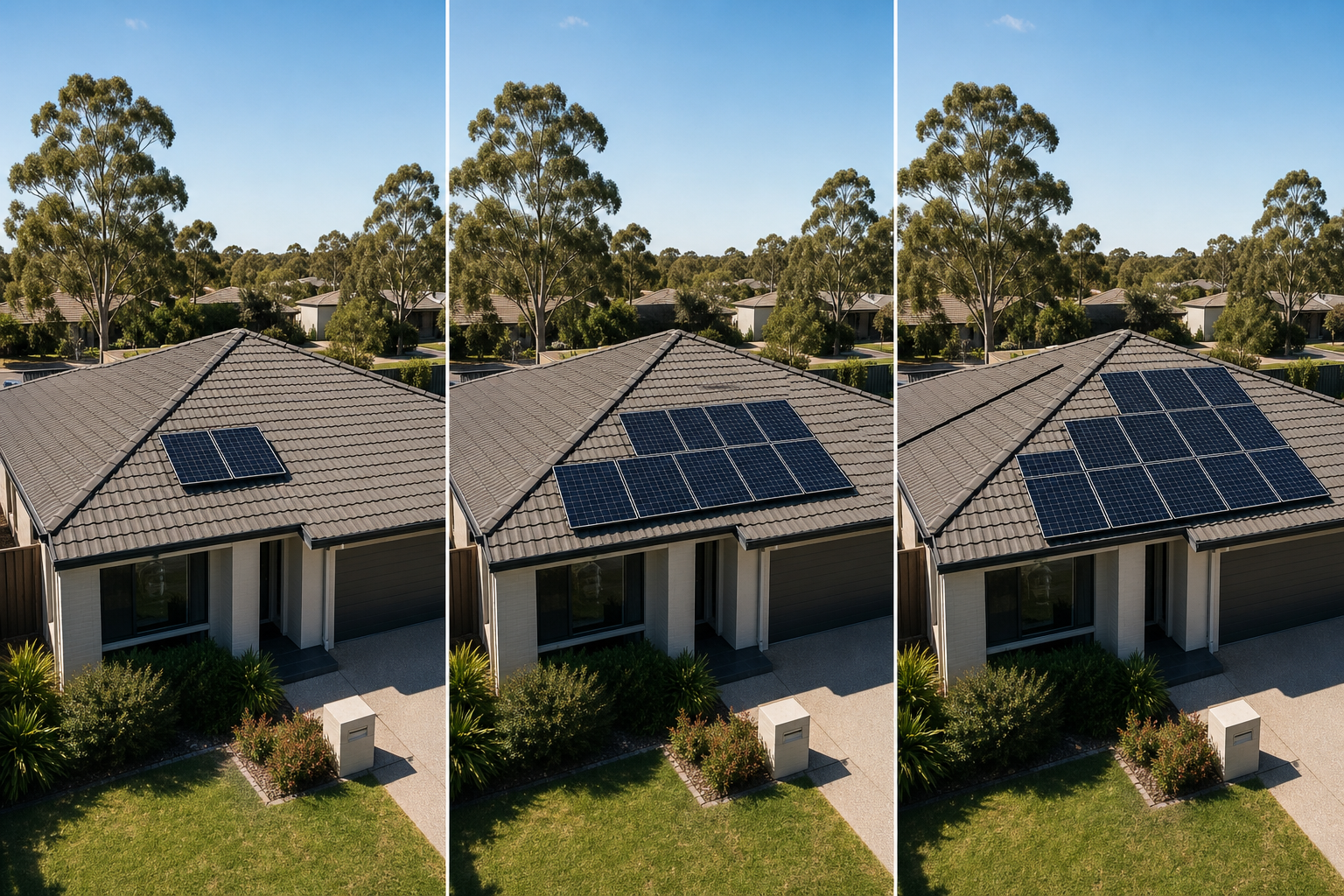
| 6–6.6 kW | Average suburban home | $4,000 – $8,000 |
| 8–10 kW | Larger homes, EV charging | $6,000 – $11,000 |
| 15–20 kW | Small business rooftop | $12,000 – $25,000+ |
*STC = Small‑scale Technology Certificates. These are effectively an upfront discount based on expected generation. Actual prices vary by state, installer and component brands.
Very cheap deals outside these bands are often cutting corners: lower‑quality panels or inverters, minimal warranties, rushed installs, or aggressive finance attached.
1.2 Battery price guide
In 2026, home batteries are still the expensive part of the equation. Broadly:
| Battery usable capacity | Typical use case | Indicative installed cost* |
|---|---|---|
| 6–8 kWh | Small/average home, partial backup | $6,000 – $10,000 |
| 10–13 kWh | Average family home, evening load | $8,000 – $16,000 |
| 13–20 kWh+ | Large homes, high usage / EVs | $13,000 – $25,000+ |
*Includes battery, hybrid inverter or additional inverter hardware, wiring, and typical installation.
Batteries can make sense, but their payback is usually longer than panels alone unless you:
- Have high evening usage
- Are on a time‑of‑use tariff with big peak charges
- Want backup for frequent outages
1.3 Commercial / small business systems
For small businesses, price per kW can be similar or slightly lower than residential for larger systems, but:
- Structural assessments, switchboard upgrades and access machinery can add thousands.
- Finance structures are more varied (chattel mortgage, lease, PPA, green loans).
A typical small‑to‑medium business might look at:
- 10–30 kW roof system: roughly $12,000–$40,000
- 30–100 kW: $40,000–$140,000+, with more engineering and grid approvals
If you’re weighing equipment or fit‑out finance for solar alongside other assets, it’s worth understanding how lenders look at business assets generally – see our guide on how business equipment finance works in Australia.
2. Why quotes vary so much – and what actually drives cost
Not all 6.6 kW systems are equal. Five main drivers explain most price differences.
2.1 Panel and inverter quality
- Tier‑1 panels vs generic brands: Better‑known brands cost more but usually offer more stable output and longer product warranties (20–25 years vs 10–12 years).
- Inverter type and brand: A high‑quality string inverter or reputable microinverter system will cost more upfront but is the heart of the system.
A “cheap” 6.6 kW quote might be $4,000; a high‑end equivalent might be $7,000–$8,000. Over 20 years, that extra $3,000–$4,000 can easily be worth it in output and lower failure risk, especially if you’re borrowing over time.
2.2 Roof complexity and site costs
Expect higher costs if:
- Your roof is steep, high, multi‑storey, or has limited access
- Switchboard or meter upgrades are required
- There’s asbestos, old wiring or structural work
A simple single‑storey tin‑roof install can be $1,000–$2,000 cheaper than a complex, multi‑storey tile roof with switchboard works.
2.3 Size of system
There are economies of scale. The jump in cost from 3 kW to 6.6 kW is not double – the scaffolding, labour and much of the wiring are already there. Often, you’re paying mostly for extra panels.
If your roof and meter can handle it, stretching to a slightly larger system can improve value per kW, provided your usage or future EV plans justify it.
2.4 Warranties, after‑sales and installer quality
Good installers price in:
- Design time
- Quality mounting hardware
- Commissioning and monitoring setup
- Future call‑backs and service
You’re paying partly for who will pick up the phone if something fails in year 8.
2.5 Finance and sales channel
This is where busy people often get stung.
- “Interest‑free” deals often hide merchant fees of 15–25% baked into the system price.
- High‑pressure sales (“sign tonight and we’ll throw in a battery”) usually mean a margin is hiding somewhere.
Always ask for a cash‑price quote without bundled finance. If they can’t or won’t give it to you, treat that as a red flag.

3. How to read a solar quote properly
A decision‑grade quote should be clear enough that you could hand it to a second installer and they’d know exactly what’s being supplied.
3.1 Essentials your quote should include
Check for:
- Panel brand and model, total kW
- Inverter brand and model (or microinverter brand per panel)
- Mounting system brand
- Layout or design summary (roof orientation, number of panels per string)
- Estimated annual generation (kWh) and assumptions used
- All site costs: switchboard upgrade, meter changes, cabling runs, scaffolding
- Grid connection fees or charges
- Warranties: product, performance, and installation
- Finance terms – interest rate, fees, payment term, who the lender is (if finance is included)
If any of these are missing, ask for them in writing before signing.
3.2 Comparing quotes fairly
When you’ve got 2–3 quotes, put them side‑by‑side on a few key metrics.
| Factor | Quote A | Quote B | Quote C |
|---|---|---|---|
| System size (kW) | 6.6 kW | 8.2 kW | 6.6 kW |
| Panels (brand/model) | Brand X 415 W | Brand Y 410 W | Brand Z 440 W |
| Inverter type | 5 kW string inverter | 6 kW string inverter | Microinverters |
| Estimated annual output | 9,500 kWh | 11,000 kWh | 9,200 kWh |
| Total price (post‑STC) | $5,200 | $6,800 | $7,900 |
| Price per kW | $788 | $829 | $1,197 |
| Product warranty (panels) | 15 years | 25 years | 25 years |
| Inverter warranty | 10 years | 10 years | 15 years |
| Installation warranty | 5 years | 10 years | 10 years |
Often the “cheapest” quote is also:
- Using less efficient panels
- Offering shorter warranties
- Estimating unrealistically high output
Look at price per kW, warranties, and expected output, not just the total.
3.3 Red flags in a quote
Be cautious if you see:
- Big promises like “$0 bills” without detailed modelling
- Vague brand descriptions (“premium panels” but no model number)
- No mention of roof or switchboard condition
- Finance that is only described as “interest‑free” or “$X per week” with no APR
If you’re also thinking of paying via your home loan, pair this quote review with our practical guide on using your home loan to pay for solar.
The strategy continues below
You've seen the problem and the groundwork — now unlock the exact steps our CPA-certified brokers use, including 6 more sections. Enter your email for instant, free full access.
Free access. No spam — unsubscribe anytime. Your details stay confidential.
Frequently asked questions
Talk to a CPA-certified broker
Free consultation, plain-English advice tailored to your situation.