
Article
How a Sydney First‑Home Buyer Safely Settled a High‑Rise Off‑the‑Plan Unit
A detailed case study of a Sydney professional who bought a high‑rise off‑the‑plan apartment and settled safely. We walk through the numbers, lender hurdles, valuation risk, FHBG/FHSS strategy and what they did in each stage so you can copy the playbook this week.
Key Takeaway
This article explains how a Sydney first‑home buyer safely settled a high‑rise off‑the‑plan apartment by planning around lender policy changes, valuation risk, and government scheme timing from day one. It shows an $820,000 unit example, where a 5% valuation drop would have lifted the effective LVR to ~96% without extra savings. The case study ends with a practical one‑week action plan so readers can copy the same buffer, structure, and timeline strategy before committing to an off‑the‑plan purchase.

This topic is covered in full on Tailored Loans Sydney
A detailed case study of a Sydney professional who bought a high‑rise off‑the‑plan apartment and settled safely. We walk through the numbers, lender hurdles, valuation risk, FHBG/FHSS strategy and what they did in each stage so you can copy the playbook this week.
Read the full guide on tailoredloans.sydneyBuying a high‑rise off‑the‑plan apartment as a first‑home buyer in Sydney is doable and can be safe – but only if you plan for settlement risk, not just the deposit.
In this case study, we follow a late‑20s professional who bought a high‑rise off‑the‑plan unit in inner Sydney and settled without drama, even after interest rate rises and tighter credit rules. You’ll see the numbers, the lender rules for high‑density buildings, how we stacked first‑home schemes, and the exact steps taken at each stage – so you can decide what to do this week on your own purchase.
1. The buyer, the property and the problem we had to solve
1.1 Who this case study is based on
This is a composite case study based on several real clients – all first‑home buyers purchasing high‑rise, off‑the‑plan apartments in inner Sydney between 2022–2025.
We’ll call our buyer Sarah:
- 29‑year‑old professional working in North Sydney’s finance/IT corridor
- PAYG income: $115,000 + super
- Stable role in a large employer (reflecting North Sydney and City of Sydney’s high‑income, service‑sector job base)
- Genuine savings: ~ $80,000
- No other debts except a HELP balance of ~$12,000
Goal: Buy and move into her own place within 2–3 years, close to the CBD, with a train line nearby, and keep enough buffer to avoid joining the roughly 28.2% of mortgage holders currently ‘At Risk’ of mortgage stress in Australia (Roy Morgan, 2026).
1.2 The property: high‑rise off‑the‑plan in inner Sydney
Sarah targeted a major new high‑rise project in an inner‑Sydney precinct – think Green Square / Mascot / inner‑south style density, with strong transport links and lots of recent apartment supply.
- Property: 1‑bed + study, 55 m² internal, 8 m² balcony
- Level: 15 in a 28‑storey tower (high‑density category for most lenders)
- Contract price: $820,000
- Car space + storage included
- Expected completion: 24–30 months from exchange
High‑density, smallish apartments like this sit in the ‘non‑standard’ lending bucket. Lenders often treat them similarly to the properties covered in:
- Financing High‑Density, Small and Studio Apartments Without Nasty Surprises
- Borrowing for Small Strata, Studios and Company Title Units in Sydney’s East
That means stricter LVR caps, postcode risk flags and tighter valuations.
1.3 The core problem
Sarah could afford the holding cost at current rates. The real risk was settlement in two years’ time:
- Would the final valuation match the contract price?
- Would lender policies on high‑rise units tighten in the meantime?
- Would she still qualify for schemes like the First Home Guarantee (FHBG) or state stamp duty concessions?
We had to design a strategy that would still work if:
- values dropped 5–10%
- interest rates rose another 1–2%
- lender LVR caps on high‑density apartments tightened
2. The finance brief: what ‘success’ looked like
2.1 Sarah’s requirements
Sarah came in with a clear brief:
- Use government schemes if possible, but not at the cost of safety
- Minimum deposit: 10% if viable, to keep time in the market
- Avoid family guarantees – she wanted to stand on her own
- Keep future repayments comfortably under 30–35% of take‑home pay, modelled at rates at least 3% above current (consistent with APRA’s serviceability buffer and our own guidance from multiple previous analyses)
2.2 Our risk lens as a CPA + Tax Agent + Broker
Looking through a combined tax + cashflow + credit lens, we framed success as:
- Settlement certainty – no last‑minute scramble if valuations or policies changed.
- Cash buffer – at least 6 months of living costs and loan repayments after settlement.
- Scheme timing – using FHBG/FHSS/state concessions only if they truly improved Sarah’s position.
- Future flexibility – ability to keep the unit later as an investment if she decided to upgrade, similar to the strategy in How a Bondi Couple Upgraded Homes Without Selling Their Unit First.
3. Stage 1 – Pre‑contract: can she safely sign?

Before Sarah paid a holding deposit, we ran three workstreams: borrowing capacity, scheme options, and settlement risk.
3.1 Borrowing capacity and safe limit
Indicative market ranges at the time (illustrative only):
- Owner‑occupier variable P&I rates: 5.8–6.3% p.a.
- Assessment rate after APRA buffer (approx.): 8.8–9.3% p.a.
We modelled three scenarios on an $820,000 purchase.
Table 1 – Borrowing and repayment scenarios (illustrative only)
| Scenario | Purchase price | Deposit | Loan amount | Rate (actual) | P&I repayment (30 yrs) | % of take‑home (approx.) |
|---|---|---|---|---|---|---|
| A – 20% deposit | $820,000 | $164,000 | $656,000 | 6.0% | ~$3,930/month | ~29% |
| B – 15% deposit | $820,000 | $123,000 | $697,000 | 6.0% + LMI | ~$4,180/month | ~31% |
| C – 10% deposit (with FHBG) | $820,000 | $82,000 | $738,000 | 6.0% | ~$4,430/month | ~33% |
Assumptions:
- After‑tax income: ~$8,800/month (single, no kids, standard tax tables)
- No other major debts
- Repayment estimates rounded
At scenario C, even with a 10% deposit, repayments sat around the 30–35% of after‑tax income band that we treat as a practical ceiling (see facts 1, 3, 14, 20 in the knowledge base).
Sarah could pass lender servicing calculators well above this level, but we recommended treating Scenario B as the ‘comfort ceiling’ and Scenario C as the absolute maximum she’d stretch to.
3.2 Scheme strategy: FHBG, FHSS and state concessions
We mapped the rules from:
Key points for Sarah’s situation:
-
FHBG (First Home Guarantee) could allow a 5% deposit with no LMI – but:
- property price caps and postcode rules apply
- she must move in within 12 months of settlement and live there for at least 6 months
- spots are limited and must be available at application (not just at exchange)
-
FHSS (First Home Super Saver) could release up to $50,000 of voluntary contributions if she salary‑sacrificed aggressively – but she’d only access the funds closer to settlement.
-
NSW first‑home stamp duty concessions (depending on value thresholds when she buys) could save duty or offer reduced duty if she qualified.
We designed a stacked strategy:
- Aim for 10–12% cash deposit from savings by the time of exchange.
- Consider FHBG at settlement if:
- price caps still fit, and
- lender choice wasn’t overly restricted, and
- repayment comfort tests still passed.
- Use FHSS as an optional top‑up if construction was delayed and her capacity to salary‑sacrifice increased.
3.3 Settlement risk analysis – the deal breaker
The real work was stress‑testing settlement in 2–3 years, using principles from:
- Your Finance Timeline for a Green Square Off‑the‑Plan Apartment
- Why Many Standard Pre‑Approvals Collapse on Off‑the‑Plan Settlements
We modelled a 5% valuation drop at completion:
- Contract price: $820,000
- Final valuation: $779,000 (‑5%)
If Sarah’s cash deposit at settlement was still only 10% of the contract price (~$82,000), the effective LVR against the lower valuation would jump:
- Loan needed: $738,000
- Valuation: $779,000
- Effective LVR: 94.7% (plus LMI on top)
For a high‑density postcode, many lenders would not allow >90–92% LVR. Some would cap at 80–85%.
Conclusion:
- A plan built around only 10% deposit and a ‘set and forget’ pre‑approval was too fragile.
- Sarah needed a dedicated settlement buffer, separate from her everyday emergency fund (echoing knowledge facts 16 and 11–12 on valuation and policy risk).
We set a go/no‑go rule:
Don’t sign the contract unless you can commit to savings and buffers that would let you handle a 5–10% valuation drop or a change to a stricter lender.
After running the numbers and a savings trajectory, Sarah decided the project was viable – but only with disciplined savings and a clear build‑period plan.
4. Stage 2 – Exchange and the ‘quiet’ build period
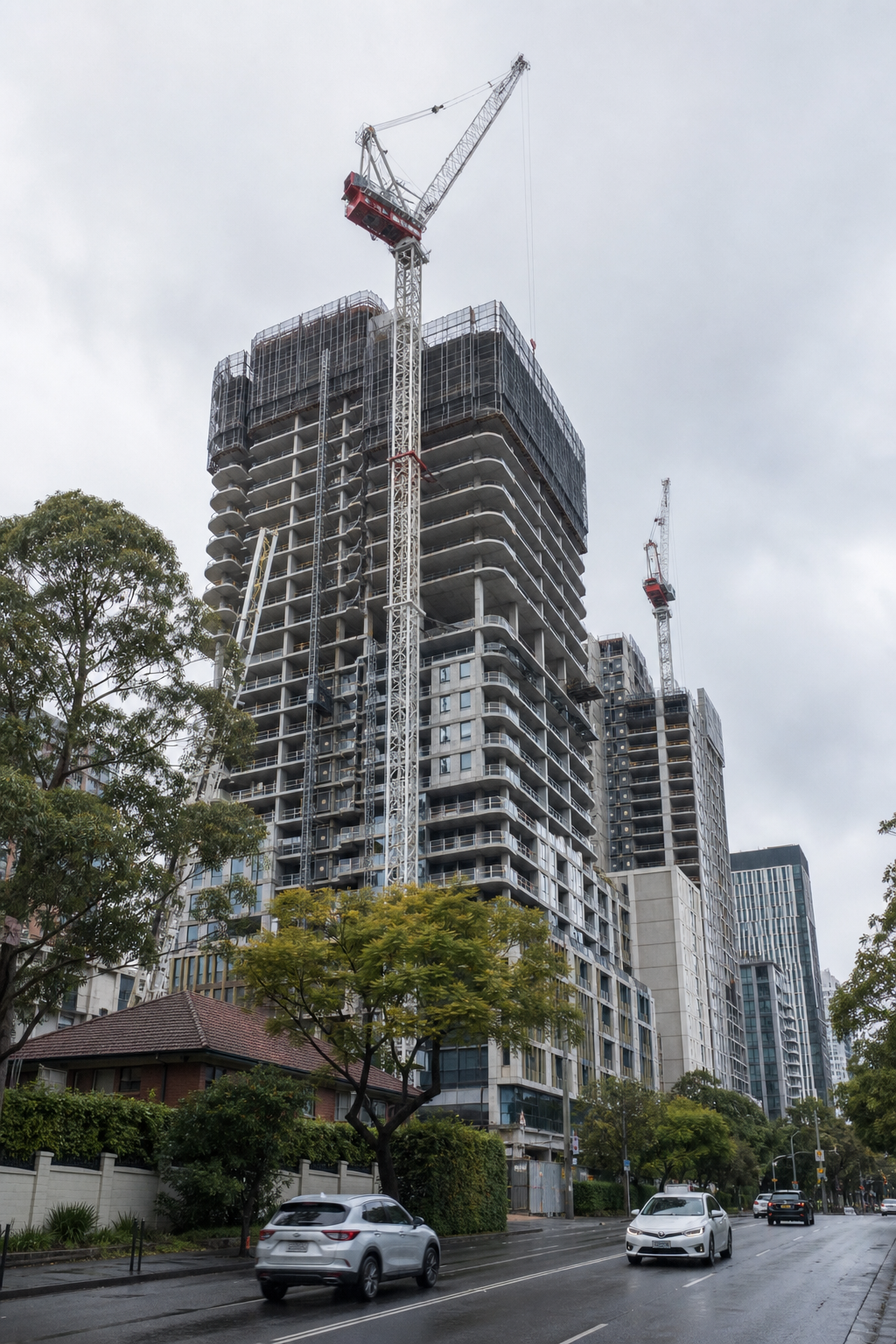
4.1 The contract and initial deposit
Sarah exchanged contracts on the $820,000 unit with:
- 10% deposit: $82,000
- Cooling‑off and contract terms reviewed by her solicitor
- Finance clause: limited, because it’s off‑the‑plan (common)
We made two critical moves at exchange:
- Reality‑checked the developer’s sunset clause and build timeline – we wanted enough time for Sarah to grow savings and possibly build FHSS contributions.
- Documented a savings schedule for the 24–30 month build period to reach at least an extra $20,000–$30,000 in cash buffers.
4.2 Why we did not rely on a long‑dated pre‑approval
Standard pre‑approvals are usually valid for 90 days. For a 2‑year build, they’re mostly false comfort.
As covered in detail in Why Many Standard Pre‑Approvals Collapse on Off‑the‑Plan Settlements:
- Lenders reassess at settlement using current policies, current income and new valuations (see knowledge fact 15).
- A pre‑approval today means little if policies on high‑density units or maximum LVRs change before completion.
We instead:
- Ran an initial servicing assessment with two different lenders to see policy diversity, especially around high‑density postcodes.
- Identified one conservative lender with stricter policy and one slightly more flexible lender as a backup.
Then we did not lock Sarah into a long‑dated pre‑approval. Instead, we:
- Kept her financials clean (no new consumer debt, no BNPL, no car loans).
- Reviewed her position every 6–9 months through the build.
4.3 Cashflow, savings, and scheme positioning during the build
Over the 24‑month build, Sarah:
- Increased savings by an average of $1,500 per month, adding roughly $36,000 to her buffer.
- Kept at least 3 months of core expenses in a separate emergency account.
- Made voluntary super contributions of $500/month to consider FHSS later, without relying on it.
By 18 months into the build, Sarah’s position looked like this:
- Initial deposit paid: $82,000
- Additional savings: ~$30,000 (after some moving costs and minor lifestyle upgrades)
- FHSS‑eligible contributions: ~$9,000 (voluntary)
This created three layers of protection for settlement:
- Core buffer – emergency savings untouched by property.
- Settlement buffer – extra $20–25k available if valuation or policy risk hit.
- Optional FHSS drawdown – a lever to pull only if needed, after checking tax and scheme rules.
 Careful planning meant settlement and the first year of repayments were manageable. As per Your Finance Timeline for a Green Square Off‑the‑Plan Apartment, the 6–3 month window before expected completion is when off‑the‑plan buyers must stop cruising and start executing. ### 5.1 Order an upfront valuation where possible Around 6 months out, the developer signalled that completion was on track. We: 1. Requested an upfront valuation from a lender whose high‑density policies we liked. 2. Checked there were no known **postcode…
The strategy continues below
You've seen the problem and the groundwork — now unlock the exact steps our CPA-certified brokers use, including 8 more sections. Enter your email for instant, free full access.
Free access. No spam — unsubscribe anytime. Your details stay confidential.
Frequently asked questions
Talk to a CPA-certified broker
Free consultation, plain-English advice tailored to your situation.