
Article
Choosing Between a Construction Loan and Equity Top-Up in Bronte
Planning a Bronte knockdown‑rebuild? This guide walks through when to use a construction loan, when an equity top‑up might be enough, and how to structure your finance so buffers, tax and cashflow still work in real life.
Key Takeaway
For a Bronte knockdown‑rebuild, the choice between a construction loan and an equity top-up depends on project size, equity, risk appetite and timing, with most full rebuilds favouring a construction loan due to staged progress payments and lender oversight. APRA’s 3% serviceability buffer and typical 80% LVR limits mean many Eastern Suburbs households need both existing equity and careful staging of valuations. The most robust strategy is often a hybrid structure with separate loan splits and 6–12 months of cash buffers in offset.
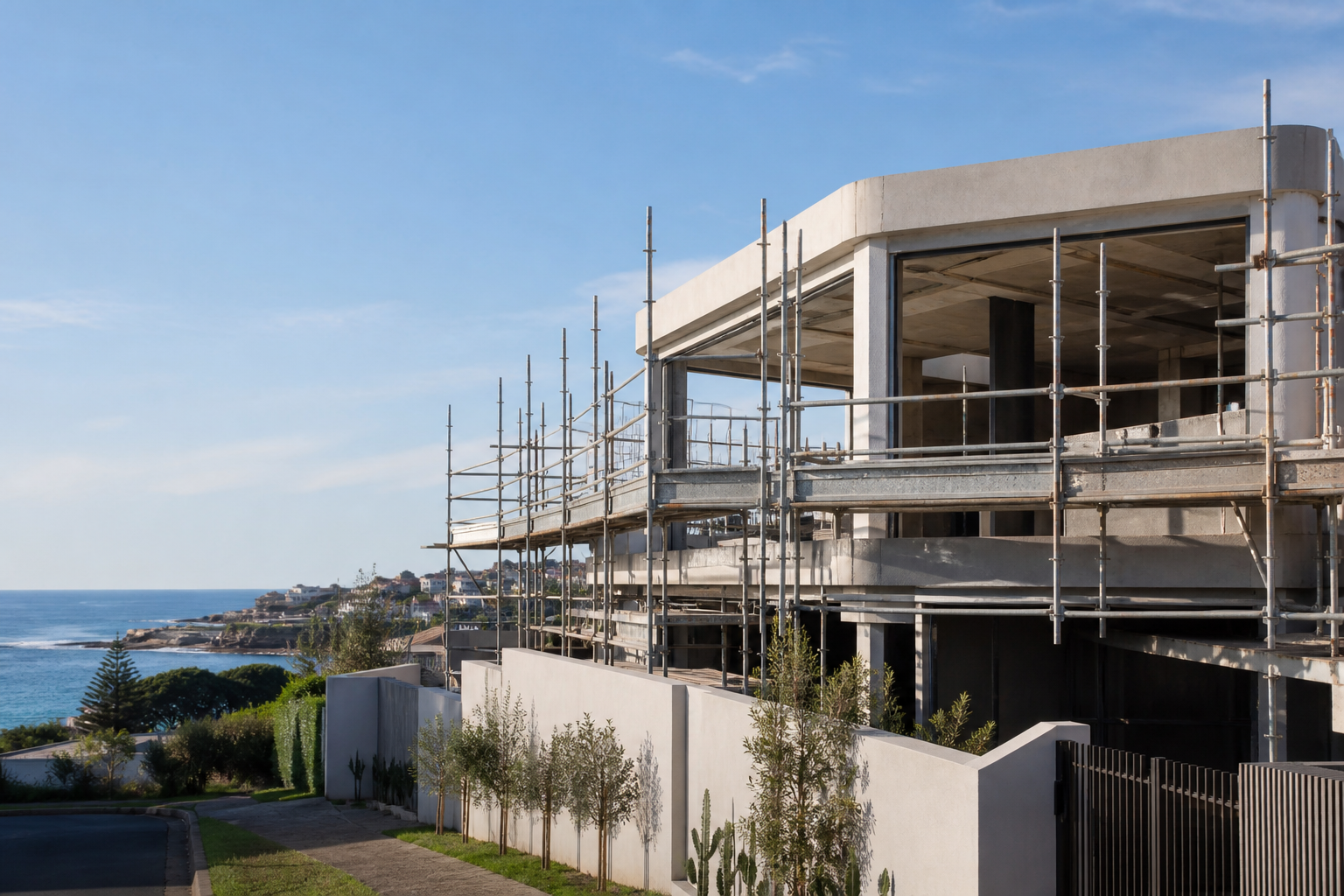
Planning to knock down and rebuild in Bronte but not sure whether you need a construction loan or just an equity top‑up?
For a full Bronte knockdown‑rebuild, you usually choose between: (1) a construction loan, where the bank funds your builder via progress payments against a fixed‑price contract; or (2) an equity top‑up, where you increase or refinance your home loan and manage payments to the builder yourself. The right choice turns on project size, equity, cashflow risk and how tightly you want the bank monitoring the build.
This guide is designed so you can make a decision this week, then talk to your broker, builder and accountant with a clear plan.
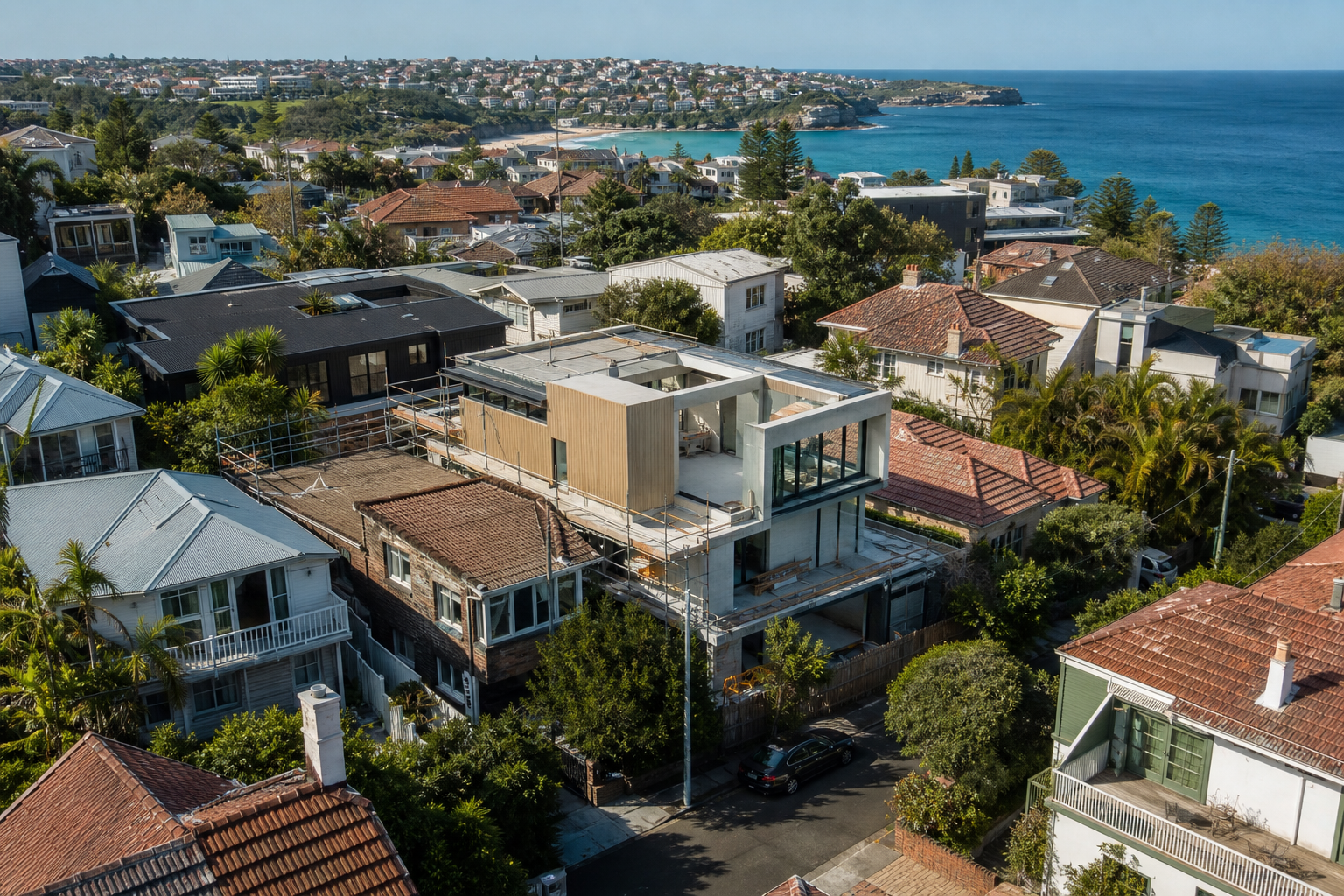
1. Bronte knockdown‑rebuild basics: what are you actually funding?
A Bronte knockdown‑rebuild is usually a two‑stage finance problem:
- Land value – what your current block is worth as‑is (often $3m+ in today’s Bronte market).
- Build cost – the fixed‑price building contract plus contingencies (often $1.2m–$2.5m+ for a high‑spec family home).
The bank cares about both:
- The total completed value ("on‑completion valuation").
- Your loan‑to‑value ratio (LVR) – ideally ≤80% to avoid or minimise Lenders Mortgage Insurance (LMI).
- Your capacity to repay under APRA’s ~3% serviceability buffer (they test repayments at a rate around 3% higher than today’s actual rate).
For many Bronte owners, the question is not “Can I borrow at all?” but “How do I structure this safely and tax‑effectively without nuking my buffers?”
If you’re still deciding between Bronte and other Eastern Suburbs locations, it’s worth reading how staging and structure work on premium sites in How to Finance a Knockdown‑Rebuild on a Premium Eastern Suburbs Block as a companion piece.
2. Construction loan vs equity top‑up: clear definitions
2.1 What is a construction loan?
A construction loan is a home loan specifically designed for building or major structural works. Key features:
- The bank uses a fixed‑price building contract and plans to assess the project.
- Funds are released in progress payments (slab, frame, lock‑up, fit‑out, completion).
- You usually pay interest only on the amount drawn during construction.
- The lender may do progress inspections/valuations before each draw.
You can use a construction loan for:
- A full knockdown‑rebuild on your existing Bronte home.
- Building a new home on a recently purchased vacant block.
2.2 What is an equity top‑up?
An equity top‑up is when you increase an existing home loan or refinance to a higher loan balance to release cash. Features:
- The bank lends up to a percentage of your property’s current value (often up to 80% LVR without LMI).
- You receive the extra borrowed funds as cash at settlement, usually into your offset account.
- You then pay the builder directly from your own funds.
Equity top‑ups (or equity release splits) are common for:
- Smaller renovations and extensions.
- Medium projects where you have very strong equity and income.
- Funding finishes, landscaping and contingencies alongside a construction loan.
For a good overview of equity release safety, see Safely Using Eastern Suburbs Home Equity for Reno, Investment and Buffers.
3. Side‑by‑side: construction loan vs equity top‑up in Bronte
3.1 Comparison table
| Feature | Construction loan | Equity top‑up / equity release |
|---|---|---|
| Best for | Full knockdown‑rebuild with fixed‑price contract | Smaller or medium projects, or topping up buffers |
| How funds are released | Progress payments direct to builder | Lump sum to you, you pay builder |
| Bank monitoring | High – plans, contract, inspections, valuations | Lower – mainly upfront valuation and checks |
| Interest during build | Interest only on drawn balance | Full interest on total top‑up from day one |
| Valuation basis | Land now + completed value | Current value only (unless post‑reno reval later) |
| Admin and paperwork | Higher – DA, plans, fixed‑price contract required | Lower – standard refinance/top‑up process |
| Flexibility to change scope | Low – changes require variations, may affect loan | Higher – you control payments and variations |
| Risk control if builder fails | Better – staged payments and valuations | You carry more risk and need tighter oversight |
3.2 A worked Bronte example
Let’s assume:
- Current Bronte home (older dwelling, great position) value: $3.2m.
- Existing home loan: $1.4m (LVR ~44%).
- Proposed fixed‑price build contract: $1.6m.
- Expected completed value: $4.6m.
Option A – Full construction loan
- Target LVR on completion: 80% of $4.6m = $3.68m maximum total lending.
- Existing loan: $1.4m.
- Maximum potential construction facility: $3.68m – $1.4m = $2.28m (well above the $1.6m build, so serviceability and lender policies will be the real guardrails).
During the build:
- You only draw the construction loan as invoices come in.
- If after slab and frame you’ve drawn $800k at 7% p.a., interest is about $4,667 per month on that drawn amount, not on the full $1.6m.
Option B – Equity top‑up only
Suppose you refinance and release equity without a construction facility:
- Target LVR: 80% of current $3.2m value = $2.56m.
- Existing loan: $1.4m.
- Usable equity top‑up: $1.16m.
You still need $1.6m for the build, so you’d have a $440k gap to cover from savings or other sources. Meanwhile, you’re paying full interest on the entire extra $1.16m from day one, even if the builder has barely started.
Outcome: for a full knockdown‑rebuild at these numbers, an equity top‑up on its own is rarely enough. Most Bronte families end up with either a construction loan, or a hybrid (some equity release plus a smaller construction facility).

The strategy continues below
You've seen the problem and the groundwork — now unlock the exact steps our CPA-certified brokers use, including 8 more sections. Enter your email for instant, free full access.
Free access. No spam — unsubscribe anytime. Your details stay confidential.
Frequently asked questions
Talk to a CPA-certified broker
Free consultation, plain-English advice tailored to your situation.