
Loading the latest on mortgages, RBA & inflation…
Local Knowledge Finance

Article

From Dover Heights Apartment to House: Borrowing Limits and Risks

Thinking about stretching from an apartment to a house in Dover Heights? This guide walks through realistic borrowing limits, local price dynamics, risk traps and one‑week actions so you can upgrade without putting your family or business under unsafe pressure.

Published 22 July 2026Updated 22 July 202611 min read

Key Takeaway

This guide explains how much borrowers can realistically stretch when upgrading from an apartment to a house in Dover Heights, focusing on borrowing limits under APRA’s 3% serviceability buffer and local high-price dynamics. It breaks down lender calculators, equity and deposit requirements, and uses numeric examples to show safe versus risky repayment levels relative to income. Readers learn how to stress-test their upgrade plan, avoid mortgage stress risk, and design a one-week action plan with buffers in place.

From Dover Heights Apartment to House: Borrowing Limits and Risks

Thinking about stretching from a Dover Heights apartment to a house? In practice, the decision comes down to two numbers: how much a lender will let you borrow, and how much you can safely afford without putting your family or business under stress.

In this guide we’ll walk through realistic Dover Heights upgrade pathways, how banks set your borrowing limit (and why that’s not the same as a safe limit), plus the key risks to watch before you sign a contract.


1. What changes when you go from unit to house in Dover Heights?

Moving from an apartment to a house in Dover Heights isn’t a normal upgrade. You’re dealing with:

  1. High entry price for freestanding homes and larger semis.
  2. Big jumps in land value, not just dwelling value.
  3. More volatile valuations – a few recent prestige sales can skew price expectations.
  4. Higher running costs – rates, insurance, maintenance and renovations.

In Woollahra LGA (which includes Dover Heights), the 2021 Census shows a median weekly mortgage repayment of $900, versus $560 for Greater Sydney. That gap has likely widened with recent rate rises, so you need to assume your post-upgrade repayments will be at the top end of Sydney norms.
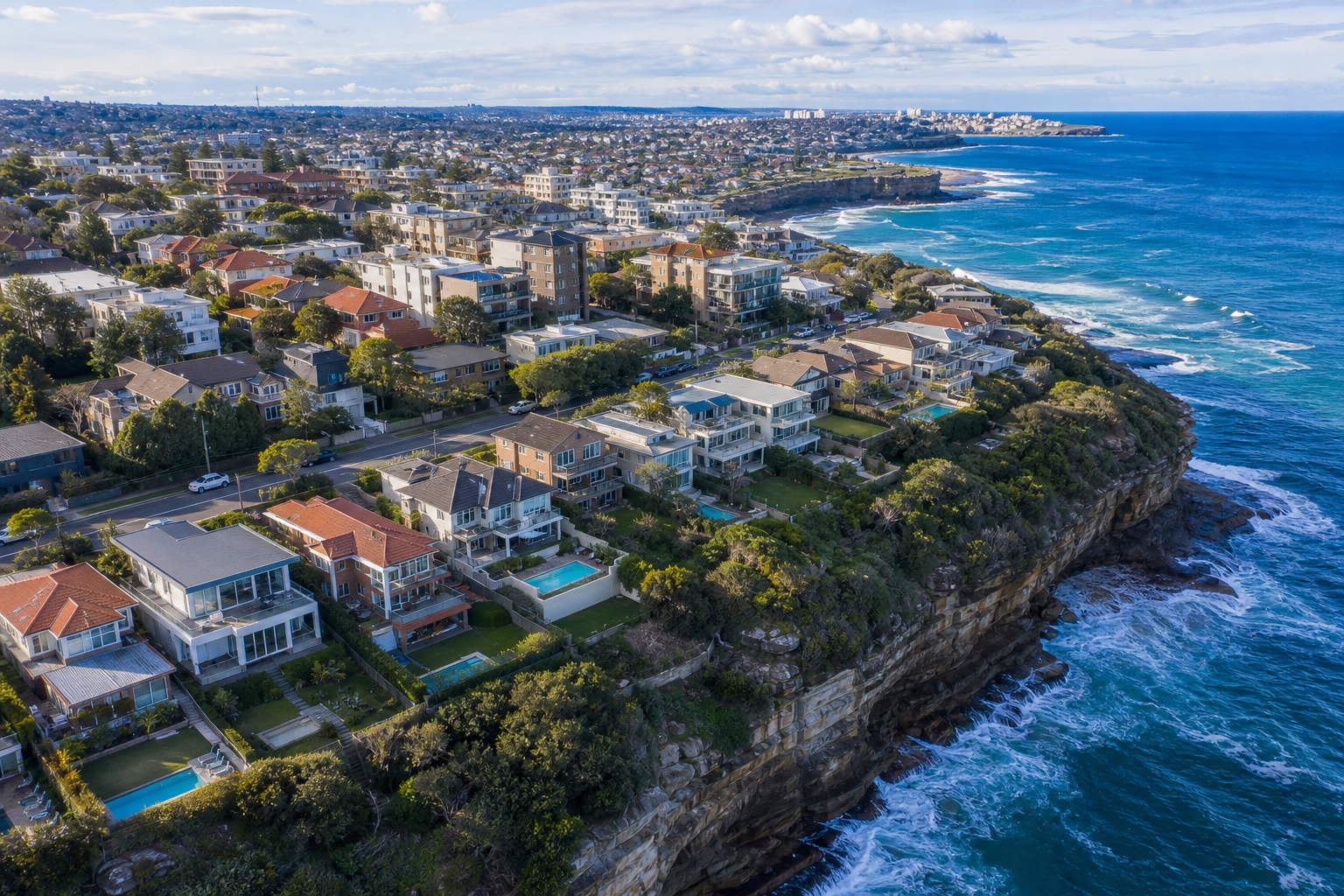
Apartments and houses in Dover Heights from above Dover Heights has a sharp price jump between apartments and houses driven by land value.

Typical Dover Heights upgrader profile

Most people we see upgrading in Dover Heights fall into one of these camps:

  • Professionals with strong household income stepping up from a Bondi/Rose Bay/Mascot unit.
  • Existing Dover Heights or nearby owners moving from a smaller apartment or semi to a family house.
  • Self-employed or business owners juggling company, trust and sometimes SMSF structures.

If you haven’t already, it’s worth reading the broader strategy piece, “Blueprints for First and Next Homes in Dover Heights” (your parent topic), and also how similar upgrades work in nearby markets: /insights/upgrading-within-into-mascot-unit-to-bigger-home.


2. How banks calculate borrowing limits for a Dover Heights upgrade

2.1 Key moving parts in your borrowing power

Every mainstream lender will look at roughly the same inputs when you apply to upgrade:

  • Income – salary, bonuses, rental income, business profits, distributions.
  • Employment type – PAYG vs self-employed, and stability.
  • Existing debts – home loans, HECS/HELP, car loans, credit cards (limits, not just balances).
  • Living expenses – compared to HEM benchmarks.
  • Proposed loan size and rate.

By APRA guidance, lenders must stress-test repayments at least 3% above the actual interest rate.[10,14] So even if you expect to pay around 6.5% today, your borrowing capacity is tested at ~9.5%.

For self-employed borrowers, lenders may also use alt-doc methods using bank statements and BAS, often with slightly higher rates and lower maximum LVRs. See: /insights/bank-statement-bas-home-loans-alt-doc-income-assessment.

2.2 Why the bank’s maximum is not your safe maximum

Roy Morgan’s research on mortgage stress shows around 28.2% of Australian mortgage holders were ‘At Risk’ in the three months to April 2026, and that proportion rises sharply as repayments consume more of after-tax income.

From our Eastern Suburbs work, a practical ceiling is to keep total home and investment loan repayments below roughly 30–35% of net income.[16]

Banks will often approve loans where stressed-test repayments chew up more than this. So you should treat the bank’s approval as the outer boundary, not the target.


3. Worked example: unit to house borrowing in Dover Heights

Let’s run through a simple, realistic upgrade scenario. These are illustrative numbers only, not advice.

3.1 Starting point – current apartment

  • 2-bed apartment value: $1.6m
  • Outstanding loan: $900k (P&I, 25 years remaining)
  • Current rate: 6.3% p.a. (variable)
  • Combined after-tax household income: $260k (about $400k gross)
  • Other debts: small car loan, no credit cards.

Approximate current mortgage repayments at 6.3% over 25 years: ~$5,900 per month.

3.2 Target house and required loan

Say you’re eyeing a Dover Heights house around $4.2m.

If you sell first and clear the apartment loan:

  • Sale price (after costs): $1.55m net
  • Clear existing $900k loan → leaves $650k equity
  • Stamp duty on $4.2m (NSW, established home): ~$209k
  • Purchase and move costs: allow $40k–$60k

To keep LVR at 80% on the new home (to avoid LMI):

  • Max 80% loan: $3.36m
  • Required total funds: $4.2m + $209k + say $50k ≈ $4.459m
  • Your equity contribution: $4.459m – $3.36m = $1.099m

You only have $650k from the unit sale, so you’re short roughly $450k.

To bridge that gap you could:

  1. Accept LMI and borrow above 80% LVR (if a lender will do it at these numbers), or
  2. Lower the purchase price, or
  3. Bring in family help (gift, loan or guarantee), or
  4. Keep leveraging existing or other assets.

3.3 What do repayments look like?

Assume you do manage to buy at $4.2m with a $3.55m loan (around 85% LVR plus costs funded with equity/family help) over 30 years at 6.5% p.a.

  • Monthly P&I repayments ≈ $22,400

On $260k net income (~$21,700 per month), that’s already over 100% of your take-home pay. Completely unworkable – the numbers simply don’t clear.

Even if your net household income is $350k (~$28,500 per month), repayments of $22,400 would be ~79% of net income, far beyond sensible limits and into what Roy Morgan classes as ‘Extremely At Risk’ territory for many households.

The point: for most upgraders, Dover Heights houses require either very high stable income, very large equity, or a more modest next step.


4. Safe vs risky stretching: what does “too far” look like?

4.1 Benchmarks for Dover Heights households

Using our 30–35% of net income guide for total repayments:[16]

  • On $260k net income (~$21,700 p.m.), safer repayments = $6,500–$7,600 per month.
  • On $350k net income (~$28,500 p.m.), safer repayments = $8,500–$10,000 per month.

At 6.5% p.a. over 30 years, those repayments equate to roughly:

Net household incomeSafe monthly limit (35%)Approx safe loan (6.5%, 30 yrs)
$260k$7,600~$1.2m–$1.3m
$350k$10,000~$1.6m–$1.7m
$450k$13,100~$2.1m–$2.2m

Indicative only – lenders test at ~3% higher rate and use their own calculators.

If your current apartment loan is already $900k, jumping to a $2.0m+ loan still means:

  • Repayments rising from ~$5,900 to somewhere in the $10,000–$14,000 per month range, and
  • Your household budget needing to absorb that increase plus higher living costs, rates and maintenance.

4.2 Signs you’re stretching too far

You’re likely moving into risky territory if:

  • The bank’s maximum approval is more than 20–30% above the loan size you can comfortably service when you stress-test yourself.
  • After modelling 2–3% rate rises and a 30–50% drop in business drawings for six months, you can’t maintain repayments and essential spending.[9]
  • You’d need to consolidate lots of personal or business debts into the new home loan just to make the numbers work (see /insights/consolidating-business-and-personal-debts-before-home-loan).
  • You’d be left with less than 3–6 months of total expenses in buffers (offset, savings, redraw plus unused credit lines).

For Dover Heights in particular, where price swings can be large in a downturn, going too close to your maximum borrowing capacity also exposes you to negative equity risk if values retreat.


5. Managing key risks when upgrading in Dover Heights

Couple reviewing borrowing limits for an upgrade Understanding your true borrowing limit is vital before stretching to a Dover Heights house.

5.1 Market and valuation risk

Dover Heights is a tight, high-value market. That cuts both ways:

  • Good properties hold value well over the long term.
  • Short-term prices can swing harder than broader Sydney when sentiment changes.

Key risks:

  • Overpaying at auction based on a few hot comparables.
  • Low, conservative valuations from bank panels, which may show a value below your contract price.

Practical protections:

  • Work with a broker who knows the local valuer panels and can order upfront valuations with a couple of likely lenders.[/insights/dover-heights-mortgage-broker-vs-banks-non-local]
  • Keep a valuation buffer in your plan – don’t structure a deal that only works if the valuer hits the top of the agent’s price guide.

5.2 Cashflow and mortgage stress

Roy Morgan’s ‘At Risk’ and ‘Extremely At Risk’ categories hinge on what share of your after-tax income goes to repayments.[1,4]

Before stretching, run a brutal cashflow test:

  1. Model repayments at +2–3% interest.
  2. Plug those into a budget that includes realistic Woollahra-level living costs.
  3. Add kids’ schooling, strata (if any), insurance, holidays, and a maintenance allowance.

If that test budget leaves you with less than 10–15% of income free after savings, you’re probably leaning too far out.

For more on building buffers and worst-case planning, see /insights/risk-management-buffers-worst-case-planning-broker.

5.3 Structuring risks for self-employed and investors

For business owners and investors, complexity multiplies:

  • Your income is often shaded or averaged by lenders.[10]
  • You may have personal guarantees on business debt – which means if things go wrong, lenders can chase your personal assets.[6]
  • You may also be thinking about investment property, SMSF lending and new negative gearing or CGT rules.

Safe principles:

  • Don’t drag long-term home debt into short-term business problems – keep business facilities separate.[13]
  • Use separate loan splits for home, investment and business so interest deductibility stays clean.[19]
  • Coordinate tax planning and profit distributions 12–24 months before a major upgrade.[3,5]

Our guide on blending personal, business and SMSF debt for high-end homes has more detail: [/insights/coordinating-personal-business-smsf-loans-dover-heights].

5.4 Debts, credit limits and consolidation

High-rate non-deductible debts (credit cards, personal loans) are borrowing power killers.[17]

Because lenders assess credit limits, not just balances, even unused cards drag your capacity down.[2]

Before an upgrade:

  • Reduce unnecessary card limits.
  • Pay down or close personal loans where practical.
  • If consolidating into the home loan, use a separate 3–7 year split rather than rolling them into a 30-year term, so you actually pay them off faster.[18]

Our Dover Heights–specific consolidation guide is here: [/insights/consolidating-personal-investment-debts-dover-heights-mortgage].


6. Choosing your upgrade pathway: sell first, buy first, or keep both?

Family moving into upgraded Dover Heights house A clear strategy and buffers can turn an ambitious Dover Heights upgrade into a sustainable move.

6.1 Key options

Most Dover Heights upgraders follow one of three paths (similar to Mascot upgraders, but with bigger numbers):

  1. Sell first, then buy – lower risk, clearer budget, potentially need temporary accommodation.
  2. Buy first with bridging finance – more convenience, higher short-term risk.
  3. Keep the unit as an investment and buy the house – highest leverage and risk, requires strong income.

We unpack these pathways in more detail for another suburb here: [/insights/upgrading-within-into-mascot-unit-to-bigger-home]. The same decision logic applies; only the price points change.

6.2 Sell first: safest for most Dover Heights households

Pros:

  • You know exactly how much equity you have.
  • You don’t juggle two full mortgages for long.
  • Banks like the simplicity – tends to maximise your borrowing capacity.

Cons:

  • You may need to rent or stay with family between sale and purchase.
  • Risk of market moving against you in the gap.

This usually suits:

  • Households already close to their safe borrowing limit.
  • Self-employed borrowers with lumpy cashflow.

6.3 Buy first with bridging: convenience at a price

Bridging finance allows you to buy the new Dover Heights house, then sell the apartment later.

Risks:

  • Short-term debt is calculated on your “peak debt” (old plus new property), so interest costs spike.
  • If your old property takes longer to sell or sells for less than expected, you can be left with a bigger end debt than planned.

You should model:

  • At least a 10% lower sale price for your apartment.
  • A longer-than-expected sale period.
  • Peak debt interest at 2–3% above current home loan rates.

6.4 Keeping the apartment as an investment

In theory, holding the unit as an investment while upgrading to a house sounds attractive. But in Dover Heights numbers, it’s often too much leverage unless:

  • Your household income is very high and stable.
  • The apartment has a modest remaining loan and strong rent.

If you do keep it:

  • Structure separate loan splits so you can keep track of deductible vs non-deductible interest.[19]
  • Factor in the 2026–27 reforms to negative gearing and CGT, which are tightening tax benefits for established properties.

7. One-week action plan: from vague idea to decision-ready

Many Dover Heights upgraders sit on the fence for months because the numbers are fuzzy. Here’s how to turn it into a decision you can act on this week.

7.1 Day 1–2: Clarify your brief and safe envelope

  1. Write down your non-negotiables (rooms, parking, school catchment, walkability) and your “nice-to-haves”.
  2. Calculate your after-tax income and current monthly spending.
  3. Use a simple rule: target total repayments ≤30–35% of net income as your safe limit.[16]
  4. Convert that repayment into a rough maximum loan using a calculator at 6.5–7.0% p.a.

7.2 Day 3–4: Get a proper borrowing and risk assessment

Book a session with a broker who understands both residential and business lending.

You want:

  • A full borrowing capacity assessment under multiple lenders.
  • A stress-tested safe limit, not just the bank’s maximum.
  • Upfront valuations on your current property if possible.
  • A view on how to structure any business, personal or SMSF debt.[13]

Case studies of how this played out for other Eastern Suburbs clients are here: [/insights/boutique-broking-case-studies-eastern-suburbs].

7.3 Day 5–7: Refine your path and tidy your numbers

Based on your safe limit and market reality:

  • Decide whether the next step is a Dover Heights house, a semi, or a nearby suburb with more forgiving numbers.
  • Choose your pathway: sell first, buy first with bridging, or keep the unit.
  • Start tidying your profile:
    • Reduce unnecessary credit card limits.[2]
    • Clear or consolidate high-rate personal debts into a shorter home loan split if appropriate.[17,18]
    • Align your tax planning for the next 12–24 months with your borrowing plan.[3,5]

If the numbers for a Dover Heights house genuinely don’t stack up yet, you’ve still achieved something vital: a clear gap analysis and a plan to close it.


Key takeaways

  • In Dover Heights, the jump from apartment to house often means doubling or tripling your loan, so the real question is not “Can the bank say yes?” but “Can we safely live with this for 10+ years?”.
  • A practical safety guide is to keep total mortgage repayments under 30–35% of net income, even if lenders will approve more.
  • Self-employed and investor borrowers need to think beyond rates, focusing on structures, tax changes and guarantees so the family home isn’t carrying all the risk.
  • Choices like sell first vs buy first, whether to keep the apartment, and whether to consolidate debts can raise or lower your risk dramatically.
  • A one-week sprint – clarifying your brief, testing your numbers with APRA-style buffers, and getting a proper borrowing assessment – can turn a vague upgrade idea into a firm yes, no, or “not yet”.

If you’d like decision-grade numbers tailored to your situation, you can book a free 15‑minute Dover Heights strategy call at https://localknowledge.finance. We’ll look at your income, tax position and existing debts together – your tax, your loan, one expert – and map a safe borrowing limit and upgrade pathway you can act on this year.

General advice only.

Frequently asked questions

It depends on your income, debts and equity, but many households only gain an extra $300k–$800k of usable borrowing when moving from a unit, not the $2m+ often needed for a freestanding Dover Heights house. Lenders must test your repayments at about 3% above the actual rate, which significantly caps capacity, especially for self-employed borrowers. A tailored borrowing assessment is essential before you start making offers.
For high-cost areas like Dover Heights, a sensible ceiling is to keep total home and investment loan repayments under roughly 30–35% of your after-tax household income. Beyond this, the risk of mortgage stress rises quickly, as shown in Roy Morgan’s ‘At Risk’ and ‘Extremely At Risk’ categories. Always stress-test your budget at higher interest rates and with some drop in income.
Selling first is usually the safer option because you know your exact equity and avoid juggling two full home loans for long. Buying first with bridging finance can work, but it temporarily increases your debt and exposes you to sale-price and timing risk. The right choice depends on your buffers, income stability and how tight your borrowing capacity is once both properties are in the picture.
You can, but it significantly increases your total leverage and required income. Keeping the unit means servicing both loans, even if some interest becomes tax-deductible. This path generally only works safely where the apartment loan is modest, rent is strong, and household income is high and stable. Separate loan splits for home and investment debt are important to preserve tax deductibility and refinancing flexibility.

Talk to a CPA-certified broker

Free consultation, plain-English advice tailored to your situation.

Your details are kept confidential. We’ll never share them.