
Article
From Mascot Unit to Bigger Home: Practical Upgrade Paths That Work
A decision-grade guide to upgrading from a Mascot apartment to a larger home, with clear paths, numbers, and loan options you can act on this week.
Key Takeaway
Upgrading from a Mascot unit to a larger home usually means choosing between selling first, using a bridging loan to buy before you sell, or keeping the current unit as an investment, with each path driven by equity, borrowing capacity and risk tolerance. With APRA’s 3% serviceability buffer and tightened lending rules for some Mascot apartment types, many households can upgrade only if they structure loans and timing carefully. The key actionable step is to map all three scenarios with a broker this week using real Mascot price assumptions and your exact income and debts.

Upgrading from a unit to a bigger home in or around Mascot usually comes down to three decisions: (1) whether to stay local or move slightly out, (2) whether to sell before you buy, buy before you sell, or keep your unit, and (3) how to structure the finance so the bank actually says yes. This guide turns those into numbers you can compare and a plan you can start on this week.
In Mascot’s unit‑heavy market, lenders can be wary of some buildings, and the APRA‑required 3% serviceability buffer makes borrowing for an upgrade tighter than many expect. The good news: with the right sequence and structure, moving from an apartment to a townhouse or house is still very achievable for many Mascot owners.
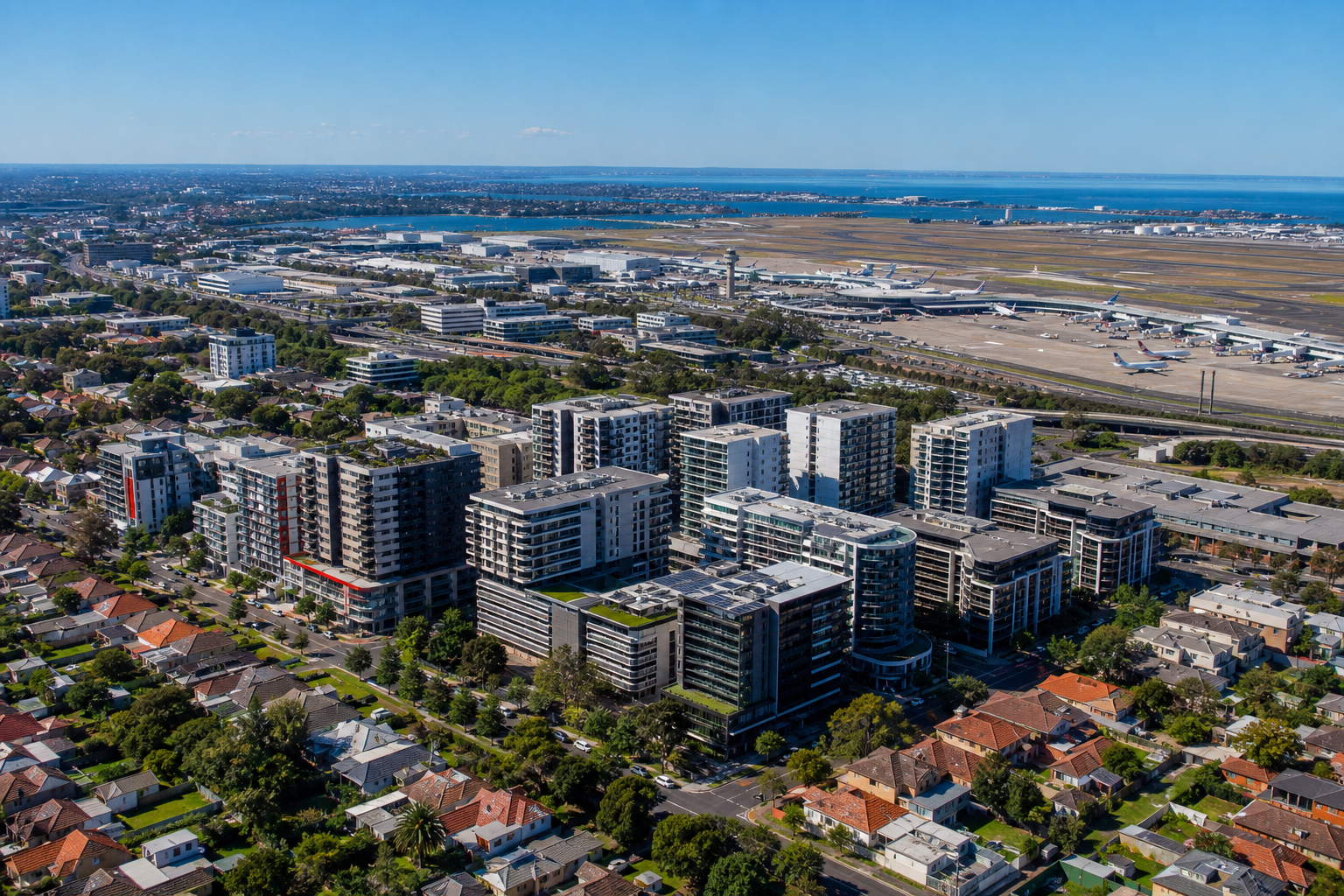
Mascot’s mix of high‑density apartments and nearby houses shapes your upgrade options.
1. Start with your actual Mascot position today
Before you pick a path, you need a clean snapshot of where you are now: equity, borrowing power, and the kind of property you own.
1.1 Know what your Mascot unit really looks like to a bank
Banks don’t treat all Mascot apartments equally. High‑density towers, smaller studios and mixed‑use buildings often have tighter lending rules and lower maximum LVRs.
If you haven’t already, read How Mascot Property Types Shape Your Home Loan Options This Year. Key points for upgraders:
- Some Mascot units are capped at 70–80% LVR, even for owner‑occupiers.
- Smaller units (under ~50–55 m² internal) can be treated like "non‑standard" security.
- Flight‑path and mixed‑use sites can affect valuation and LVR.
This matters because your usable equity depends on what lenders are prepared to lend against, not just an agent’s price guide.
1.2 Quick equity sense‑check (worked example)
Let’s say:
- Current Mascot unit value (bank valuation): $900,000
- Current home loan: $500,000
- Indicative maximum LVR banks will allow on your unit for an upgrade: 80%
Maximum loan at 80% LVR = $900,000 × 80% = $720,000
Usable equity = $720,000 – $500,000 = $220,000
That $220,000 can help fund:
- Deposit and costs on the new place
- Stamp duty
- Moving and minor renovation costs
If your building is in a tighter category (say, 70% LVR cap), the same unit might only support a $630,000 loan limit — dropping usable equity to $130,000. That’s a big strategy difference.
1.3 Check your borrowing power under today’s rules
Lenders must test your ability to repay at a rate at least 3% higher than the actual rate (APRA buffer). So if you’re quoted 5.8% p.a., the bank will test you at 8.8% or more.
That means:
- Higher card limits, BNPL, car loans or personal loans cut borrowing capacity sharply.
- Self‑employed and aviation workers around Mascot often face extra shading and averaging of income.
If you’re in that group, pair this guide with Smart Mascot Home Loans for Aviation, Expats and Complex Income and Choosing the right documentation pathway for your next home loan. The documentation path you choose (full‑doc vs alt‑doc) can make or break an upgrade.

2. The three main upgrade paths in Mascot
For most Mascot owners wanting to move from unit to house or townhouse, the options are:
- Sell first, then buy
- Buy first with a bridging loan, then sell
- Keep the Mascot unit as an investment and buy the next home
These are the same three paths outlined at a national level in Financing a major home upgrade without derailing your current home, but Mascot adds some local twists.
Modelling sell, bridge and keep scenarios turns vague plans into clear numbers.
2.1 Option 1: Sell first, then buy
This is often the lowest‑risk path and the simplest for lenders.
How it works
- List and sell your Mascot unit.
- Pay out your existing loan and costs.
- Use the net proceeds as a deposit on your bigger home (Mascot or nearby).
Pros
- Clear budget: you know exactly what you can spend.
- Cleaner application: one loan at a time, easier serviceability.
- No bridging interest or pressure to offload quickly.
Cons
- You may need temporary accommodation if you don’t find a new home quickly.
- You might feel "rushed" into buying whatever is available.
- If the market rises between your sale and purchase, you lose some upside.
Worked example – sell first, upgrade within Mascot
- Mascot unit sale price: $900,000
- Selling costs (agent, marketing, legals): ~$30,000
- Current loan payout: $500,000
Net cash after sale = $900,000 – $30,000 – $500,000 = $370,000
Now you target a townhouse or semi:
- Purchase price: $1,350,000
- Stamp duty (NSW, existing home): ~ $60,000 (rough guide)
- Legals, inspections, moving: say $10,000
Total funds needed = $1,350,000 + $60,000 + $10,000 = $1,420,000
Using $370,000 as deposit and costs leaves:
New loan required = $1,420,000 – $370,000 = $1,050,000
Loan‑to‑value ratio (LVR) on new place = $1,050,000 ÷ $1,350,000 ≈ 78%, inside the 80% sweet spot.
This is often the cleanest structure for a straight owner‑occupied loan.
2.2 Option 2: Buy first with a bridging loan
Bridging finance lets you secure the new home before selling your Mascot unit.
How it works
- Lender takes security over both properties.
- You borrow enough to cover your existing loan plus the new purchase.
- For 6–12 months, interest may be capitalised (added to the balance).
- Once the unit sells, sale proceeds clear the "bridging" portion, leaving your end loan.
Bridging is covered in detail in the national guide at /insights/financing-major-home-upgrade-managing-existing-property. In Mascot, the key issue is being realistic about your unit’s value and sale time.
Pros
- You can buy the right home when it appears, not just when you’ve sold.
- Only one physical move; no interim rental for most households.
- Less pressure to accept a low offer on your unit.
Cons
- Two properties mean larger "peak debt" and tighter lending rules.
- If your Mascot unit is in a high‑density or complex building, some lenders won’t do bridging against it.
- If the unit sells for less than expected, you carry more permanent debt.
Worked example – bridging loan numbers
- Existing Mascot unit: value $900,000, loan $500,000
- New home (e.g. Pagewood/Eastgardens house): $1,500,000
- Estimated selling costs on unit: $30,000
- Target LVR (total debt vs total security): 80%
Peak debt calculation
- Existing loan: $500,000
- New purchase price: $1,500,000
- Purchase costs (duty + legals etc., rough): $80,000
Peak debt = $500,000 + $1,500,000 + $80,000 = $2,080,000
Total security value = $900,000 (unit) + $1,500,000 (house) = $2,400,000
Peak LVR = $2,080,000 ÷ $2,400,000 ≈ 87% – usually too high without LMI.
So you’d typically need either:
- More cash savings, or
- A cheaper upgrade target, or
- A lender allowing higher LVR plus LMI for bridging (not all do).
If the unit sells for $900,000, and $530,000 of that clears your existing loan and costs, the net $370,000 reduces the peak debt. Your end loan on the new home could land near $1.71m in this example, which is >90% LVR – likely too high. This is why the exact numbers matter.
2.3 Option 3: Keep your Mascot unit as an investment
Many owners ask: "Can I keep the Mascot unit and rent it out?" Often this is attractive because:
- Mascot’s rental demand is strong.
- You like the idea of building a small portfolio.
- You want long‑term exposure to the airport corridor.
The trade‑offs:
- You must service both the new home loan and the investment loan.
- APRA buffers and post‑2027 tax changes to negative gearing and CGT make the numbers more sensitive to cashflow.
Under the 2026–27 Federal Budget reforms, many residential rental losses on established properties bought after 12 May 2026 will be quarantined rather than offset against other income. That means you can’t rely on negative gearing to subsidise a cashflow‑hungry investment forever.
Worked example – keep unit + buy new home
Same starting point:
- Mascot unit value: $900,000, loan: $500,000
- New home price: $1,350,000
You might:
- Refinance the Mascot unit to 80% LVR = $720,000
- Release $220,000 equity for deposit + costs
- Convert that loan to an interest‑only investment split
- Take a new owner‑occupied loan for the balance on the new home
The lender will include rental income from the Mascot unit, but typically shade it (e.g. use 70–80% of expected rent), and still test both loans at buffer rates. A careful split structure is important here so you keep investment and home debt clearly separated, especially as tax rules evolve.
3. Comparing the three Mascot upgrade paths
Here’s how the options stack up at a high level.
| Path | Main strengths | Main risks | Best for |
|---|---|---|---|
| Sell first, then buy | Clear budget, simpler loan, no bridging interest | Possible gap between sale and purchase, risk of prices rising in between | Households prioritising certainty and cleaner numbers |
| Buy first with bridging | Secure the right home before selling, one move | Higher peak debt, lender policy constraints on some Mascot units, risk of lower sale price | Strong incomes, solid equity, confident about selling unit quickly |
| Keep unit as investment | Build portfolio, keep Mascot exposure, rental income | Double debt, tighter serviceability, changing negative gearing and CGT rules | Higher incomes, stable jobs/self‑employed with strong history, long‑term investors |
In reality, many households start with a preferred path, then adjust once the numbers and lender policies are clear.
Many Mascot upgraders look to nearby suburbs for larger homes within budget.
4. Staying in Mascot vs moving slightly out
Not every upgrade from a Mascot unit has to be into a Mascot house. A lot of clients end up choosing between:
- Bigger Mascot apartment or townhouse
- House further out (e.g. Kogarah, Arncliffe, Bexley, Botany, Pagewood)
4.1 What actually changes with each move?
Upgrading within Mascot
Pros:
- Minimal lifestyle disruption: same commute, schools, community.
- Familiar building stock and strata dynamics.
- Strong rental demand if you later convert to investment.
Cons:
- Limited detached house stock; you may be choosing between "bigger unit" vs "small townhouse".
- Some lenders still cautious about high‑density towers even for high‑end apartments.
Moving slightly out
Pros:
- Better chance of a freestanding home or larger block.
- More diversity in property types and lender appetite.
Cons:
- Change in commute and school catchments.
- Different council rules, parking, and amenity.
4.2 Price bands and borrowing impact (illustrative)
Indicative 2026 price bands (not valuations, just working examples):
- 2‑bed Mascot unit: $850k–$1.0m
- 3‑bed Mascot townhouse: $1.3m–$1.6m
- Freestanding house in nearby suburbs: $1.4m–$1.9m+
If your borrowing capacity (after buffers) tops out around $1.2m total debt, that pushes you toward:
- Upgrading to a bigger apartment or townhouse with more moderate price uplift, or
- Moving to an area where your budget stretches further.
The companion article Mascot Home Strategies: First‑Home, Investor and Upgrader Game Plans walks through realistic upgrade steps for different budget levels and income types.
5. Sequencing, settlement and risk management
The difference between a smooth upgrade and a stressful one is often timing and buffers, not just the headline price.
5.1 Aligning settlement dates
Where possible, aim for:
- Same‑day settlement: sell in the morning, buy in the afternoon.
- Or, negotiated settlement periods that give you a bridge without formal bridging finance (e.g. long settlement on your purchase, shorter on your sale).
Your solicitor and broker should coordinate contracts, finance dates and any sale conditions (like "subject to purchase" or vice versa) so you’re not forced into urgent decisions.
5.2 Buffers for higher‑rate environment
RBA monetary policy has kept rates elevated to manage inflation, with the cash rate at or above 4% in 2026 after previous hikes. That means upgrade plans must stand up to:
- Higher actual repayments today, and
- Additional buffer testing by banks (assessment rates often 8%+).
A sensible approach is to:
- Model repayments at 1–2% above your assessed rate, not just the current variable rate.
- Size cash buffers based on true essential expenses, not just a flat $20k–$30k figure (see the buffer guidance noted in /insights/risk-management-buffers-worst-case-planning-broker).
5.3 Insurance and income protection
When taking on a larger home loan, protecting your household from a forced sale is critical. As explored in /insights/what-happens-large-home-investment-loans-when-you-pass-away, having life insurance sufficient to clear at least the home loan is one of the most effective safeguards. Consider, with advice:
- Life and TPD cover sized to at least your new home loan balance.
- Income protection or business continuity plans if self‑employed.
6. Self‑employed, aviation and complex income upgraders
Mascot and the airport corridor have outsized numbers of:
- Aviation staff with allowances and irregular shifts.
- Self‑employed contractors and small business owners.
- Expats moving back and forth.
These patterns can make serviceability and documentation the main bottleneck, not equity.
6.1 Full‑doc vs alt‑doc for upgrade loans
- If you have two years of strong, lodged tax returns, full‑doc will usually give the best rates.
- If your latest year is stronger and the older one drags you down, some lenders will use the most recent year only; others will average or take the lower.
- If your returns don’t yet reflect your true current income, an alt‑doc loan using BAS, business bank statements or an accountant’s letter may open more options (at higher rates and stricter LVRs).
Over time, many self‑employed upgraders can move from alt‑doc back to mainstream full‑doc lending once two solid years of returns are lodged, as outlined in /insights/switching-alt-doc-to-full-doc-mainstream-lending.
6.2 Cleaning up debts before upgrading
Multiple cards, car loans, or business debts in personal names can choke your borrowing capacity. Consolidating Business and Personal Debts Before Your Next Home Loan explains when rolling debts into your home loan helps and when it simply shifts risk onto the family home.
Key points:
- Lenders look poorly on repeated cycles of "refi the cards, then re‑max them".
- Selective, well‑structured consolidation can improve serviceability if tied to a clear payoff plan and separate loan split.
7. One‑week action plan for Mascot upgraders
If you’re serious about moving from a Mascot unit to a bigger home, here’s what you can actually do this week.
7.1 Day 1–2: Get the facts on your current position
- Pull your latest loan statements and check your current rate, balance and remaining term.
- Ask a Mascot‑savvy broker for a valuation estimate from at least two lenders — not just an agent appraisal.
- List all personal, investment and business debts and limits (credit cards, car loans, BNPL, overdrafts).
7.2 Day 3–4: Map the three upgrade paths for your numbers
With a broker who understands Mascot:
- Run sell‑first numbers: what would your net cash after sale realistically be, and what size loan does that support?
- Run bridging numbers, including peak debt and buffer testing.
- Run keep‑as‑investment numbers with conservative rent and updated tax rules (especially post‑2027 negative gearing and CGT changes).
Use the scenarios and worked examples in /insights/financing-major-home-upgrade-managing-existing-property as a template, but plug in Mascot‑specific valuations and rents.
7.3 Day 5–7: Align lending, tax and lifestyle
- Check with your accountant how the new 30% minimum CGT rate and indexation rules from 1 July 2027 might affect holding or selling your Mascot property over time.
- Decide how far you’re willing to move (if at all) in search of a bigger home – Mascot, nearby suburbs, or further.
- Agree with your partner (if applicable) on your risk line: for example, "We won’t go above 80% LVR on the new home" or "We only keep the unit if holding costs are no more than $300/month after tax".
Once you’ve done that, you’re essentially ready for pre‑approval and to start making offers with confidence.
8. When should you not upgrade yet?
It can be just as important to recognise when waiting is smarter.
You might pause an upgrade if:
- Serviceability is marginal and relies on aggressive assumptions about bonuses, overtime or business growth.
- You’d need >90% LVR plus LMI on the new home, without a clear pathway to reduce that quickly.
- Your emergency buffer would fall below three months of essential living costs and repayments.
- You’re unsure whether you’ll stay in Sydney or on your current career path for at least the next 3–5 years.
In those cases, consider interim steps:
- Modest renovation of the current unit to improve liveability.
- Targeting a slightly larger / better‑laid‑out unit in Mascot as a stage‑one upgrade.
- Building savings and cutting non‑deductible debts for 6–18 months, then reassessing.
Turn Your Mascot Home Loan into a 10‑Year Property Strategy has examples of staged upgrade journeys that reach the same destination with less stress.
Key takeaways
- Upgrading from a Mascot unit to a bigger home usually means choosing between selling first, using bridging finance, or keeping your unit as an investment.
- Lender views on your existing building (LVR caps, valuations) and APRA’s 3% buffer can materially limit how much you can borrow.
- Bridging loans and "keep the unit" strategies can work well, but only if you model realistic sale prices, rents and post‑2027 tax settings.
- Self‑employed, aviation and expat borrowers around Mascot need to pay extra attention to documentation pathways and income shading.
- A one‑week sprint to map all three paths with Mascot‑specific assumptions will usually reveal a clear, practical way forward – or a smart reason to wait.
Ready to see which upgrade path actually works for you? Book a free 15‑minute Mascot upgrade strategy call at https://localknowledge.finance — you’ll get one conversation that covers your tax, your loan options and your next property move with a CPA, Tax Agent and Mortgage Broker in one. Or, start by testing your borrowing power with our calculator at https://localknowledge.finance/calculators and bring those numbers to a call.
General advice only.
Frequently asked questions
Talk to a CPA-certified broker
Free consultation, plain-English advice tailored to your situation.
