
Article
Turn Green Square or Mascot Into Your Launchpad to the Eastern Suburbs
How to use an apartment in Green Square or Mascot as a strategic stepping stone into a house or larger home in the Eastern Suburbs, with clear numbers and timelines you can act on this week.
Key Takeaway
Using Green Square or Mascot as a stepping stone into the Eastern Suburbs means buying bank‑friendly stock, targeting 20–30% equity within 7–10 years, and keeping at least a three‑month buffer. For a $900k Zetland unit growing 4% p.a., equity can reach around $360k by year 10, enough to fund a 20% deposit and costs on a $1.6m–$1.7m Eastern Suburbs upgrade. The key actionable step is to map today’s property to a specific target home and timeline, then run the numbers on equity, debt and cashflow under APRA’s 3% buffer.
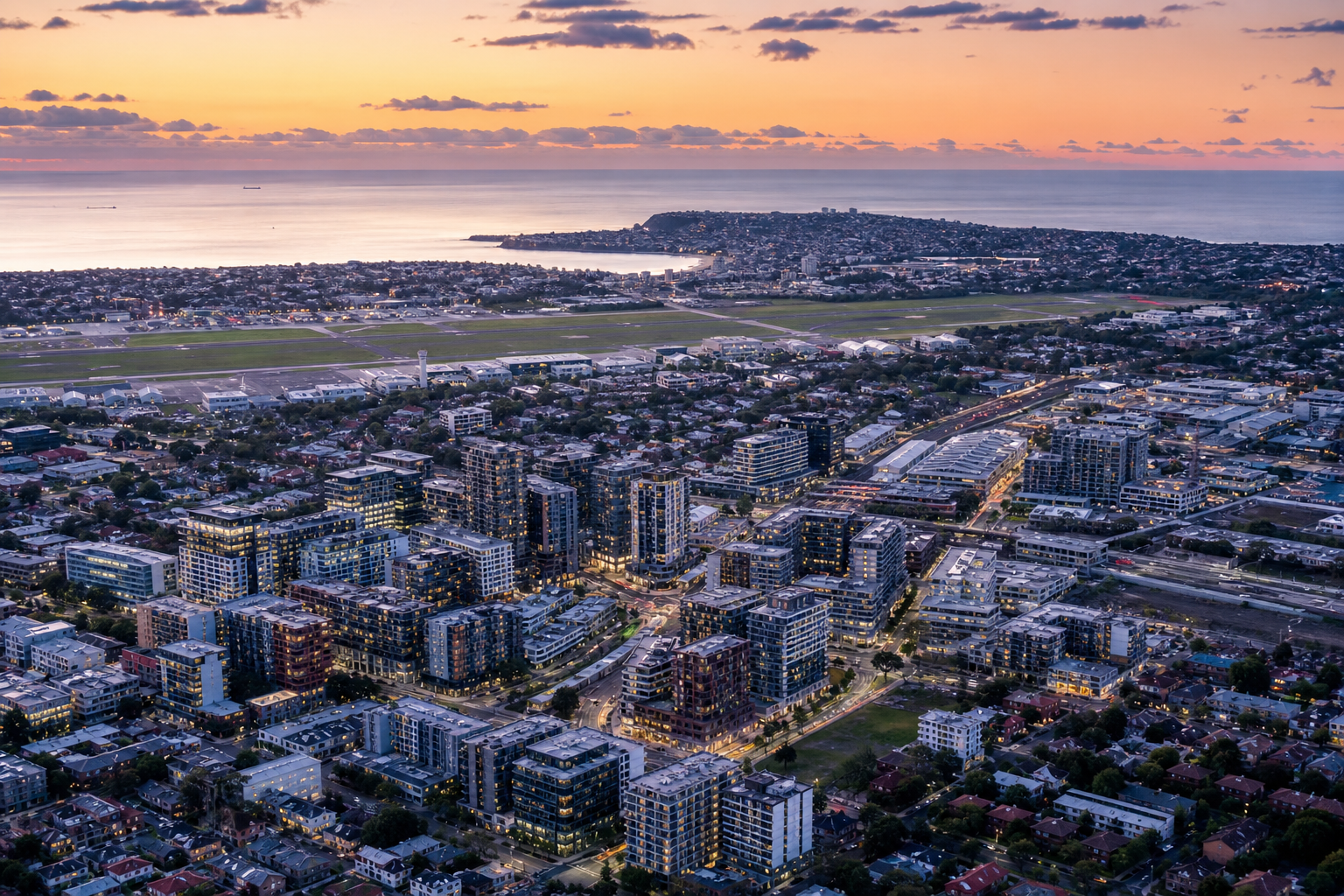
This topic is covered in full on Tailored Loans Sydney
How to use an apartment in Green Square or Mascot as a strategic stepping stone into a house or larger home in the Eastern Suburbs, with clear numbers and timelines you can act on this week.
Read the full guide on tailoredloans.sydneyUsing Green Square or Mascot as a stepping stone into the Eastern Suburbs is about one thing: buying a bank‑friendly asset now that can realistically grow enough equity to fund your upgrade deposit later, without blowing up your cashflow or tax position.
In practice, that means picking the right apartment or townhouse, aiming for 20–30% equity inside 7–10 years, and structuring your loans so you can tap that equity safely when it’s time to move.
1. What a realistic stepping‑stone path actually looks like
Let’s anchor this with numbers.
Example:
- Today: $900k two‑bed in Zetland, 90% lend (FHBG) → $810k loan.
- Assume 4% p.a. growth over 10 years (not a forecast, just a planning rate).
- Value in 10 years ≈ $1.332m.
- If you’ve paid the loan down to ~$700k, you have ~$632k equity.
At a conservative 80% LVR, usable equity is roughly:
$1.332m × 80% − $700k ≈ $366k usable equity.
That’s enough to cover a 20% deposit plus costs on a $1.6m–$1.7m Eastern Suburbs home, if the rest of your borrowing capacity stacks up under APRA’s 3% buffer.
The stepping‑stone strategy works when:
- The first property is in a deep, liquid market (lots of buyers, lots of banks happy).
- You don’t over‑gear; you keep buffers in offset.
- You plan the upgrade math now, not in year nine.
If you’re still weighing up whether you can even start in Green Square, pair this with the walkthrough in /insights/can-you-afford-first-home-green-square-numbers-walkthrough.
2. Why Green Square and Mascot work as launchpads
2.1 Location and buyer depth
Green Square (Zetland/Waterloo) and Mascot sit between:
- The CBD and Eastern Suburbs employment hubs, and
- Bayside’s airport and port‑driven economy (per Bayside Council’s economic profile).
That means:
- Strong tenant demand (good for serviceability and rent coverage).
- Deep resale markets (more comparable sales, less valuation drama).
- A broad mix of buyers – first‑timers, investors, downsizers.
Banks generally like this mix, provided you avoid extremely small or niche stock.
2.2 Price gaps that make the ladder possible
Indicative (not advice, and not live valuations):
| Area | Typical 2‑bed unit | Typical family house |
|---|---|---|
| Zetland/Green Square | $850k–$1.1m | N/A (very limited) |
| Mascot | $750k–$1m | $1.6m–$2.1m |
| Eastern Suburbs (Randwick, Maroubra, Rose Bay units) | $1.1m–$1.6m | $2.5m+ |
Your goal is to use sub‑$1m stock in the inner south to reach $1.5m–$2m+ stock in the east later, without needing a miracle.
For detailed help lining up first‑home schemes with Green Square and Mascot pricing, see:
The strategy continues below
You've seen the problem and the groundwork — now unlock the exact steps our CPA-certified brokers use, including 4 more sections. Enter your email for instant, free full access.
Free access. No spam — unsubscribe anytime. Your details stay confidential.
Frequently asked questions
Talk to a CPA-certified broker
Free consultation, plain-English advice tailored to your situation.