
Article
Knockdown Sites and Duplex Potential in Bronte: A Finance-First Guide
Thinking about a Bronte knockdown or duplex project? This guide explains how banks value sites, what they’ll lend against, and how to structure your loan so you can act confidently when the right block appears.
Key Takeaway
This article explains how Australian lenders value Bronte knockdown and duplex sites and how that drives borrowing capacity and loan structure. It covers land and “as‑if complete” valuations, typical residential LVR bands up to 80–90%, and when projects tip into small‑development lending. A worked example shows how a $5m duplex build might be funded using staged construction draws and buffers. Readers gain a clear, finance‑first checklist to assess a Bronte site before they offer.
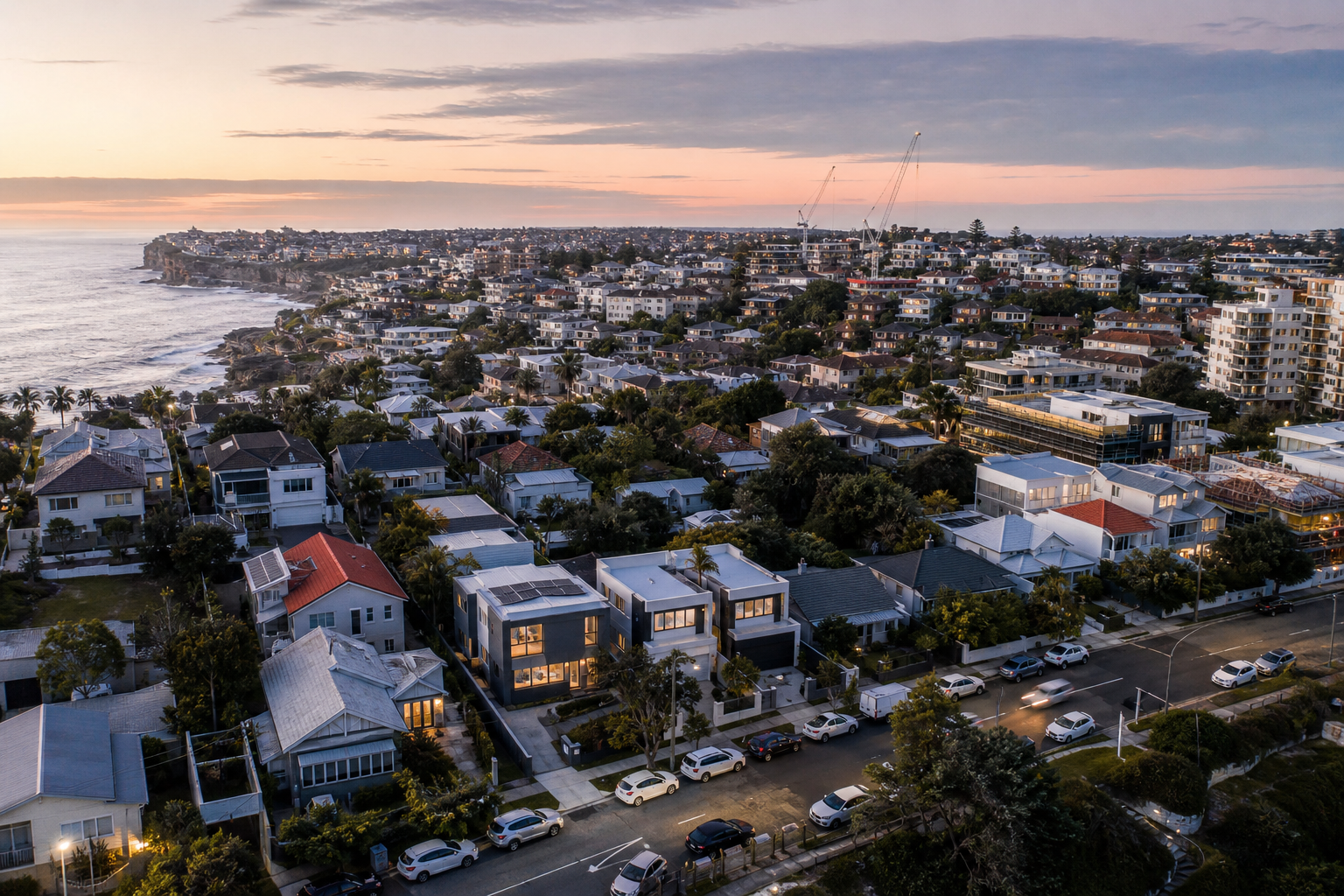
Bronte knockdown and duplex projects: start with the bank’s view
In Bronte, the gap between an old cottage and a pair of luxury duplexes can be several million dollars. But your project only works if the bank agrees with your numbers, funds the build, and stays with you when costs move.
For knockdown and duplex sites, lenders don’t care about the architect’s brochure. They care about land value today, realistic end value, your capacity to service the loan under a 3% APRA buffer, and whether the project still stacks up if costs or values shift. If you understand that lens, you can move quickly when a good site hits the market—without gambling on settlement.
In simple terms: for most Bronte knockdown or duplex projects you’ll use a construction loan secured against the land and build contract. The bank will lend up to a percentage of either (a) land value plus build cost, or (b) the valuer’s ‘as‑if complete’ value, whichever is lower. Beyond a certain size or risk level, the deal slips into ‘small development’ territory with stricter rules.

1. What makes a good knockdown or duplex site in Bronte?
1.1 The three lenses: planning, market and bank
A Bronte site that looks perfect to an architect can still be problematic for a lender. You need all three lenses to line up:
- Planning lens – Zoning, FSR, height limits, heritage, floor-space and private open-space rules under Waverley Council.
- Market lens – What buyers actually pay for new homes or duplexes on comparable blocks nearby.
- Bank lens – How a conservative valuer will treat the existing dwelling, land and proposed improvements.
A strong site is one where:
- Zoning clearly supports your intended outcome (single luxury home or two attached dwellings).
- Recent comparable sales support your end values, not just agent quotes.
- Services, access and slope don’t add hidden cost that erodes profit or equity.
1.2 Typical Bronte site patterns
You’ll commonly see:
- Old freestanding cottages on 300–450m² blocks ripe for a single high-end home.
- Corner or wider-frontage lots that may suit duplexes where zoning and FSR allow.
- Narrow, deep blocks that still work, but with tighter build envelopes and more design complexity.
Bronte is tightly held and high value, so purchase prices already bake in a good chunk of the development upside. That matters when you run the numbers: there’s less margin for error on build costs, time overruns or valuation downside.
1.3 Quick feasibility sense-check
Before you get lost in floor plans, run a back-of-the-envelope test:
- Expected end value (for a single home, or each duplex x 2)
- Less: land cost (including stamp duty, legals, buyer’s agent, etc.)
- Less: total build and soft costs (builder, consultants, DA, contingency, interest, rent elsewhere)
If the total margin is thin before finance costs and tax, you’re trying to squeeze too much out of a premium suburb. At this point, bring in finance and tax thinking early. New negative gearing rules that favour new builds after 12 May 2026 can tilt the maths for investors, but only if the structure is right.
For a deeper funding overview in the Eastern Suburbs, see How to Finance a Knockdown‑Rebuild on a Premium Eastern Suburbs Block.
2. How valuers look at Bronte knockdown and duplex sites
2.1 Land value vs ‘as‑if complete’ value
For a knockdown or duplex build, lenders usually rely on one or both of:
- ‘As is’ valuation – what the land and existing dwelling are worth today.
- ‘As‑if complete’ valuation – what a prudent buyer would pay for the finished project at current prices.
The bank will typically lend against the lower of:
- Land value + build contract (plus a margin for fees), and
- The as‑if complete value.
This is how a lender protects itself if your build budget is undercooked or you overestimate final values.
2.2 Evidence the valuer actually uses
Valuers in Bronte will heavily weight:
- Recent settled sales of new or near-new homes / duplexes in the same pocket.
- Block characteristics – size, frontage, slope, easements, orientation, streetscape.
- Views and amenity – distance to beach, elevation, overshadowing.
Glossy renders and agent appraisals are low on their priority list. They’ll also assume a conservative standard of finish and may haircut values if your design is unusually large or high-spec for the street.
2.3 Duplex-specific valuation wrinkles
For duplex projects, there are two common approaches:
- Aggregate on completion – total value of both dwellings in one line (more common if they must be sold together or Torrens subdivision is uncertain).
- Individual on completion – each side valued separately, particularly if subdivision is straightforward and end buyers are likely to be owner-occupiers.
This distinction matters:
- If you intend to keep one duplex and sell one, you need the valuer and lender on the same page about separate end values and how debt will be allocated between them.
- For investors, keeping loan splits clearly separated by purpose (home vs investment) is critical for future tax deductibility.
3. Loan-to-value ratios (LVRs) and when it becomes ‘development’
3.1 Typical LVR bands in Bronte
Indicative residential lending bands (exact policy varies by lender):
| Scenario | Typical Max LVR* | LMI Likely? | Comments |
|---|---|---|---|
| Owner-occupier, single home knockdown-rebuild | 80–90% | >80% usually yes | Higher LVRs need strong income and clean file |
| Investor single dwelling (new build) | 80% | 80–90% with LMI | Negative gearing rules now favour new builds |
| Small duplex project, keep one / sell one | 70–80% | Above 80% rare | Banks more conservative on partial sell-down |
| Multi-duplex / 3+ dwellings on one title | 65–75% | LMI rarely available | Often classed as small development |
*Illustrative only, not a quote. Lenders also apply a 3% interest rate buffer on servicing under APRA rules.
Once your project looks like a business venture rather than an upgraded home, lenders may treat it as residential development finance: lower LVRs, pre-sales, tighter conditions and higher pricing.
3.2 How banks decide if you’re a ‘developer’
Banks will look at:
- Number of dwellings on the title.
- Estimated end value relative to your income and asset base.
- Intention to sell all, some, or keep them long term.
- Your experience with construction or development.
Building a single home, or one duplex where you keep both, is more likely to sit in standard residential territory. Building two, selling one and keeping one is a grey zone. More than two, or clear intent to sell down quickly, pushes you into small development.
If you’re unsure where your project sits, read How to Finance a Knockdown‑Rebuild on a High‑Value Home for the residential end and then seek advice before you sign a contract for anything more complex.
The strategy continues below
You've seen the problem and the groundwork — now unlock the exact steps our CPA-certified brokers use, including 6 more sections. Enter your email for instant, free full access.
Free access. No spam — unsubscribe anytime. Your details stay confidential.
Frequently asked questions
Talk to a CPA-certified broker
Free consultation, plain-English advice tailored to your situation.