
Article
Land Tax And Your Family Home In NSW: Trust, Company Or Own Name?
Clear, NSW‑specific guide on land tax for the family home — when the main residence exemption applies, what happens in trusts and companies, and how to structure ownership without sabotaging future tax and lending options.
Key Takeaway
In NSW, the family home avoids land tax best when owned directly by individuals claiming the principal place of residence exemption; trusts and companies usually lose this concession and can face annual land tax of over $10,000 on higher-value land. Discretionary trusts are typically taxed at surcharge rates, while only specific fixed or concessional trusts may access limited PPR relief. Buyers should compare 10–20 year land tax and CGT costs and seek coordinated legal, tax, and lending advice before placing a home in a trust or company.

This topic is covered in full on Tailored Loans Sydney
Clear, NSW‑specific guide on land tax for the family home — when the main residence exemption applies, what happens in trusts and companies, and how to structure ownership without sabotaging future tax and lending options.
Read the full guide on tailoredloans.sydneyIn NSW, the cleanest way to avoid land tax on your family home is usually to own it in your own name and claim the principal place of residence (PPR) exemption. Holding the home in a trust or company almost always means the exemption is lost and annual land tax applies, sometimes at surcharge rates. The rare cases where a trust structure works are narrow and should be tested carefully with numbers.
This guide steps through how the NSW land tax rules treat the family home in your own name, in a trust and in a company — and how to weigh that against asset protection, lending and long‑term tax outcomes.
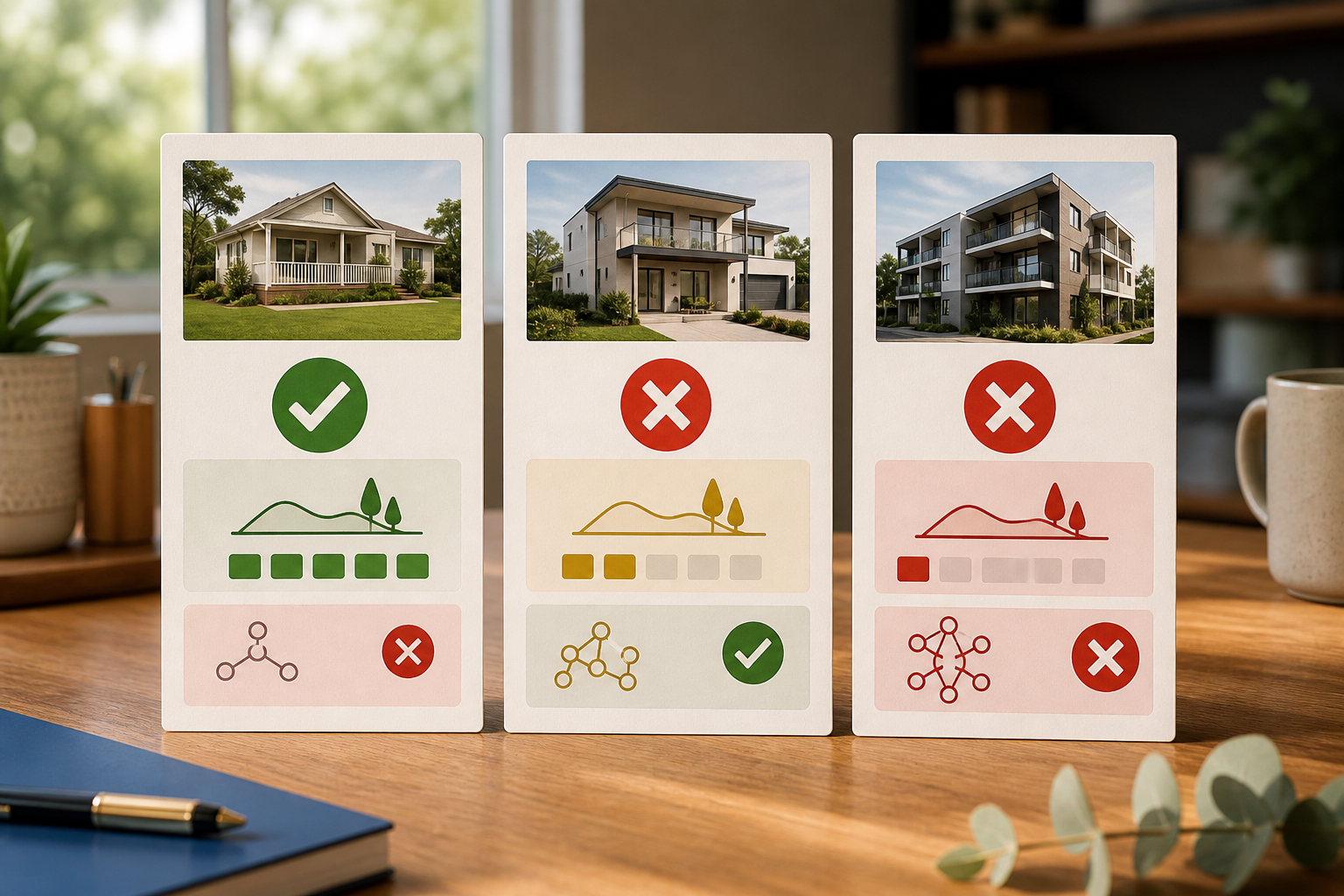
1. NSW land tax basics for the family home
1.1 Quick definition: what is NSW land tax?
NSW land tax is an annual tax on the unimproved value of taxable land you own as at 31 December each year. Your main home is usually exempt, but investment and some holiday properties are not.
Key points (based on current NSW rules, which change periodically):
- It’s assessed on the total taxable land value you own in NSW.
- Your principal place of residence can be exempt if strict conditions are met.
- Trusts and companies don’t get the PPR exemption in most cases.
- Foreign owners and many discretionary trusts can face extra “surcharge” land tax.
Exact thresholds and rates change over time, so always check the current NSW Revenue website or speak with your adviser.
1.2 Principal place of residence (PPR) exemption in plain English
For individuals, the PPR exemption normally applies if:
- You own the property (or at least one spouse does), and
- You live in it as your main residence, and
- You don’t claim another property as your PPR for land tax.
If you meet the rules, that property’s land value is generally ignored for land tax.
For most households, this is the single biggest land tax concession available. Losing it just to put the home in a structure is a large financial decision.
2. Own name vs trust vs company: how land tax works
2.1 Own name: default and usually best for land tax
If you (and/or your spouse) own the family home directly:
- You can claim the PPR exemption (subject to the rules).
- You can generally enjoy the main residence CGT exemption on sale.
- Lenders understand the structure and policy is straightforward.
From a land tax perspective, this is as good as it gets.
2.2 Discretionary (family) trust
A typical family (discretionary) trust is not a person for PPR purposes and generally cannot claim the main residence exemption.
That means:
- The land value of the home is usually fully taxable.
- Many standard NSW family trusts are treated as special trusts, often taxed at higher or surcharge rates.
- There is usually no land tax threshold for a special trust — tax can start from the first dollar of land value.
Combine this with the fact that putting the home in a discretionary trust generally sacrifices the full main residence CGT exemption and you can easily create a six‑figure long‑run tax cost on a high‑value property (see our deeper discussion in /insights/discretionary-trust-own-family-home-asset-protection-tax).
2.3 Fixed trust (including some unit trusts)
NSW does recognise some fixed trusts for land tax purposes. A fixed trust is one where beneficiaries’ interests are fixed — they’re more like unit holders or tenants in common rather than discretionary beneficiaries.
If a trust qualifies as a fixed trust under NSW Revenue rules:
- Land tax may be assessed as if the underlying individuals own their portion.
- In some carefully structured cases, individuals may effectively access thresholds or PPR concessions.
But:
- The trust deed must be drafted with land tax rules in mind.
- Revenue NSW looks at real substance — not just what you call the trust.
- Getting this wrong can mean years of backdated land tax and penalties.
2.4 Companies
A company cannot live in a property, so it generally cannot claim the PPR exemption.
Consequences:
- The home becomes fully subject to land tax each year.
- If the shareholder is a discretionary trust or foreign person, surcharge land tax may also apply.
Owning a pure family home in a company in NSW is usually a red flag unless there’s a very specific reason (for example, a mixed‑use or commercial property where the residential part is minor and the tax focus is different).
3. Worked NSW land tax example: own name vs trust vs company
To decide this week, you need to see numbers, not just theory.
3.1 Assumptions
Let’s take a Sydney home with:
- Purchase price: $2.5 million
- Current land value (unimproved): say $1.6 million (for illustration only)
- You plan to live there for 15–20 years
Indicative annual land tax numbers (rounded, for concept only, based on a notional NSW schedule):
| Structure | PPR exemption? | Indicative annual land tax on $1.6m land value* | 15‑year total (no indexation)* |
|---|---|---|---|
| Own name (PPR claimed) | Yes | $0 | $0 |
| Discretionary family trust | No (special) | ~$28,000 | ~$420,000 |
| Fixed trust (qualifying) | Possibly | Could be $0–$14,000 | ~$0–$210,000 |
| Company | No | ~$14,000 | ~$210,000 |
*Purely illustrative to show scale; actual NSW thresholds, rates and surcharge rules change and must be checked at the time.
Even with conservative assumptions, losing the PPR exemption for 15–20 years can easily cost hundreds of thousands of dollars in extra tax.
When someone says “We’ll just put the home in a trust for asset protection”, this is the sort of number you need to weigh up.

4. NSW principal place of residence exemption in more detail
4.1 Individual owners: standard rules
For individuals, Revenue NSW will usually grant the PPR exemption if:
- You moved in within a reasonable time of purchase (often within 6 months).
- You live there continuously, or only move out within specific temporary absence rules.
- Only one property per family unit (spouses and dependent children) is claimed at a time.
You can sometimes:
- Claim the PPR on a building site while building, or
- Keep the exemption for a limited period after moving out (for example, while the property is listed for sale).
The exact details change, so always confirm current rules.
4.2 Limited trust/company exceptions
NSW has historically offered only narrow PPR‑style concessions where:
- A particular type of trust holds the land solely for a person who occupies it as their home, and
- Very specific legislative and administrative tests are met.
These are not your everyday family trust arrangements. They typically:
- Need a custom deed that restricts who can benefit from the trust.
- Often require notification and/or approval by Revenue NSW.
- Can be administratively heavy and unforgiving if your family situation changes.
If someone proposes a “NSW principal place of residence exemption trust”, ask for:
- The exact legislative reference; and
- Written guidance from Revenue NSW or a private ruling backing the approach.
If they can’t produce both, you may be an expensive test case.
4.3 Mixed‑use and partial exemptions
If part of the land is used for a genuine business (for example, a shop‑top or home‑office with public access):
- The PPR exemption may only apply to the residential portion.
- The business part of the land value can be taxable.
Tax and lending both get trickier when you have mixed‑use land. As with interest deductibility on mixed‑use live–work properties, splitting and documenting purposes clearly is critical for long‑term clarity (see the principles in /insights/mixed-use-shop-top-housing-live-work-finance-guide).
The strategy continues below
You've seen the problem and the groundwork — now unlock the exact steps our CPA-certified brokers use, including 7 more sections. Enter your email for instant, free full access.
Free access. No spam — unsubscribe anytime. Your details stay confidential.
Frequently asked questions
Talk to a CPA-certified broker
Free consultation, plain-English advice tailored to your situation.