
Article
How To Fund Solar, Batteries And EV Chargers In Strata Buildings
Practical finance options for solar, batteries and EV chargers in Australian strata buildings when you don’t own the roof — including strata loans, green loans, embedded networks and individual workarounds.
Key Takeaway
Australians in strata buildings can fund solar, batteries and EV chargers through building-wide strata loans, special levies, embedded network or PPA arrangements, and in some cases individual borrowing, even when they don’t own the roof. Because loan purpose, not security, drives tax outcomes, owner-occupied solar borrowing is usually non-deductible while common-area or investment-use systems may allow deductions. Owners should model per-lot levy impacts over 10–15 years and stress-test savings 20% below quotes before voting on any upgrade or finance structure.
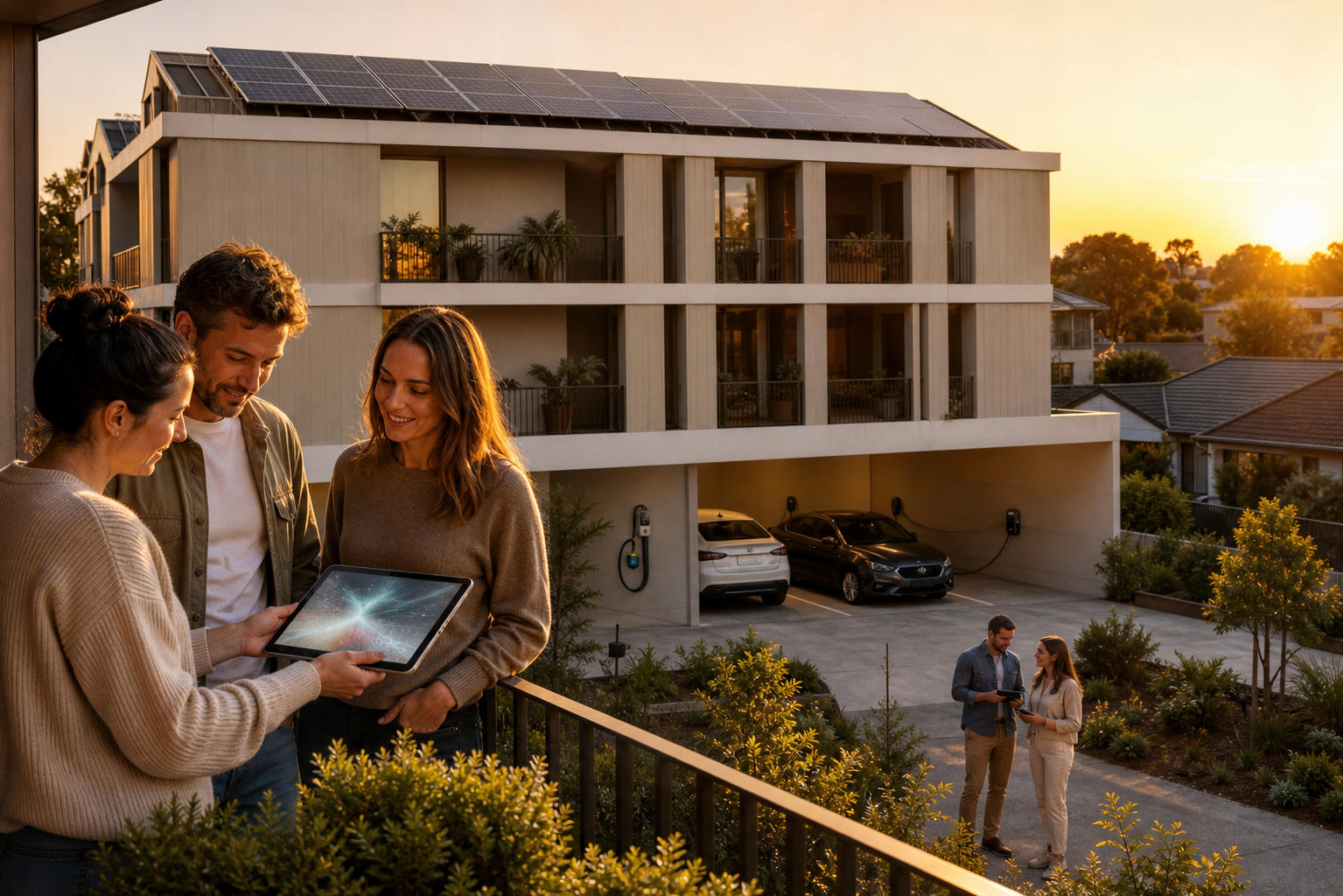
Most apartment owners assume solar, batteries or EV chargers are off the table because they don’t own the roof. In strata, that’s only half-true. You can’t just drill into common property, but you can still access solar and EV charging through building-level projects, embedded networks or clever individual workarounds – and there are realistic finance options for each.
In a strata building, the key decision is usually not “Can I get solar?” but “How do we fund a shared system fairly, without wrecking cashflow or resale values?” This guide walks through practical finance paths you can actually act on this quarter.
Fast answer: If your building wants solar, batteries or EV chargers, you typically fund them via (1) a strata loan, (2) special levies, (3) a green or sustainability loan, or (4) an embedded network / power purchase agreement where a provider pays upfront and recoups costs through bills. Individual borrowing is possible for some solutions (balcony solar, allocated EV bays), but the big gains usually come from building-wide projects agreed at an owners corporation meeting.
1. Ground rules: solar and EV projects when you don’t own the roof
Before you go near finance, you need to know what’s legally and physically possible in strata.
1.1 What counts as common property vs lot property?
In most NSW, VIC and QLD strata schemes:
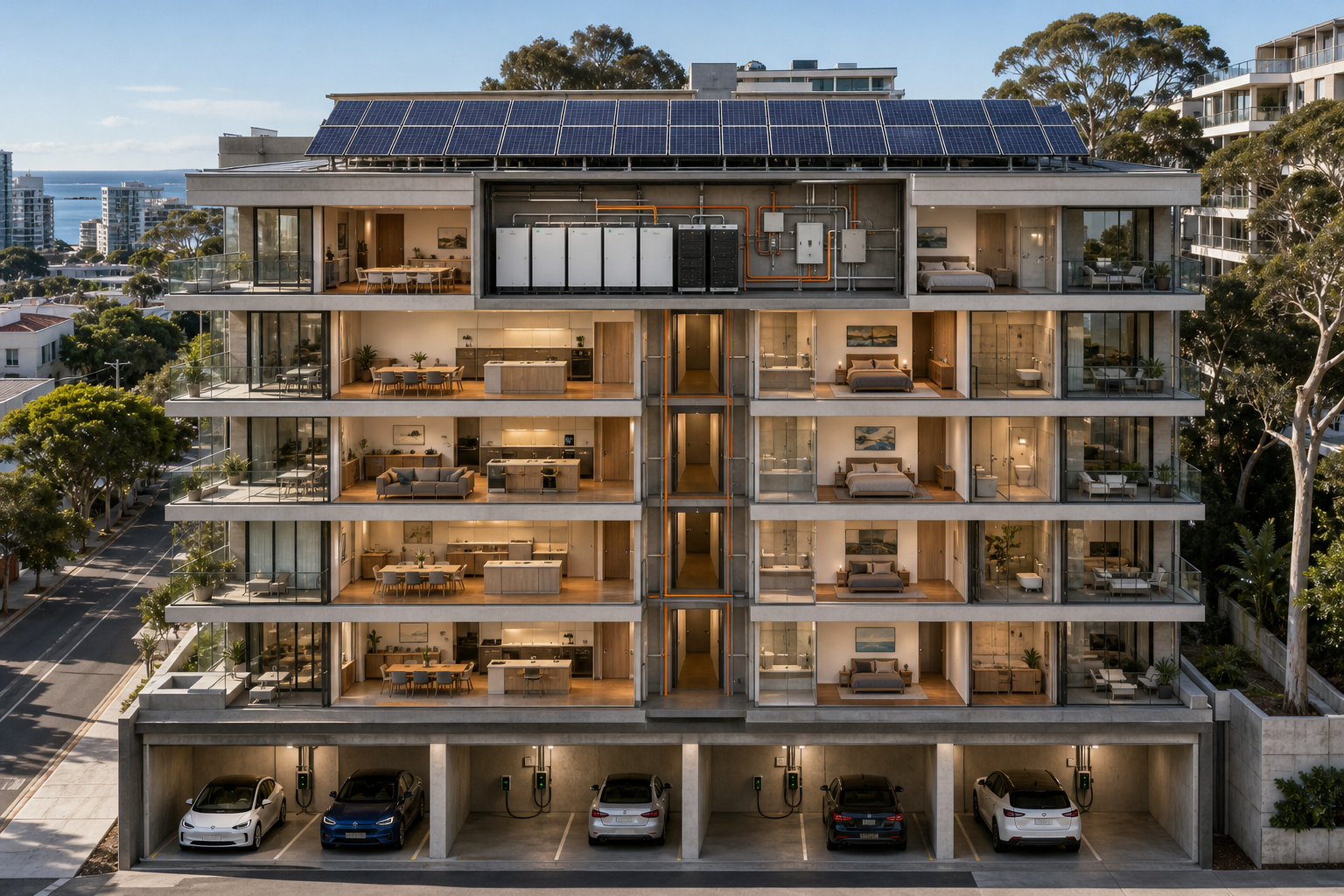
- The roof, external walls, main power infrastructure and car park structure are common property.
- Your internal wiring, power points, sub-board and sometimes your car space may be part of your lot (check your strata plan).
If the project touches common property – which roof solar, central batteries and most EV charger wiring will – you need:
- A formal owners corporation resolution (usually special resolution for improvements).
- Relevant by-laws to manage cost-sharing, access and maintenance.
(Those by-laws and metering rules are covered in your sibling guide, By-Laws, Metering and Cost Sharing for Solar and EV Projects in Strata.)
1.2 Individual vs building-wide projects
You’ll usually be choosing between:
- Building-wide:
- Solar array on the common roof.
- Central battery in a plant room.
- Shared EV infrastructure in the car park (chargers on some or all bays).
- Individual or hybrid:
- Balcony or window solar (plug-in or through a dedicated circuit).
- A charger wired to your own meter in your allocated car space.
- A pay-as-you-go EV system run by a third party.
Finance flows differently depending on which camp you’re in:
- Building-wide = strata loan, levies, or embedded network finance.
- Individual = personal, home loan, business or EV supplier finance.
1.3 What are you actually trying to achieve?
Be clear on the primary outcome before debating finance:
- Lower common-area bills (lifts, hall lights, car park, pool).
- Cheaper electricity for residents.
- Future-proofing for EV uptake.
- Sustainability / ESG improvements for resale and tenant appeal.
Each goal points to different designs and funding choices. For example, if your building is full of investors with short hold periods, a long payback, levy-heavy solution may struggle to get up unless resale benefits are crystal clear.
2. Main finance options for strata solar, batteries and EV chargers
You effectively have five main funding paths, often combined.
2.1 Strata loans (building borrows as a group)
A strata loan is taken out by the owners corporation/body corporate and repaid via levies. Lenders look at the building, size of the works and scheme health, not just individual owners.
Key points (see also /insights/how-strata-finance-works-structures-rules-lender-appetite):
- Typically unsecured, no mortgage over individual lots.
- Terms around 3–15 years, sometimes up to 20 for large works.
- Repayments funded by increased administrative or special levies.
- Interest rates usually higher than home loans, but often lower than many personal or vendor finance options.
Strata loans can fund:
- Rooftop solar for common areas plus residents.
- Central batteries.
- EV backbone infrastructure, with user-pays for individual chargers.
2.2 Special levies (pay cash from owners)
A special levy is a one-off or staged contribution from owners to pay for capital works.
Pros:
- No interest cost.
- Simpler admin, no lender covenants.
Cons:
- Can be a big cash hit for some owners.
- May depress short-term saleability if levies feel punitive.
Many buildings use a blend: partial special levy, partial strata loan. That reduces debt while smoothing the cost for owners under cash pressure.
2.3 Green or sustainability-linked loans
Some banks and non-banks offer sustainability or green strata loans for upgrades like solar, batteries, efficient HVAC and EV infrastructure.
They may offer:
- Slightly lower margins versus standard strata loans.
- Better terms if you hit certain energy-performance metrics.
The mechanics are similar to a normal strata loan – the difference is pricing and sometimes reporting requirements. You still need an owners corporation resolution and to model per-lot levies.
2.4 Embedded networks and power purchase agreements (PPAs)
If your owners don’t want to borrow, an embedded network provider can sometimes:
- Pay for the solar and/or battery.
- Take over building electricity purchasing/supply.
- Recover their investment via electricity charges over 10–20 years.
You’ll see this framed as:
- PPA (Power Purchase Agreement) for the building.
- Long-term operations and maintenance contract.
Pros:
- Little or no upfront capital from the owners corporation.
- Predictable energy pricing, often with built-in discounts versus grid power.
Cons:
- Long contracts (10–20+ years), complex termination terms.
- You effectively outsource part of the building’s energy future.
- If not structured well, owners may feel locked in.
The finance is hidden inside the per‑kWh rate the provider charges. Always compare against the equivalent of a strata loan plus grid power over the same period, discounting installer-projected savings by roughly 20% for safety, a rule of thumb we use across all solar modelling.
2.5 Individual borrowing (home, personal or business loans)
Individual borrowing comes in when:
- You’re paying the connection cost to wire a charger to your lot.
- You’re buying balcony solar or a plug-in system.
- You’re a business owner installing a charger or solar to support company EVs.
Finance options can include:
- Home loan top-up or separate split.
- Personal or green loan.
- Business or asset finance (for commercial use).
Be careful using very long-term, secured borrowing for small systems: as we note in your related article on apartment solar, balcony and plug‑in systems often have modest savings, so if you spread them over 25–30 years of mortgage, the interest can exceed the bill reduction.
The strategy continues below
You've seen the problem and the groundwork — now unlock the exact steps our CPA-certified brokers use, including 6 more sections. Enter your email for instant, free full access.
Free access. No spam — unsubscribe anytime. Your details stay confidential.
Frequently asked questions
Talk to a CPA-certified broker
Free consultation, plain-English advice tailored to your situation.