
Loading the latest on mortgages, RBA & inflation…
Local Knowledge Finance

Article

Solar for Granny Flats and Secondary Dwellings: Finance and Rent Uplift

A practical Australian guide to deciding if solar on a granny flat or secondary dwelling stacks up. Covers finance options, rent uplift, metering choices and quick numbers you can run this week.

Published 25 July 2026Updated 25 July 202613 min read

Key Takeaway

Solar on a granny flat or secondary dwelling can pay off when the installed cost (often $4,000–$8,000 for 6–6.6 kW in 2026) is matched with higher rent, better tenant appeal and lower holding risk. The guide explains metering options, rent uplift ranges, and financing via equity top‑ups, construction loans or small business finance. It concludes with an action plan to run numbers, adjust leases and structure funding so landlords can act within a week.
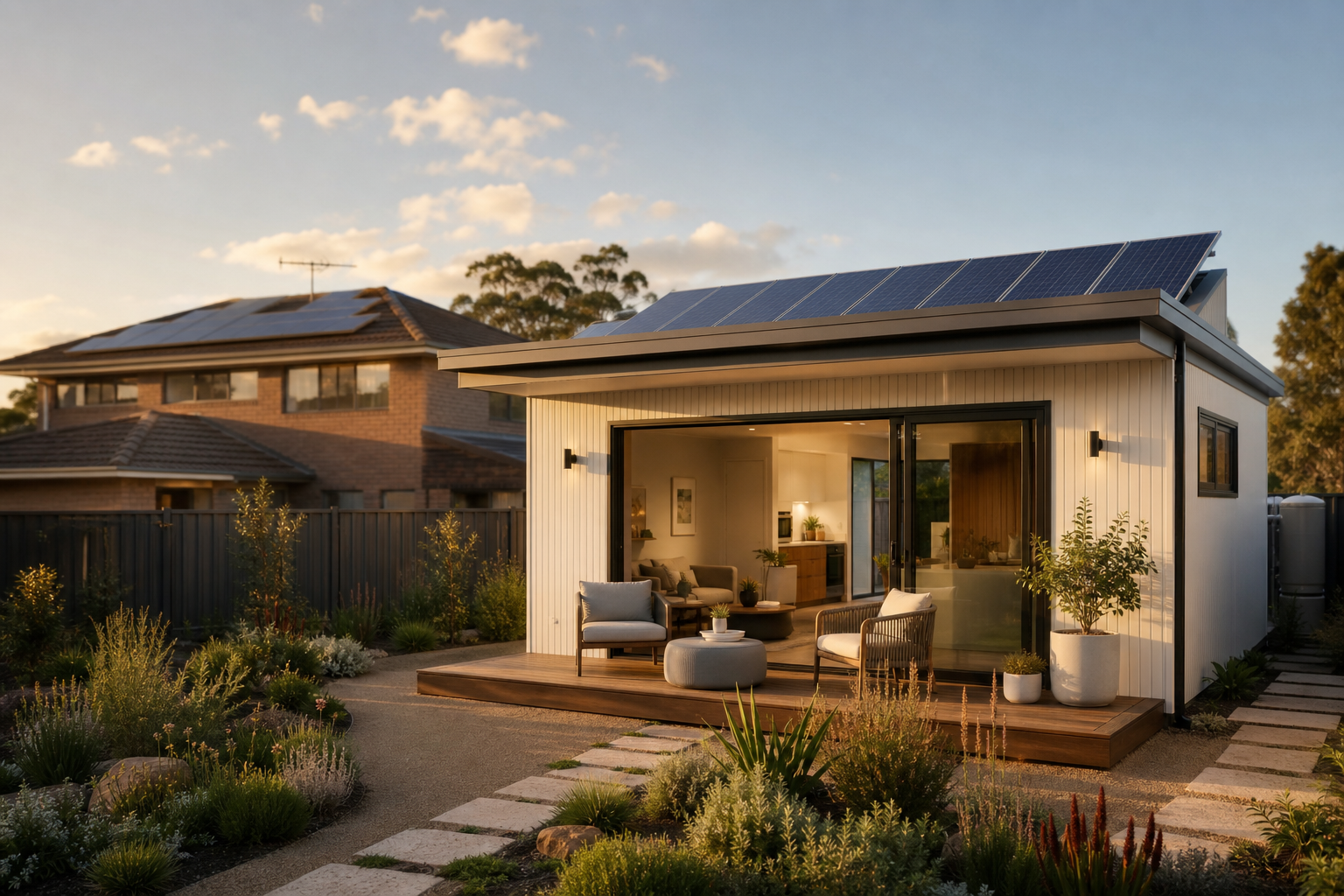
Solar for Granny Flats and Secondary Dwellings: Finance and Rent Uplift

Investors are waking up to a simple idea: if your granny flat or secondary dwelling is tenanted, solar can turn a plain backyard unit into a premium, cheaper‑to‑run home.

In practice, solar on a granny flat lifts rent and reduces vacancy only when the finance, metering and lease are set up with intent. This guide steps through how to run the numbers, choose a metering model, structure the loan and decide whether solar makes sense for your secondary dwelling this week.


1. How solar changes the economics of granny flats

A granny flat or secondary dwelling with solar can be more than a feel‑good upgrade. Done right, it changes three key numbers:

  1. What tenants are willing to pay in rent.
  2. How often the property sits vacant.
  3. Your net annual cashflow after bills, interest and tax.

For a typical 6–6.6 kW solar system in 2026 costing around $4,000–$8,000 after STCs (Small‑scale Technology Certificates) [source: /insights/solar-system-costs-quotes-budgeting-before-you-borrow], you’re aiming to recover the outlay within 5–8 years via some mix of:

  • Higher rent (or ‘bills included’ package rent).
  • Lower power bills if you pay utilities.
  • Lower vacancy and better tenant quality.

Quick rule‑of‑thumb payback

As a starting yardstick:

  • Annual rent uplift target: 8–15% of total solar cost.
  • Simple payback window: 6–10 years for most metro markets.

If a system costs $6,000 installed, you’re looking for at least $500–$900 per year of combined benefit (extra rent, saved bills, lower vacancy) to make the decision comfortably defensible.

For deeper system cost detail and how to build a realistic budget before you borrow, see What Solar System Really Costs You – And How Much To Borrow.


2. Metering and billing models: who gets the benefit?

The biggest decision with solar on a granny flat isn’t the panels. It’s how the electricity flows and who gets paid.

2.1 Common configurations for secondary dwellings

Most landlords end up with one of four models:

  1. Separate meter, tenant pays power directly

    • Granny flat has its own NMI and retailer account.
    • Tenant gets bill savings from daytime usage.
    • You capture value via higher rent and lower vacancy, not direct bill savings.
  2. Embedded or sub‑meter, landlord on‑charges power

    • Main house has primary meter; granny flat has sub‑meter.
    • You receive one power bill, then invoice the tenant for usage (and possibly a solar charge).
    • More admin and compliance; check state rules on on‑charging and maximum mark‑ups.
  3. Bills‑included rent

    • You keep the main account; tenant pays a higher all‑inclusive rent.
    • Solar lowers your electricity cost, increasing your margin.
    • Works best with careful caps/assumptions and tenants with stable usage.
  4. Shared system across house + granny flat

    • One array sized to both roofs, feeding a common meter.
    • Benefit is split indirectly via rent for the flat and lower bills for the main house.

2.2 Metering choice vs rent strategy

Different metering choices match different rent strategies:

  • Premium, separate‑meter tenancy: Charge modestly higher rent because tenants love lower bills and clear control over their account.
  • Value‑add “bills included”: Charge more rent for simplicity, but you carry usage risk.
  • Family or staff accommodation: Shared meter with informal cost‑sharing can be fine if everyone is aligned.

If you want to charge more for ‘bills included’ after adding solar, pair this guide with our deeper pricing tactics in Can You Charge Tenants More for ‘Bills Included’ When You Install Solar? (cluster sibling).


3. Worked examples: rent uplift and cashflow

Let’s look at realistic numbers so you can sanity‑check your own scenario.

3.1 Scenario A: Separate‑meter granny flat, investor landlord

  • Location: Outer Sydney suburb.
  • Existing set‑up: 2‑bed granny flat renting for $420/week, separate power meter (tenant pays bills).
  • Solar install: 6.6 kW, $6,000 fully installed.
  • Finance: Equity top‑up on investment loan at 6.5% p.a., 25‑year P&I.

Loan cost

  • Annual repayment on $6,000 over 25 years @ 6.5% ≈ $490 p.a.
  • First‑year interest component ≈ $390 (deductible because purpose is to improve rental income).

Rent uplift assumption

  • Local agents suggest tenants will pay $15–$25/week more for a solar‑equipped granny flat with bills 20–40% lower.
  • Take mid‑point: +$20/week = $1,040 per year extra rent.

Net cash impact (year one)

  • Extra rent: +$1,040 p.a.
  • Extra interest + principal repayment: −$490 p.a.
  • Pre‑tax net gain: +$550 p.a.
  • Tax: interest is deductible, principal isn’t. If you’re on a 37% marginal tax rate:
    • Interest deduction benefit ≈ $390 × 37% = $144.

After‑tax picture (simplified)

  • Cash outflow: −$490.
  • Tax benefit: +$144.
  • Net after‑tax cost: −$346.
  • Extra rent: +$1,040.

Net after‑tax cashflow uplift: approximately +$694 per year, or an 11.5% return on the $6,000 outlay.

3.2 Scenario B: Bills‑included model, dual occupancy

  • Situation: Main house + attached secondary dwelling in regional city.
  • Current arrangement: $360/week rent for granny flat, landlord pays all utilities.
  • Annual combined electricity bill: $2,600 (flat estimated share $1,200).

Solar install

  • 8 kW system on shared roof: cost $8,500.
  • Expected bill reduction: 45% = $1,170/year savings in total bill.

Assume no change in nominal rent, but:

  • Existing rent remains competitive, vacancy drops from 4 weeks to 1 week per year.
  • At $360/week, 3 weeks less vacancy = $1,080/year extra rent collected.

Annual benefit

  • Bill savings: +$1,170.
  • Extra rent from lower vacancy: +$1,080.
  • Total benefit: $2,250/year.

On an $8,500 system, simple payback ≈ 3.8 years. Even after financing costs, that’s strong.


4. Financing options for solar on granny flats

How you fund the system can make or break the deal. Your main choices:

  1. Home loan equity top‑up on the investment property.
  2. Including solar in a construction/renovation loan.
  3. Separate unsecured or asset finance (often for small business use).

For a broad overview of funding options and traps, see Essential Questions To Ask Your Broker Before Financing Solar.

4.1 Equity top‑up on the investment loan

You draw against existing equity in the property, often as a small additional split.

Pros

  • Lowest interest rate versus personal loans or credit cards.
  • Payment spread over 20–30 years, keeping repayments modest.
  • Interest generally deductible if the granny flat is income‑producing.

Cons

  • Total interest paid over decades can exceed system cost if you don’t repay early.
  • Increases your loan balance and LVR; watch LMI thresholds (80%, 90%, etc.).

Use a separate loan split for the solar spend so deductible and non‑deductible debt stay clean and traceable.

4.2 Construction or renovation loan

If you’re building the granny flat now, you can usually:

  • Add solar into the building contract and fund it within a construction loan; or
  • Keep it separate and do an equity top‑up later.

Including solar in the build means it’s part of the valuer’s cost‑to‑complete and progress payments. This is ideal if the dwelling won’t be income‑producing until after construction.

For a deeper comparison between construction‑loan versus equity‑top‑up approaches, see How to Finance Solar During a Renovation or Extension.

4.3 Solar as part of a small business

If you’re a tradie, medical or allied health professional building a secondary dwelling that doubles as a home office or consulting room, there may be scope to:

  • Fund part of the solar via business equipment or chattel mortgage finance, and
  • Treat a proportion of interest and depreciation as business deductions (always confirm with your accountant).

This starts to overlap with the logic in:

Where solar predominantly serves an income‑producing use (e.g. a studio or consulting suite), a purpose‑built business facility may sit alongside your investment loan.


5. Comparing finance methods: cost, risk and flexibility

Below is an illustrative comparison for funding a $6,000 solar system on a granny flat.

OptionTypical rate (indicative only)TermMonthly repaymentTotal repaidKey prosKey cons
Equity top‑up (home loan split)6.0–7.0% p.a.25 years~$39–$42~$11,700–$12,700Lowest monthly cost, interest may be deductible, simpleHigh total interest if not repaid early, increases LVR
Personal loan (unsecured)9–14% p.a.5–7 years~$100–$130~$6,000–$10,000Faster paydown, ring‑fenced from propertyHigher rate, no property security but serviceability hit
Business chattel / asset finance8–12% p.a.3–7 years~$95–$160~$5,500–$11,000May offer accelerated deductions, preserves home equityOnly suitable where clear business use and ownership

Repayments are indicative and rounded. Always get actual quotes and independent tax advice.

From a pure investment property lens, an equity top‑up or construction loan inclusion will usually be cheapest and simplest, provided you:

  • Keep it in a separate, clearly purpose‑linked split; and
  • Plan to pay extra off that split over the panel payback period (e.g. 7–10 years), not 30.

6. Tax, ownership and compliance basics

6.1 Interest deductibility

For investment properties, the ATO focuses on loan purpose. If the borrowed funds are used to install solar that helps you earn rental income, the interest is generally deductible against that income.

Key points:

  • Deductibility does not depend on which property secures the loan; it follows the use of the funds.
  • Splitting loans by purpose makes tax compliance much cleaner (and future refinancing easier).
  • If your granny flat is used by family at below‑market rent, or vacant for long periods, deductions may be limited.

6.2 Depreciation and capital works

Solar PV systems on residential investment properties are usually treated as plant and equipment or part of capital works, with deductions spread over time.

  • The rules have tightened around second‑hand assets; new installs on new or substantially renovated dwellings are generally more favourable.
  • With coming changes to capital gains tax discounts from 1 July 2027, the after‑tax outcome of adding improvements will become more nuanced; higher cost bases help, but gains are taxed differently.
  • Always check the latest ATO guidance or get a quantity surveyor schedule when you add major assets.

6.3 State rules on sub‑metering and on‑charging

If you’re planning a sub‑meter and on‑charging model:

  • Most states have rules about transparency, itemised bills and not profiting excessively from reselling electricity.
  • In some jurisdictions, ‘embedded network’ rules can apply if you’re effectively acting like a mini‑retailer across multiple dwellings.
  • Your managing agent should understand local requirements; if they don’t, treat that as a red flag.

7. When solar on a granny flat makes sense – and when it doesn’t

7.1 Green flags: strong candidates

Solar is more likely to stack up where:

  • Dual income potential is high: areas where granny flat rents are strong relative to build cost.
  • Tenants are bill‑sensitive: students, singles, small families, retirees on fixed incomes.
  • High daytime usage: work‑from‑home, retirees, young families at home with kids.
  • You plan to hold for 10+ years: time allows for panel payback and capitalisation into value.

7.2 Amber flags: tread carefully

Be cautious where:

  • The granny flat is often vacant or used intermittently (e.g. short‑stay, family visits).
  • Roof orientation/sha d ing makes generation poor, pushing payback out beyond 12–15 years.
  • You can’t increase rent or reduce vacancy meaningfully (e.g. very soft local rental market).

7.3 Red flags: usually not worth it

Solar may not be the best use of capital if:

  • You’re likely to subdivide and sell the granny flat block separately within a few years and can’t easily price in the upgrade.
  • You’re already extremely leveraged and edging into riskier LVR territory to fund the system.
  • The granny flat will become owner‑occupied shortly, making the tax and rent logic weaker (though owner‑occupier bill savings can still be attractive).

8. How valuers and buyers treat solar on secondary dwellings

Valuers rarely give you a dollar‑for‑dollar uplift for solar. Instead, they consider it in:

  • Comparable sales: if other dual‑occupancy properties with solar have sold well, it supports a higher value.
  • Rental evidence: higher rent and lower vacancy improve the capitalised yield.
  • Marketability: properties that rent faster and attract better tenants can command tighter yields.

In high‑income, highly educated areas (think something like Woollahra, where over half of residents hold a Bachelor degree or higher), buyers may value sustainability features more, but they still anchor on rents and yields.

If your solar investment lifts combined rent by, say, $20–$40/week and tightens vacancy, that improved income stream can support a modest valuation uplift, even if the valuer doesn’t separately itemise the panels.

For more detail on valuation treatment, cross‑reference the cluster article How Valuers Treat Solar and Batteries When Assessing Your Investment Property.


9. One‑week action plan: from idea to decision

You don’t need months to make a decision on solar for your granny flat. Here’s how to get to “yes” or “no” in a week.

Diagram-style view of solar on house and granny flat roofs with meters Deciding how electricity flows between house, granny flat and meters is just as important as system size.

Day 1–2: Clarify usage and metering

  1. Check current lease and bills

    • Who pays power now?
    • Is there a separate meter or sub‑meter?
    • What have the last 12 months of bills looked like (if you pay)?
  2. Estimate tenant profile

    • Are they home during the day?
    • Are they likely to see large bill savings from solar (e.g. air‑con, electric hot water, WFH)?
  3. Decide preferred future model

    • Separate meter, bills‑included, or on‑charging.

Day 3–4: Get numbers and quotes

  1. Collect three quotes for a system sized to the granny flat’s usage (or combined use if sharing with main house).

  2. Talk to a property manager (or two)

    • Ask what rent premium, vacancy improvement or tenant quality uplift they’ve seen with solar‑equipped granny flats in your area.

Landlord and broker reviewing solar finance options for a granny flat A short conversation with your broker can clarify the best way to fund solar on a secondary dwelling.

Day 5: Finance and tax check‑in

  1. Speak with your broker
    Use the script in Essential Questions To Ask Your Broker Before Financing Solar to cover:

    • Best loan split structure for deductibility and flexibility.
    • Impact on borrowing power and LVR.
    • Whether a construction approach or equity top‑up suits you better.
  2. Quick chat with your accountant

    • Confirm interest deductibility and likely depreciation treatment.
    • Confirm any GST or business‑use implications if the space doubles as an office.

Day 6–7: Decide and document

  1. Run your payback and ROI

    • Combine: expected rent uplift + bill savings (if you pay) + vacancy reduction.
    • Compare to annual loan cost and installation spend.
    • Aim for payback inside 7–10 years with positive cashflow.
  2. Update your lease template

    • Spell out who pays for power, what’s included in rent, and any solar‑specific terms (e.g. no tampering with inverter, access for maintenance).
    • For bills‑included, consider fair‑use clauses.
  3. Make the call

    • If the numbers stack up, lock in your preferred installer and finance structure.
    • If they don’t, revisit system size, metering model or negotiate harder on quotes.

Tenanted granny flat with solar panels at dusk Solar can justify higher rent and reduce vacancy when paired with the right lease and metering set-up.


10. Practical tips to squeeze more value from solar on a granny flat

A few tweaks can turn an average install into a great one:

10.1 Size and orientation

  • Don’t oversize a system well beyond daytime demand if feed‑in tariffs are low; aim to maximise self‑consumption.
  • If the granny flat has limited roof, consider placing more panels on the main dwelling’s roof but wiring for shared benefit.

10.2 Tenant education

  • Provide a one‑page solar “cheat sheet” explaining when to run appliances for maximum savings.
  • Many tenants won’t intuitively shift usage; a small nudge can materially improve perceived benefit.

10.3 Marketing and photos

  • Feature solar prominently in your advert headlines and copy.
  • Include a simple claim such as “Previous tenants paid around $X/month for power with solar” (if accurate).
  • Show a photo of the inverter and panels; it signals a modern, well‑maintained property.

10.4 Maintenance and monitoring

  • Use online monitoring to spot faults early; a broken inverter silently destroys your value proposition.
  • Consider a basic cleaning schedule if your property is in a dusty or coastal area.

Key takeaways

  • Solar on a granny flat or secondary dwelling can lift rent, reduce vacancy and improve long‑term value when the metering, lease and finance are set up deliberately.
  • Aim for combined annual benefits (rent + bill savings + vacancy) of at least 8–15% of install cost, with a simple payback under 7–10 years.
  • Equity top‑ups or construction loans are usually the most cost‑effective funding paths, but separate splits and clear loan purposes are critical for tax and future flexibility.
  • Metering model (separate meter vs bills‑included vs on‑charging) is just as important as system size in determining who really benefits.
  • A one‑week process – quotes, rent advice, finance chat and a simple ROI test – is enough to reach a confident yes/no decision.

If you’d like help running these numbers for your own granny flat or dual‑occupancy property, book a free 15‑minute strategy call at localknowledge.finance. In one conversation you can line up your tax, your loan structure and your solar plan with the same expert – a CPA, tax agent and mortgage broker in one. Or, start by stress‑testing your borrowing power and cashflow with our calculators at localknowledge.finance/tools.

General advice only.

Frequently asked questions

It’s usually worth it if the combined benefit from higher rent, lower vacancy and lower bills (where you pay utilities) gives you a payback inside about 7–10 years. In most metro and strong regional markets, a modest rent increase of $10–$25 per week plus reduced vacancy is enough to justify a typical 6–6.6 kW system, especially when financed via a small, well‑structured loan split.
If the granny flat is used to produce rental income, interest on money borrowed to install the solar system is generally deductible because the loan purpose is income‑producing. Depreciation or capital works deductions may also apply to the system itself. The rules are technical and changing, so you should confirm the treatment with your accountant and keep clear records of the loan split used to fund the install.
A separate meter gives the tenant direct control over their account and makes billing simple, which many renters prefer. However, if you want to offer ‘bills included’ rent or on‑charge power, a shared supply with sub‑metering can work. The right choice depends on your rent strategy, local regulations on on‑charging, and how much administration you’re willing to handle.
Yes, in many markets property managers report tenants are willing to pay more for homes with lower power bills, especially where air‑conditioning or electric hot water drives usage. The uplift is modest, often $10–$25 per week, but combined with improved tenant demand and lower vacancy it can materially improve your annual cashflow. Always test your assumptions with local agents and recent rental evidence.

Talk to a CPA-certified broker

Free consultation, plain-English advice tailored to your situation.

Your details are kept confidential. We’ll never share them.