
Article
How Banks Value One‑of‑a‑Kind Rose Bay Homes – And Protect You
One‑of‑a‑kind Rose Bay homes don’t fit neatly into bank valuation boxes. This guide shows how valuers price uniqueness, what can go wrong, and how to protect your borrowing, auction strategy and renovation plans this week.
Key Takeaway
Banks value unique Rose Bay homes by starting with recent comparable sales and then applying conservative adjustments for views, architecture and land, usually lending against the lower of purchase price or valuation. For prestige properties, even a 5–10% valuation gap can wipe out $300k–$600k of borrowing capacity. Buyers and owners should test valuation ranges early, choose lenders with flexible prestige policies, and structure buffers so a single low valuation doesn’t derail settlement or refinancing plans.

Buying or refinancing a one‑of‑a‑kind Rose Bay home is exciting – but bank valuations can quickly turn that excitement into pressure.
For unique and prestige homes, banks still rely on standard valuation rules: they lend against the lower of the purchase price or an independent valuation, using conservative assumptions and recent comparable sales. The more unusual the property, the harder it is to find comparables – and the more likely a cautious valuer is to come in under the number you, your agent or your architect believe the home is worth.
This guide explains how that plays out specifically for Rose Bay, and what you can do this week to reduce valuation risk before you bid, sign, or refinance.
1. Why unique Rose Bay homes are hard to value
1.1 What “one‑of‑a‑kind” really means to a bank
In Rose Bay, “unique” might mean:
- Architect‑designed rebuild on a steep site
- 270‑degree harbour views or rare Opera House sightlines
- Trophy homes on small streets with no recent comparable sales
- Houses with integrated boat storage or shared marina access
- Heritage elements, unusual layouts or mixed residential/commercial use
To a bank valuer, uniqueness is a double‑edged sword:
- It can support a premium price, but
- It makes it harder to prove that premium using hard data.
The valuer’s legal duty is to be defendable and conservative, not to validate the listing agent’s story. When in doubt, they usually shade value down, not up.
If you haven’t read it yet, it’s worth pairing this with our overview of how different property types are treated in the area: Decoding Rose Bay Property Types and Lending Rules This Year.
1.2 Typical price points and why 5–10% matters so much
In today’s market, it’s common to see:
- Well‑located family homes in Rose Bay trading between $4m–$7m
- Harbourside or view homes going well above that
On a $5.5m architect‑designed home:
- You agree to pay: $5.5m
- You plan for an 80% LVR loan: $4.4m
- Bank valuation comes in at $5.1m (7% under)
- Maximum 80% lend becomes: $4.08m
You now need an extra $320,000 in cash/equity or the deal doesn’t work.
On paper, it’s “only” 7%. In your real life, it can be the difference between settling and walking away.
1.3 Valuers are not trying to match your contract price
A common misconception in Rose Bay is that valuers simply confirm what you’ve paid. They don’t.
They are engaged by the lender to answer one question: “If we had to sell this property in a reasonable period, at arm’s length, what would it achieve?”
That means:
- They can – and often do – come in below contract
- They may ignore “outlier” sales agents are using as price anchors
- They tend to discount emotional premiums (e.g. architectural features you love)
Your goal is not to convince the valuer the home is special. It’s to make sure your finance plan still works if a conservative valuer takes a red pen to the number.
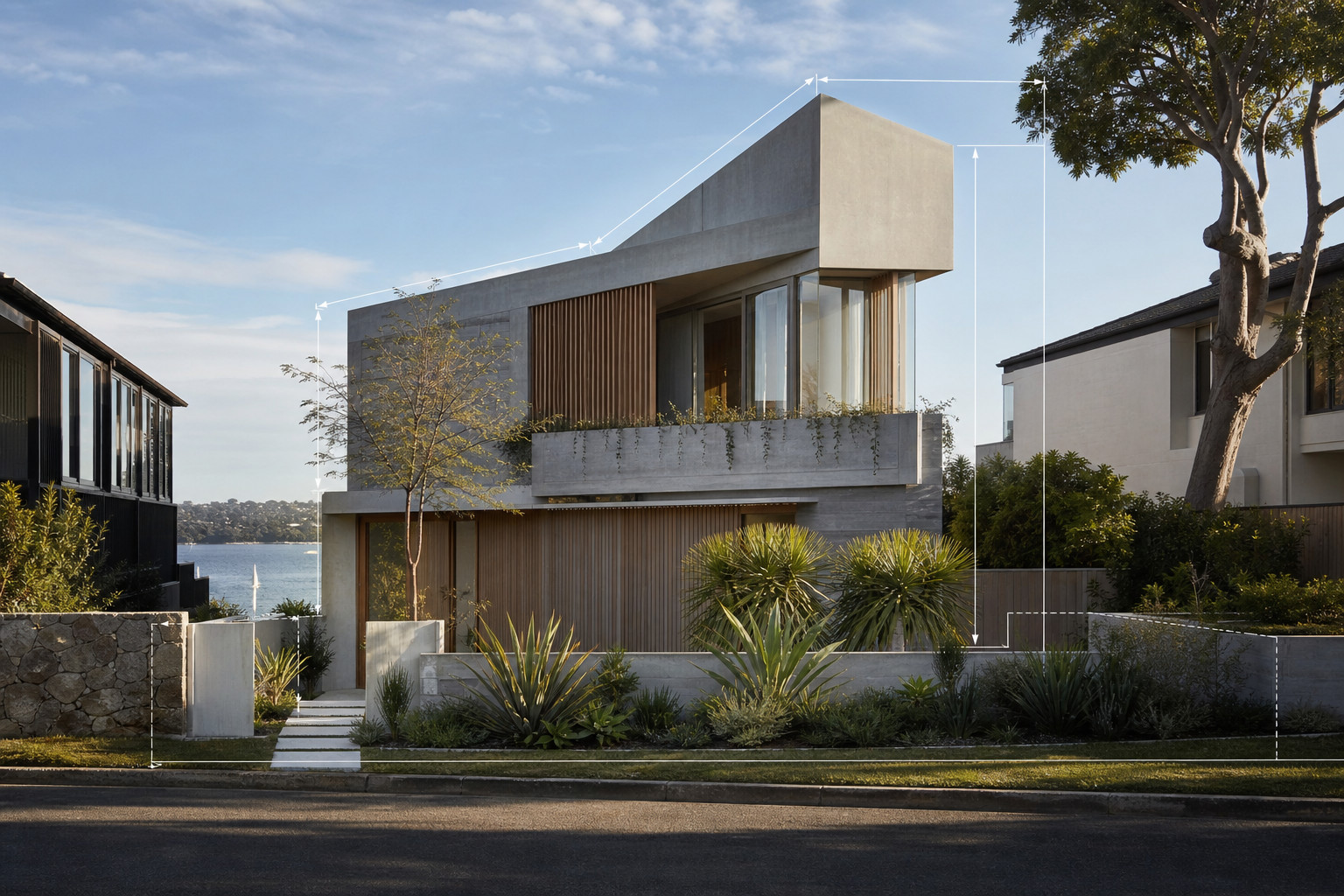
Architect-designed homes in Rose Bay often sit outside standard valuation boxes.
2. How bank valuers actually price unique properties
2.1 The comparable sales (comps) method – with twists
For most Rose Bay homes, valuers use a direct comparison method:
- Identify 3–6 recent sales as similar as possible (size, land, views, condition, location).
- Adjust each sale up or down for differences (e.g. extra bedroom, better view, inferior street).
- Cross‑check land value against published land values and other sales.
- Sense‑check the result against broader suburb medians and neighbouring pockets.
With truly unique properties, they may stretch to:
- A wider time period (e.g. 6–18 months of sales)
- A wider geography (e.g. Vaucluse, Dover Heights, Point Piper for benchmarks)
- Using a summation approach – land value plus replacement cost of improvements
But even then, anything that feels “too generous” is usually trimmed back.
2.2 What makes a sale a good comparable in Rose Bay?
Valuers in this pocket pay close attention to:
- Exact location: waterfront versus one‑street‑back can shift value sharply
- View corridors: filtered water glimpse vs full, protected harbour panoramas
- Access: stairs, steep driveways, tight streets, shared drive access
- Land use: subdivision potential, zoning constraints, easements
- Build quality: architect‑designed with high‑end finishes vs cosmetic renovation
If your home has a rare combination (e.g. deep waterfront, boat access, level entry, modern build), there might be no perfect comparable. That’s when conservatism really bites.
2.3 Internal vs kerbside vs desktop valuations
Lenders don’t always send someone inside. Different valuation types matter a lot for unique homes:
| Valuation type | What it involves | Typical use | Risk for unique homes |
|---|---|---|---|
| Desktop | Data + photos only, no visit | Low LVR, generic houses/units | High – can easily miss uniqueness or over‑rely on median data |
| Kerbside | Drive‑by, exterior inspection | Established areas, moderate LVR | Medium–High – external appeal seen, but layout/views missed |
| Full/internal | Complete internal and external inspection | Higher value/complex properties | Lower – but still conservative; best for unique properties |
For one‑of‑a‑kind Rose Bay properties, pushing for a full internal valuation is usually non‑negotiable if you want the uniqueness properly recognised.
2.4 How prestige and price brackets change the lens
Once values move into the top 5–10% of the market, lenders often:
- Tighten maximum LVRs (sometimes 70–80% max, depending on policy)
- Scrutinise the valuation firm and even the individual valuer
- Override valuations they see as “soft” or “optimistic”
A house that would easily value at $3.5m might be much more contested at $8m. The higher the price, the more evidence the valuer wants, and the more hesitant they are to assume the whole market would pay what a motivated buyer just did.
3. Top factors that drive value (and volatility) in unique Rose Bay homes
3.1 Design and liveability versus pure aesthetics
Architect‑designed doesn’t automatically mean “bank‑friendly value”. Valuers look for:
- Functional floor plans and natural light
- Logical bedroom/bathroom counts for the price point
- Indoor‑outdoor flow and site use
- Quality of construction and finishes
An avant‑garde design with awkward bedrooms, poor storage and hard‑to‑maintain features might impress architects, but can make valuers nervous about resale appeal.
3.2 Water, views and access – how they really price in
Not all water views are equal, and neither are their impacts on value.
Valuers tend to price:
- Absolute waterfront with safe boat access: largest premium, but sensitive to any encumbrances, shared access or environmental overlays.
- Protected, wide harbour views: strong premium, especially if protected by height limits or topography.
- Filtered or partial views: modest uplift; easily discounted if future development could block them.
They will also consider:
- Noise (e.g. busy roads, flight paths)
- Exposure (wind, salt, privacy)
- Practical access for families and older buyers
Our related piece on marina and mooring impacts digs into this more: How Marinas, Moorings and Shared Waterfront Access Affect Your Rose Bay Loan (cluster sibling).
3.3 Land, zoning and hidden constraints
With unique homes, land can be as important as the building:
- Zoning and FSR: drives redevelopment potential and buyer depth
- Easements and rights of way: shared driveways, access to moorings, services
- Heritage or conservation: can limit changes, affecting some buyers’ appetite
- Irregular or steep blocks: tricky builds, access issues, limited use of site
A valuer will often benchmark land value against other local sales, then effectively “back into” what the house must be worth on top.
Valuers rely heavily on recent comparable sales and location nuances in Rose Bay.
4. The biggest risks with bank valuations on unique homes
4.1 The low valuation shock – three scenarios
There are three common ways a valuation can derail plans:
- Purchase shortfall: valuation below contract price reduces maximum loan size.
- Refinance block: valuation below expectations means your LVR stays too high to refinance or access equity.
- Renovation squeeze: valuation doesn’t recognise planned improvements, limiting construction or increase‑limit approvals.
Let’s run a Rose Bay‑specific worked example.
Scenario: upmarket refinance for renovation
- Current home estimated by you/agent: $7.2m
- Existing loan: $3.8m (53% LVR on your estimate)
- You’d like an extra $800k for a major renovation.
- You’re targeting 70% LVR max with the lender.
If the valuation matches your estimate:
- 70% of $7.2m = $5.04m maximum lend.
- New total debt after renovation facility = $4.6m (comfortably inside 70%).
If the bank valuation comes in at $6.6m instead:
- 70% of $6.6m = $4.62m maximum lend.
- You can now only borrow an extra $820k – 3.8m = $820k? Wait – but 4.62m – 3.8m = $820k.
- A smaller drop might mean the lender caps you at, say, $4.3m, and you get only $500k for works.
That can force difficult compromises mid‑build. Our renovation‑specific guide explains why banks also stress‑test your repayments harder than you might: see Financing Rose Bay Renovations, Extensions and Rebuilds (cluster article referenced in facts).
4.2 Contract price ≠ guaranteed valuation
Australian lenders generally lend against the lower of:
- The purchase price (your contract), or
- The independent valuation
This is exactly the same principle that applies to off‑the‑plan purchases, where a valuation shortfall can trigger unexpected cash needs and even LMI [(/insights/off-the-plan-valuation-change-before-settlement)].
Even in private treaty sales, the bank won’t simply “take the contract as proof”.
4.3 Why self‑employed and complex borrowers feel valuation pain more
If you’re self‑employed or have layered income (trusts, company distributions, bonuses), you already face tighter servicing.
Combine that with:
- Large loan sizes
- Possible lender restrictions on high‑density or luxury pockets
- Additional tax and cashflow planning constraints
…and a low valuation can remove your only suitable lender option.
Our guide for complex‑income borrowers – Smart mortgage strategies for self‑employed and professionals in Rose Bay – shows how to get your income story right before you even worry about valuations.
5. How to improve your odds of a sensible valuation this week
5.1 Match your lender to the property type
Not all lenders think about Rose Bay the same way.
Some are:
- Very conservative on prestige and waterfront properties
- Uncomfortable above certain postcodes, price points or LVRs
- Rigid about valuation firm panels
Others:
- Have stronger experience with Eastern Suburbs prestige stock
- Allow multiple valuation firms or access to specialist prestige teams
- Are more open to full internal inspections at higher price points
A key difference between walking into a single bank and using a broker is this lender‑fit decision: see Rose Bay mortgage broker or big‑4 bank? What really changes.
5.2 Order the right type of valuation for the stage you’re at
You can think of valuations as a sequence:
- Early stage / exploring: automated estimates, agent appraisals, data tools – good for ballpark only.
- Pre‑approval / serious interest: broker‑ordered upfront bank valuations on likely target price ranges, ideally full or kerbside.
- Post‑exchange: formal valuation tied to the final lender and loan structure.
Because most lenders apply APRA’s 3% serviceability buffer, they’re already assessing your repayments at materially higher rates. Adding a surprise low valuation on top is how people get caught in the increasing mortgage stress highlighted in recent Roy Morgan reports.
The solution: get at least one pre‑auction, pre‑offer full valuation wherever exposure is high.
5.3 Present information clearly – without trying to “sell” the valuer
You can’t tell a valuer what number to use. You can make their job easier by:
- Providing a clean list of recent, relevant local sales (addresses, dates, prices)
- Highlighting any DA approvals, renovations or structural works with documentation
- Clarifying complex access, easements or shared use arrangements in writing
- Supplying floor plans and building reports where available
Well‑organised, factual information reduces the risk they simply default to generic comparables that don’t recognise your property properly.
5.4 Use realistic value ranges – not best‑case numbers
For planning, think in ranges, not single figures.
Example for a planned purchase:
- Agent price guide: $5.2m–$5.7m
- Your true “stretch” budget: $5.5m
- You and your broker model finance at 3 valuation levels:
- $5.0m (conservative)
- $5.3m (middle)
- $5.5m (optimistic)
You then check:
- Maximum loan at each value, given your income
- Extra cash required if the bank uses the low figure
- Whether an LVR jump would trigger LMI or a different product
If the numbers only work at the most optimistic valuation, you don’t have a safe plan.
5.5 One‑week action checklist
If you are looking at a one‑of‑a‑kind Rose Bay home now, here’s what you can do this week:
- Clarify your maximum safe debt based on repayments at +3% above today’s rates, not just what the bank will lend.
- Ask for a sales evidence pack for the property and study the comparables yourself.
- Get a broker to run lender options specifically for prestige / waterfront homes.
- Order an upfront full valuation through your chosen lender where possible.
- Run best/mid/worst valuation cases and see how much extra cash each would require.
- Tighten your pre‑approval to the actual property type and price bracket – Designing Auction‑Proof Home Loan Pre‑Approval for Rose Bay Buyers walks through this in detail.
Planning around valuation ranges helps buyers and owners manage risk on unique homes.
6. Valuations, long‑term strategy and when to walk away
6.1 When a low valuation is actually doing you a favour
Sometimes a low valuation is warning you that:
- You’ve stretched beyond what the broader market would likely pay
- You’re paying an emotional premium that may not be recoverable on resale
- The property’s uniqueness is more idiosyncratic than broadly appealing
That doesn’t mean you shouldn’t buy – but it does mean you need to consciously accept the risk, not sleepwalk into it.
Our long‑range planning guide, Designing a 10‑Year Property and Mortgage Roadmap in Sydney’s East, is useful here. A one‑off decision on a trophy home can ripple through your next decade of moves.
6.2 How valuations shape renovation and investment choices
Valuation behaviour affects more than just the purchase:
- Renovations: Banks usually lend on current value plus a portion of verified construction cost, not on your projected “post‑reno” sale price.
- Future investments: A conservative valuation today can slow your ability to recycle equity into the next opportunity.
- Tax and CGT planning: While bank valuations aren’t tax valuations, understanding lender conservatism helps you model future after‑tax returns.
Given looming changes to capital gains and negative gearing from 1 July 2027, careful structuring around renovations and future investment properties is becoming even more important.
6.3 When it’s time to re‑set, not re‑fight the valuation
There are moments where it’s better to adjust than insist:
- You’ve had two independent valuations from different firms, both well below price.
- Your broker has exhausted appeal and re‑order options with little movement.
- Bridging or temporary workarounds would push repayments beyond safe levels.
At that point, your choices are usually:
- Re‑negotiate price or settlement terms (if the contract allows)
- Change your target price bracket or property profile
- Walk away and focus on a home that fits your financial strategy
The goal is not just to get this loan over the line, but to avoid joining the growing cohort of Australians in deep mortgage stress over the next few years.
6.4 Don’t forget your existing mortgage – review it in the light of new valuations
If you already own in Rose Bay and are seeing surprising auction results nearby, that may be a sign it’s time to:
- Re‑test your property’s value
- Re‑check your LVR and rate competitiveness
- Decide whether to access equity or consolidate risk
Our review guide – How to Review and Refinance Your Rose Bay Mortgage This Year – shows how to run that assessment in a week.
Key takeaways
- Banks price unique Rose Bay homes using conservative comparable‑sales logic, not agent price guides or owner expectations.
- The higher the price and the more unusual the property, the more likely a valuer is to shade down, especially where recent sales evidence is thin.
- A 5–10% valuation gap on a $4m–$8m property can create a six‑figure cash shortfall or block refinancing and renovation plans.
- You can reduce valuation risk by choosing lenders used to prestige stock, ordering full internal valuations, and planning across realistic value ranges.
- Clear documentation, pre‑auction valuations and a 10‑year view of your property strategy help you decide when to push for a higher valuation – and when to walk.
If you’re weighing up a one‑of‑a‑kind Rose Bay home or trying to unlock equity from a unique property, it can help to have one person looking at your tax, your loan and your long‑term plan together. You can book a free 15‑minute strategy call at https://localknowledge.finance/contact to pressure‑test your numbers, run valuation scenarios and map out safe borrowing limits before you commit.
General advice only.
Frequently asked questions
Talk to a CPA-certified broker
Free consultation, plain-English advice tailored to your situation.
